Choosing a breaking strain for carp fishing? Look beyond the number on the spool. Good mono around 0.35mm to 0.38mm is a useful starting point for general UK fishing, often labelled 15lb to 18lb depending on the brand. Match it to your water, its rules and anything the line could rub against.
That is the short answer, but it is not a rule you should follow without looking at the lake. Clean open water at modest range may suit mono around 0.30mm to 0.35mm. Gravel, weed, mussels or moderate snags can justify moving towards 0.35mm to 0.40mm. A fishery minimum always comes first, and there are swims where no breaking strain can make an unsafe presentation acceptable.
The size of the carp is only one small part of the decision. You need to think about the fishery rules, what the line could rub against, how far you're casting, the material you want to use, the true diameter, the knot and the condition of the line already on your reel. Get those points right and choosing the best line for carp fishing becomes much easier.
What breaking strain line should you use for carp fishing?
If you're fishing a typical UK day-ticket water with no serious snags, I would begin by looking at a dependable 15lb-class monofilament close to 0.35mm in diameter. It is forgiving enough for somebody building confidence, widely available and suitable for a huge range of bottom-bait, pop-up and solid-bag fishing. Check the spool carefully because two lines carrying the same 15lb label can be very different diameters.
On clean open water, where the margins and lakebed have been checked and the rules allow it, line around 0.30mm to 0.35mm may be enough. A slightly finer diameter can leave the spool more freely and help when extra distance is genuinely needed. There's no reason to drop down just because a thinner line looks better on the packet. If you can comfortably reach the spot with a stronger, more forgiving line, keep the extra safety margin.
For gravel, old weed stems and the sort of light snags found on many carp lakes, I would normally look around 0.35mm to 0.40mm. Lines sold as 15lb, 18lb or 20lb often sit in this area, although the label varies between brands. Abrasion resistance becomes more important here because damage usually happens where the line touches something, not because a carp simply pulls harder than the number printed on the spool.
For severe snags, stop and reassess the swim. Changing to 20lb or 25lb line won't make branches, concrete or trailing tackle safe to fish against. You must be close enough to the rods to react immediately, use a complete setup approved by the fishery and understand how every part will behave if the main line fails. If a carp can reach a dangerous obstacle before you can control it, the right decision is to move the rig or leave that part of the swim alone.
Start with the fishery rules
Before buying line, read the fishery rules or ask the bailiff. Many waters state a minimum breaking strain or diameter. Some ban braided main line, fluorocarbon leaders or any form of shock leader. Others have different rules for weed, distance casting or particular parts of the lake. These requirements override a general recommendation because the people running the water know its stock and hazards.
Don't assume that a rule copied from another lake will be accepted. A setup that is perfectly normal on a clear gravel pit may be unsuitable on a small water with islands and sunken branches. If the wording is unclear, ask before setting up. It is much easier to change a spool at home than discover on the bank that your chosen main line is not allowed.
Why carp size doesn't decide the line
Anglers often ask whether they need 12lb line for a 12lb carp or 30lb line for a 30lb carp. Fishing tackle doesn't work like lifting a dead weight. The rod bends, the clutch gives line and you change the rod angle while playing the fish. A well-balanced setup absorbs sudden lunges, which is why carp much heavier than the line's stated breaking strain can be landed safely in open water.
A smaller carp beside a snag can place far more demand on the setup than a much larger fish in clean water. Think about what is between you and the fish: sharp gravel, zebra mussels, weed stems, reeds, branches, concrete edges and steep marginal shelves. Also think about whether you can move along the bank and how quickly you can pick up the rod. Those details tell you more than the venue record.
What line diameter should I use for carp?
The breaking strain is the load stated by the manufacturer, usually in pounds or kilograms. The diameter is the thickness of the line, normally shown in millimetres. It's worth comparing both. Two spools marked 15lb may not be like-for-like if one is 0.33mm and the other is 0.38mm. The thicker one has more material to wear through, but it will take up more space on the spool and may not cast quite as freely.
Independent line tests also show that some products break above their stated strength while others finish much closer to the label. Test method, moisture, knots and the particular sample can all change the result. A straight pull on fresh line in a controlled test doesn't recreate a knot that has been cast all day and dragged across gravel. Use those tests to compare lines, but keep checking the line and knots on your own reel.
I would compare carp lines at the same diameter first, then look at knot performance, abrasion resistance, handling and spool length. This gives you a fairer picture than putting every product labelled 15lb into one group. Buying from a dependable retailer also reduces the chance of receiving old or questionable line that has been stored badly.
Monofilament, braid or fluorocarbon?
Monofilament for general carp fishing
Monofilament is the best starting point for most carp anglers. It has some stretch, knots easily, behaves well on common carp reels and comes in almost every useful diameter. The stretch helps cushion a fish close to the net and gives you a little forgiveness if your clutch setting or rod angle is not perfect. That is one reason it works so well for beginners.
Not every mono feels the same. A supple line tends to leave the spool cleanly and can be easier to cast, while a harder or thicker line may feel more wiry but offer useful resistance over rough ground. Some lines sink faster than others and some hold more memory after sitting on a spool. Look at the actual product and the fishing you do instead of assuming all monofilament is identical.
Braided main line
Braid has very little stretch and a high breaking strain for its diameter. It can transmit information well at range, which is why it is popular for marker and spod work. As a fishing main line, however, that lack of stretch means sudden force travels directly through the rod, hooklink and hook hold. Thin braid can also cut vegetation and cause damage if it is used carelessly.
Many carp fisheries ban braided main line, so never assume it is allowed. Where it is permitted, use the leader and end-tackle arrangement specified by the venue and take advice if you have not used it before. Braid is not a shortcut that makes snag fishing safe. When casting a thin braid with force, protect your casting finger with a proper finger stall or suitable glove.
Fluorocarbon main line
Fluorocarbon is denser than standard mono and can help keep line lower in the water. That can be useful for close- and medium-range fishing where line lay matters. Full fluorocarbon main lines can also be stiff, heavy and prone to remembering the shape of the spool. If the reel is overfilled or the line has been loaded badly, loose coils can quickly spoil the session.
It is often described as invisible, but that is too simple. Visibility changes with diameter, surface wear, light, water clarity and the angle from which the line is seen. A thick, damaged fluorocarbon is not automatically less noticeable than a well-positioned mono. Choose it for its sinking and handling qualities, not because the packaging promises magic.
How line diameter affects casting
A thinner line creates less drag through the rod rings and usually leaves the spool with less resistance, so it can help you cast farther. The trade-off is that there is less material available to withstand abrasion. A thicker line normally gives you more confidence over rough ground but reduces spool capacity and may cost some distance, especially when the reel is underfilled.
Distance should never be chased in isolation. If a spot can only be reached by dropping to a diameter that is unsuitable for the hazards, choose a closer area or change the safe setup. A rig presented a few yards shorter is better than a crack-off or a carp towing line. Casting technique, spool fill, lead shape and a suitable rod can often find distance without sacrificing main-line strength.
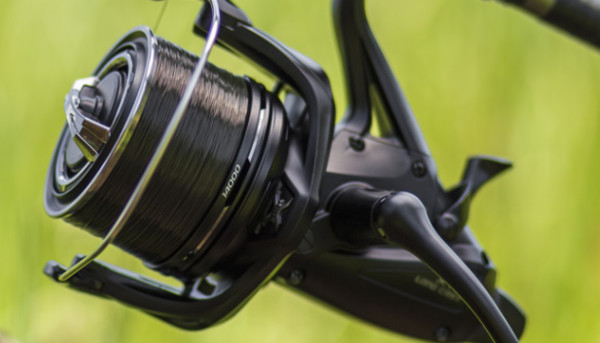
Your rod and reel also affect the result. A reel with a large, well-filled spool lets line leave in wider coils, while the right test curve helps handle the casting weight smoothly. Our guides to carp reel sizes and carp rod test curves explain how those parts fit around the main line.
Choosing carp line for weed, gravel and snags
What breaking strain line for carp fishing in weed?
Light weed doesn't automatically mean you need the heaviest line in the shop. It does mean the line may collect stems and the fish can create extra pressure if it buries itself. Use a robust diameter allowed by the venue, keep the rods attended and apply controlled pressure before the carp becomes deeply embedded. Check that the lead arrangement can work safely in the weed.
Fishing over gravel and hard edges
Gravel is one of the main reasons to think about diameter and abrasion resistance together. A line can survive one brief touch and then become progressively weaker after repeated casts across the same edge. Feel the line after each fish and whenever the lead has been pulled back over rough ground. Don't wait until you can see a deep nick.
Fishing near branches, reeds and concrete
True snag fishing requires you to stay close to the rods and be ready from the moment the rig settles. Set the clutch and rod position for immediate control, but don't lock everything solid without understanding the pressure involved. The hooklink, lead system and main line must work together. If one part is much stronger or behaves unexpectedly, a breakage can leave dangerous tackle attached to the fish.
The main line is only one part of the setup
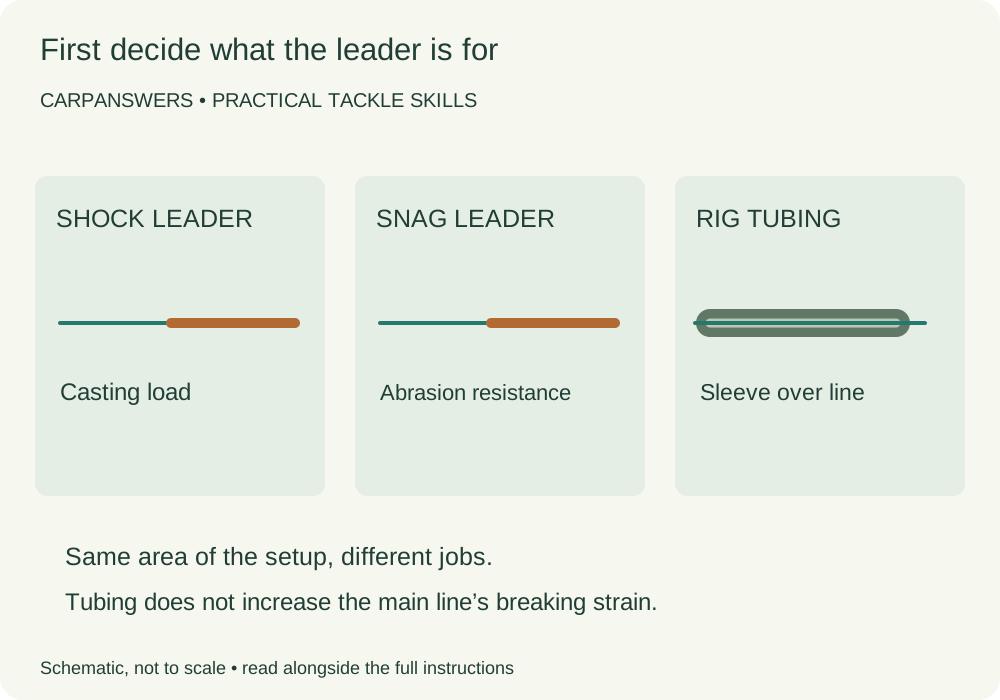
A strong main line doesn't rescue a poor knot, damaged leader or unsafe lead arrangement. The complete setup should be balanced so that it casts correctly, lets you control the fish and behaves sensibly if anything breaks. Follow the venue rules and the component maker's instructions, especially when combining leadcore, tubing, leaders, clips and quick-change parts.
Make sure the leader knot, if one is allowed, can pass through the rod rings without catching. Test the lead system in the margin and check that swivels and clips fit properly rather than forcing together parts from different systems. If you're still learning how these components work, a straightforward monofilament setup is a much better place to begin than an elaborate leader arrangement.
Knot strength is just as important
The number on the spool describes the line, not the finished connection. Every knot bends and compresses the material, and a badly formed knot can reduce strength dramatically. Use a knot recommended for that line and component, wet it when instructed and tighten it slowly. The turns should settle neatly without crossing or burning into each other.
Pull-test every important connection with safe pull tools. Never wrap line around your bare fingers or hands because thin line can cut deeply. If a knot looks kinked, uneven or cloudy, cut it off and tie it again. It takes less than a minute and removes a very avoidable weak point.
Do you need a shock leader?
A shock leader is designed to take the force generated by a heavy cast. That can be relevant when casting large leads, solid bags or baiting tackle, but leaders are banned or restricted on many waters. Poorly tied leader knots and unsafe lead systems can leave a long length of strong material attached after a breakage, which is why the rules must come first.
If leaders are permitted, match the material, strength, length and knot to the rod, casting weight and main line. Remember that a filled solid bag or spod weighs much more than it does empty. Don't copy a fixed formula from somebody using different tackle. When in doubt, ask an experienced angler or the fishery before casting.
Spooling your carp line correctly
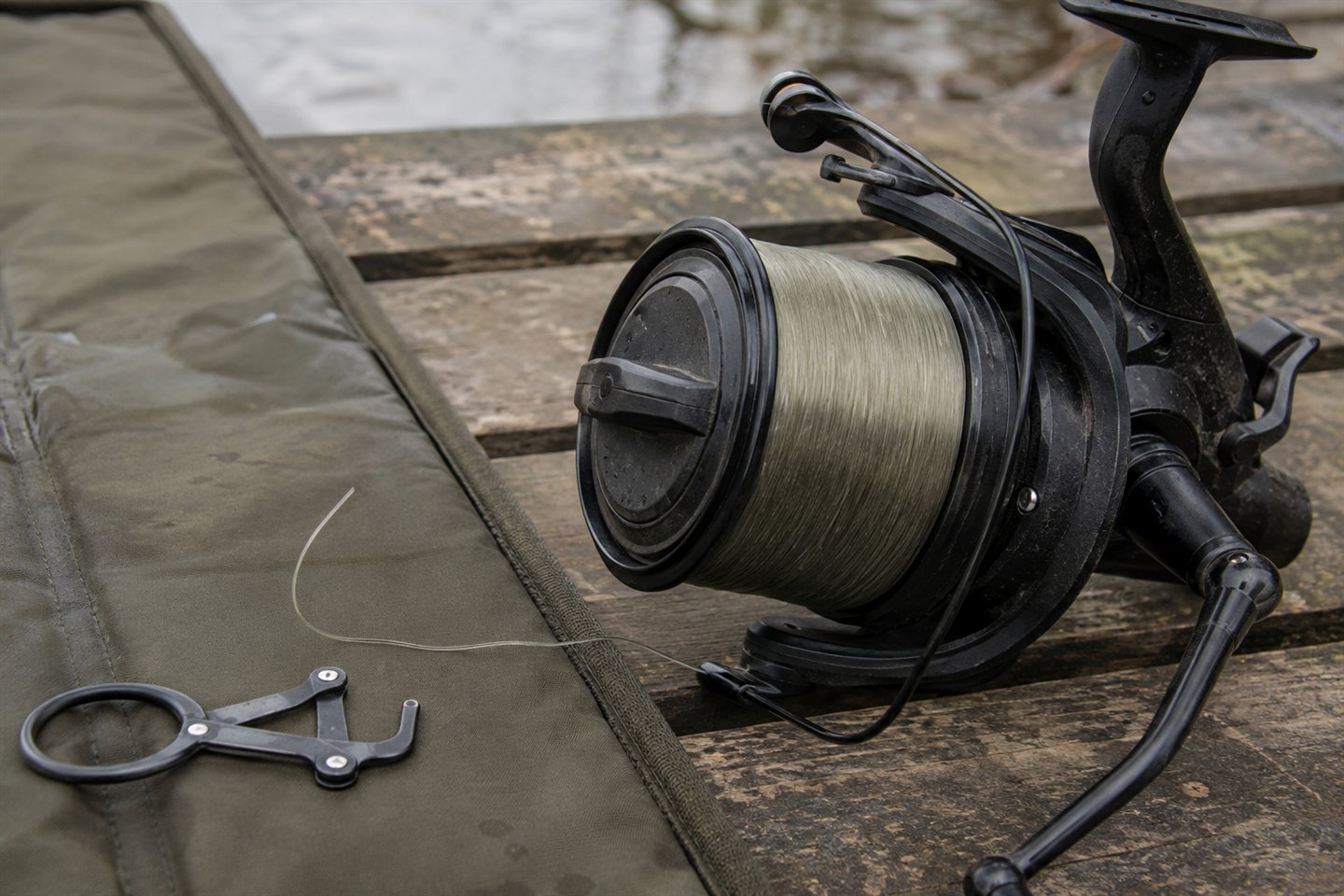
Even the best carp fishing line will behave badly if it is loaded with loose coils or too much twist. Follow the line and reel manufacturers' guidance, apply steady tension and stop at the recommended distance below the spool lip. Underfilling increases friction and reduces casting performance. Overfilling encourages loops to spring off and gather around the rod rings.
A deep spool may need backing so you don't waste hundreds of metres of new line underneath the working section. Join the backing securely and keep that connection buried well below the amount of line you expect to cast. Check the stated reel capacity at the diameter you'll really use, not at a thinner size printed beside it.
Once loaded, cast a plain lead in open water and retrieve under gentle tension if the line needs to settle. Watch for coils and check that the line roller is turning correctly. Our guide on how to spool a carp reel takes you through the complete process.
Checking carp line before every session
Begin with the first several metres because that section receives the most wear. Pass it slowly between your finger and thumb, checking for roughness, flat spots and changes in colour. Inspect the spool lip and the reel's line roller as well. A tiny chip on either part can damage fresh line on every cast.
Retie old knots, test the clutch and pull-test the connections with protected tools. Cast only after the landing net, wet unhooking mat or cradle and fish-care equipment are ready. Then test the rig and lead arrangement in the edge so you can see how it behaves. This simple routine prevents many problems before a carp is involved.
Repeat the inspection after every fish, snag or cracked-off cast. If you have dragged the line across gravel, don't assume it survived because the lead came back. Remove any suspect length straight away. You should also check behind the obvious damaged area because abrasion can extend farther than expected.
How often should carp line be changed?
There's no calendar rule that works for everyone. An angler fishing regularly over gravel may need to replace working line sooner than somebody fishing occasional short sessions in clean water. Sunlight, storage, twist, repeated casting and abrasion all affect its condition. The feel of the line is more important than whether it has been on the reel for six months or a year.
Change it when it becomes rough, badly twisted, excessively coiled or unreliable at the knot. You may only need to remove the damaged end after a normal session, but eventually that leaves too little working line on the spool. At that point, respool rather than adding a short top-up that creates another connection in the casting area.
Does carp line colour matter?
Green, brown and clear line can each blend into one lake and stand out in another, so colour should come after safe diameter, material and condition. Think about line angle too. Pinning everything hard to the bottom may suit clean ground but increase contact with weed or a sharp shelf. Good location and rod position usually matter more than a promise of perfect camouflage.
Common breaking-strain questions
Is 15lb line strong enough for carp fishing?
For many ordinary UK carp waters, a good 15lb-class mono around 0.35mm is an excellent general choice. Check the actual diameter, fishery minimum and hazards before deciding. One brand's 15lb line may be noticeably different from another, so don't rely on the label alone.
Should a beginner use 12lb or 15lb line?
I would usually point a beginner towards 15lb-class monofilament for a typical carp lake because it offers a little more margin while technique is developing. A clean, open venue may allow 12lb-class line, but there's no benefit in going lighter unless the rules, range and lack of hazards give you a clear reason.
What line should you use for a 30lb carp?
Choose for the swim rather than matching the fish's body weight. A 30lb carp in open water can be played on a sensible balanced setup, while a much smaller fish beside branches may need more robust tackle and immediate control. Fish size alone cannot answer the question.
Can you use 20lb line everywhere?
You can use a heavier line where the rules and conditions justify it, but 20lb on the label is not automatically safer. The line may be thick, stiff or unsuitable for the range, and it still fails if the knot or working section is damaged. Safe swim choice and a balanced setup remain essential.
What is the best main line for carp fishing?
There's no single best spool for every lake. A reliable monofilament of the correct diameter is the most useful general answer. Compare current options in our carp fishing line guide, then make the final choice around the fishery rules and the water in front of you.
Summary
So, what breaking strain line for carp fishing should you put on the reel? For a normal UK setup, start by comparing quality monofilament around 0.35mm to 0.38mm, commonly sold in the 15lb to 18lb range. Then adjust for fishery rules, casting range, weed, gravel, snags and the true condition of the swim.
Check the diameter as well as the breaking strain, and keep an eye on knots and abrasion during the session. Stronger line doesn't make an unsafe snag worth fishing. A balanced setup in good condition is a much better starting point than simply buying the highest number on the shelf.