Night carp fishing doesn't need to be an expedition. For beginners, a suitable venue and a daylight arrival make the first trip easier. We'll help you plan the tackle, comfort and fishing so you can enjoy being there.
An overnight session gives you access to different periods of activity, including dusk and dawn, but it doesn't guarantee more bites than a day trip. Carp may visit your area, stay elsewhere or feed at times that don't match expectations. Your first objective is to remain comfortable and capable enough to make good decisions throughout the session.
This article follows the fishing itself: choosing the swim, settling the rods before dark, interpreting indications and managing a capture. Use the separate night-fishing checklist for the complete packing routine. Keeping those two jobs separate makes it easier to prepare without turning the first night into an equipment-buying exercise.
Night carp fishing for beginners: what needs doing before dark?
Book one night on a familiar, well-managed water with open swims, clear rules and straightforward emergency access. Fish one or two rods in areas that can be played and netted safely from the bank. Avoid starting on a remote low-stock pit, a steep riverbank or a snaggy swim that demands immediate technical decisions you have not practised in daylight.
If you can, arrange the first visit with a competent angler who is willing to explain the routine. Agree where each person's rods will fish and what help is appropriate. Having company can reduce uncertainty, but it doesn't transfer responsibility for attending your own rods or make an unsuitable bank safe.
There is also nothing wrong with a gradual start. A late-afternoon visit that finishes after an hour of darkness lets you practise lighting, casting references and the route to the net without adding a full night of interrupted sleep. Build confidence with the process before adding a longer stay or more difficult venue.
Check what the overnight ticket actually allows
A day ticket doesn't necessarily include night fishing, and permission to remain on site doesn't automatically allow every activity. Ask about the booked arrival and departure times, maximum rods, permitted shelters, visitors, vehicle movements and any area-specific restrictions. Save the current rules so you can refer to them without relying on mobile reception.
Confirm how the gates operate and how emergency services can reach the site. A locked gate is not a reason to assume that assistance can use the same route as your arrival. Obtain the fishery's emergency contact information and an accurate location for your swim or lake. Tell someone at home where you're and when to expect your return.
Keep national and regional requirements separate from the fishery ticket. Check the appropriate rod licence and local rules for the country where you'll fish. The rod-licence guide explains the distinction. For England and Wales, the official freshwater rules remain the starting point; they are not replaced by a private venue's booking confirmation.
How to prepare a carp swim before it gets dark
Allow enough daylight to inspect the bank, choose fishing areas and organise the shelter without rushing. If delays mean arriving at an unfamiliar water after dark, simplify the plan or postpone fishing until you can assess it properly. Trying to recover lost time by casting immediately creates exactly the uncertainty that makes a first night difficult.
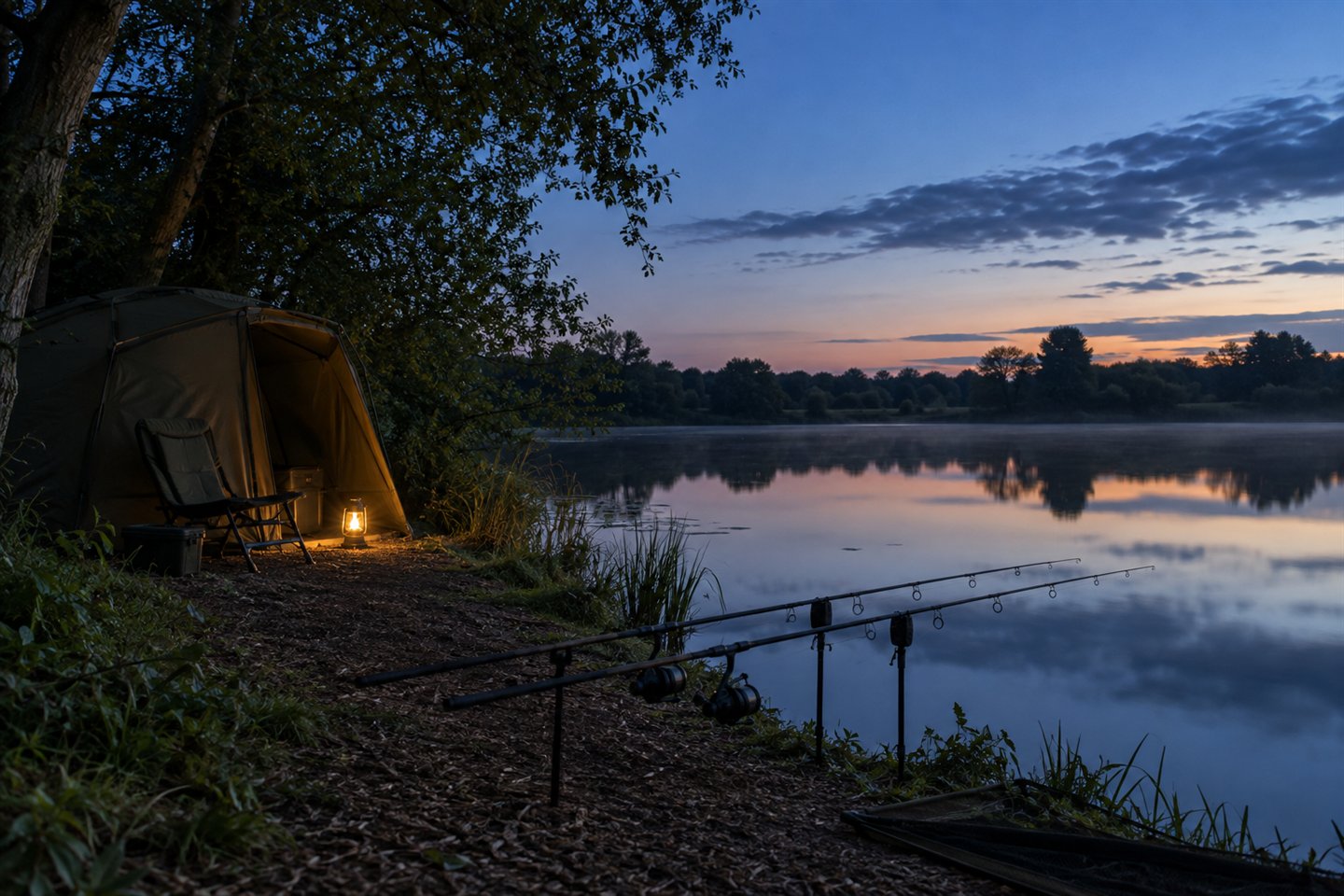
Look at the route from the shelter to the rods, the route from the rods to the landing area and the route out of the swim. Check edges, steps, roots, soft ground and steep slopes. A path that feels obvious in daylight can become awkward when wet and partly hidden by luggage. Choose another swim if the route cannot be made straightforward without damaging vegetation or altering the bank.
Position the shelter so its entrance is clear and the rods remain immediately accessible. Keep guy lines and pegs out of the working route, and place boots, torch and outer clothing where they can be found without searching. Don't plan to jump over rods, a low wall or a cradle when an alarm sounds.
The Angling Trust's freshwater safety guidance identifies increased slips and trips after dark and the need for suitable lighting. Treat illumination as working equipment rather than an optional comfort. It should let you see the ground and bank edge, not merely make the shelter feel cosy.
Choose spots you can manage at night
Begin with open-water or clear-margin presentations that leave room to play a fish. A carp showing beside tangled branches is not automatically a suitable first-night target. The important question is whether you could control and land a hooked fish there when visibility is reduced and you have just got up from the bedchair.
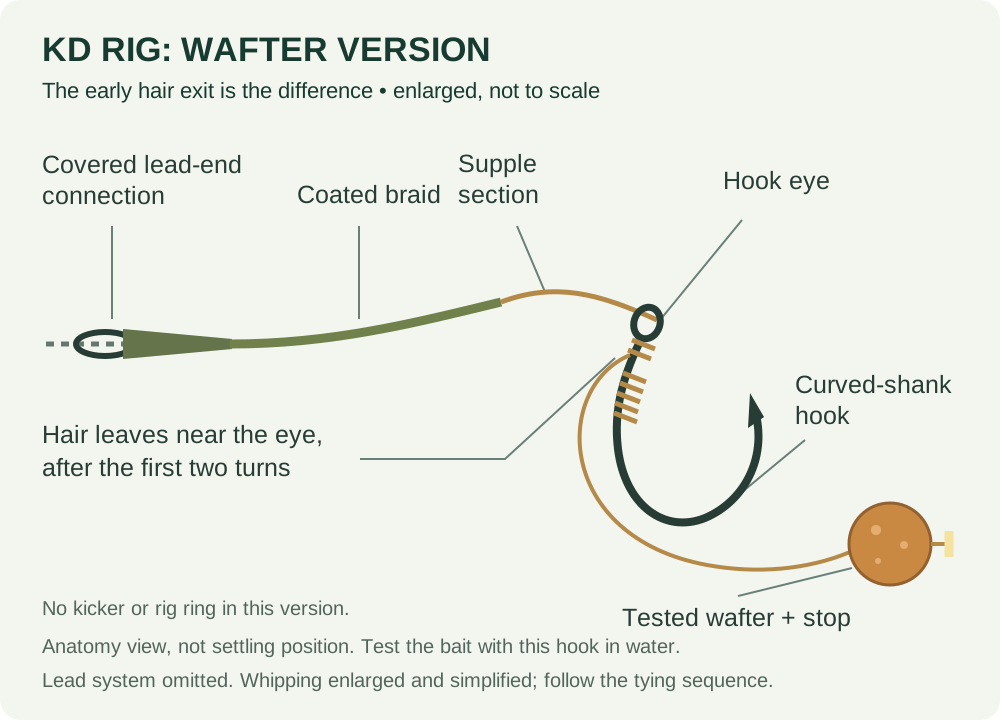
Use a familiar rig that complies with the fishery's rules and suits the bottom. Check the lead system, hook point and line condition before casting. There's no need to introduce an unfamiliar helicopter setup, complicated leader or oversized hookbait merely because the session extends overnight. Repeatability makes faults easier to recognise when the light has gone.
Mark useful casting references while you can see them clearly. Choose a skyline feature that will still be identifiable after dark, not a small object on the far bank that disappears as the light fades. Record the distance if you normally use distance sticks, and verify that the reference lies within your permitted water rather than across somebody else's line.
Distance clips require deliberate management. They can help repeat a cast, but a main line left trapped in a spool clip during fishing can prevent a fish taking line. Follow your reel's instructions and your established safe routine for removing the line after casting. If you're unsure, practise the process without a baited hook before relying on it overnight.
Set the rods and indicators before darkness
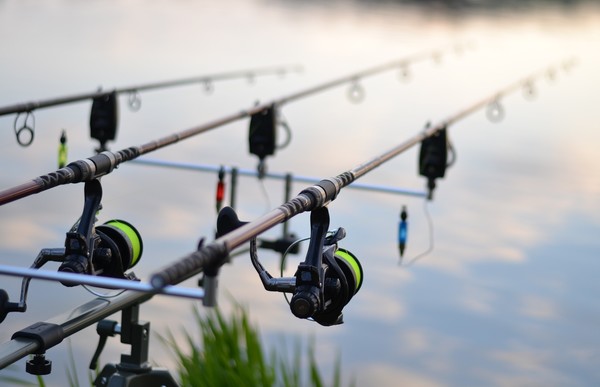
Secure the rests or pod on stable ground and make sure a taking fish cannot simply pull a rod into the lake. Set the clutch or free-spool system for the actual swim, keeping immediate control in mind. Don't loosen it excessively to compensate for sleeping farther away; change the layout or reel in if response cannot be prompt.
Test every alarm, receiver and indicator together at the fishing position. Check that you can recognise which rod is indicating, that the receiver is paired correctly and that batteries are sound. A receiver is additional information, not proof that the alarm at the rod is operating correctly. Use the alarm, bobbin and swinger setup guide if these adjustments are new.
Set sensitivity and volume to the conditions. Wind and movement on the line can cause isolated sounds, but turning everything down until genuine movement becomes difficult to recognise is not a useful cure. Adjust the line, indicator weight or rod angle first where appropriate. Keep audible disturbance to other anglers as low as practical while retaining reliable awareness.
Test the route in the actual clothing you'll use at night. Stand up, put on footwear, pick up the torch and walk calmly to the rod. If a sleeping-bag zip catches or the shelter entrance blocks movement, solve it now. The best first-night routine should not depend on athletic reactions to overcome a poorly arranged swim.
Prepare the landing area as carefully as the shelter
Assemble a suitably sized landing net before fishing and position it so it can be reached without leaning over an unsafe edge. Keep its mesh clear of hooks and obstructions. Open the mat or cradle on level ground, place the bucket and unhooking tools together and leave a clear working area around them.
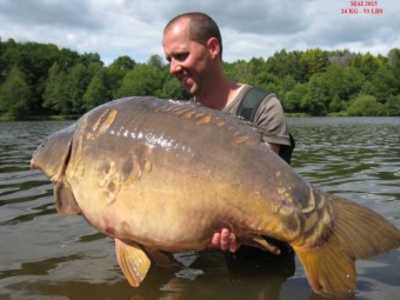
Know how you'll support the fish between net and mat. A net handle is not a lifting crane, and a large carp should not be carried suspended from it. Follow the fishery's required procedure, use a suitable sling where appropriate and ask for practical instruction before dark if you have not managed a carp of the likely size.
Set up anything genuinely needed for weighing or a quick photograph in advance, but don't make either compulsory. At night, an efficient release is more important than finding a camera setting. The carp-care guide explains the complete sequence. No part of it becomes optional because a fish was hooked at an inconvenient hour.
Use light where it helps
A headtorch frees both hands, while a separate backup means one flat battery need not leave you working in darkness. Check that you can change modes easily with cold or wet hands. Keep the spare in a known accessible place, not at the bottom of luggage beneath the bedchair.
Use a modest beam for familiar close work and sufficient light for hooks, knots, the bank edge and fish handling. A red or low-output mode can be convenient around the shelter, but colour should never take priority over seeing the task properly. If you can't distinguish the line or hook clearly, increase the light.
Avoid sweeping a powerful beam across neighbouring swims or continuously illuminating the lake. Point it at the ground while walking and direct it towards the job when working. Courtesy and practical visibility can coexist. You don't need to keep the fish-care area inadequately lit because you're worried that using a torch will spoil the whole session.
What to do when a carp alarm sounds at night?
Move promptly but calmly to the rod. Look at the indicator and line while taking control; don't sprint into the bank edge because the receiver sounds urgent. Pick up the rod, engage the normal drag if using a free-spool system and establish controlled contact. A violent overhead strike is unnecessary when the line is already tightening against the fish.
Keep the rod at a useful fighting angle and let its action and clutch absorb changes in pressure. Pay attention to where the other line lies. If fishing with a companion, give a clear request for help with the net or spare rod rather than expecting them to guess. Don't lift a fish clear of the water with the rod.
A dropping indicator can be as important as a rising one. A fish moving towards the bank may create slack, so wind carefully until contact is established rather than assuming the event was only a line bite. Persistent unusual movement, especially near any hazard, warrants prompt attention. Interpretation depends on the whole setup, not on a particular number of bleeps.
Once the carp is ready, sink the net and guide the fish over its centre rather than chasing it with the frame. Keep it supported in the water while confirming that the mat and tools are ready. If the situation becomes unsafe, seek experienced help. Never enter deep or unknown water to follow a fish or retrieve snagged tackle.
Reset after a capture without rushing
Return the carp promptly and confirm it can hold itself upright and swim away strongly. Then inspect the hook, hooklink, knots and the working length of main line. Replace damaged or doubtful components. A successful capture doesn't prove that the rig is still sound; abrasion and hook damage can occur during the fight or unhooking.
Before recasting, ask whether the original spot is still the best option and whether the reference remains visible. Repeating the daytime distance towards an uncertain target is not accuracy. If the cast cannot be made safely, use a clearly identified closer area or wait until enough light returns. There's no obligation to restore every rod immediately.
Recheck the clutch, alarm, indicator and rod security after the cast. Tidy the net and refresh the fish-care area before settling down. This short reset is easy to skip when tired, which is why it should be treated as a fixed sequence. One unhurried check prevents discovering at the next bite that the net is folded beside the mat.
Should you recast or rebait during the night?
A sound presentation doesn't need retrieving simply because a clock reaches midnight. Consider the hookbait's durability, nuisance fish, the bottom, weed on the line and any evidence that the lead has moved. If a rig was placed confidently and remains undisturbed, leaving it may be the most sensible decision.
Equally, don't turn reluctance to make noise into a reason to leave an obviously compromised rig fishing. A line that has collected debris or a bait known to be vulnerable to nuisance species may need checking. Plan accessible spares and manageable casts so correcting a real problem is straightforward rather than an operation requiring half the swim to be dismantled.
Keep additional feed proportionate to what you know. A capture may justify a little more bait, but one bite doesn't prove that a large shoal is consuming a heavy bed. If other anglers are feeding the same general area, factor that into the decision. Overnight duration alone is not a reliable measure of how much bait the lake needs.
Warmth, food and fatigue affect the fishing
A dry sleeping system and suitable layers help you remain capable when activity starts. Choose bedding for the forecast overnight conditions and your own needs, rather than assuming summer evenings stay warm until dawn. The bedchair and sleep-system guide explains the practical trade-offs without suggesting that the largest setup is always best.
Keep wet clothing away from bedding and organise a dry layer before it is needed. Ventilation helps manage condensation, but shelter instructions and current conditions should guide how vents are used. If clothing or bedding becomes wet enough that you can't stay adequately warm, stop fishing and make a safe departure rather than waiting for daylight to justify leaving.
Use a camping stove only outdoors on stable, clear ground where it is allowed, well away from shelter fabric and with adequate supervision. Never use a stove, barbecue or fuel-burning heater inside a bivvy or enclosed shelter, even with the door open. Official carbon-monoxide guidance explains the danger of taking these appliances into enclosed camping spaces.
For a first night, simple food and a flask may remove the need to cook at all. Avoid alcohol and anything that reduces alertness around the water. If you can't remain able to respond immediately, reel in. Overnight fishing is not permission to leave baited rods effectively unattended, and no alarm setting makes severe tiredness a safe arrangement.
What changes when the night doesn't follow the plan?
Rain may turn a clear path slippery, wind may change the shelter's stability and a line may start collecting weed. Check the whole working area when conditions change, not only whether the rods are still fishing. Move loose equipment away from developing puddles and stop using a swim if its footing or landing route becomes unsafe.
If you repeatedly sleep through indications, cannot operate the tackle calmly or feel too cold to manage a fish properly, retrieve the rods and rest or leave safely. That decision is a successful limit, not a failed night. You can learn from a shortened session; there is little learning value in continuing beyond the point where welfare and control are reliable.
Plan the drive home as part of the trip. A broken night's sleep can leave you less alert than expected even after an uneventful session. Allow time to rest before driving and don't arrange the first overnight around a tight work deadline. Travelling safely is more important than preserving an extra hour of fishing at dawn.
Agree a simple communication routine if fishing with a companion: who can be called for netting help, where spare lights are kept and how to avoid stepping across each other's rods. Practise the request before it is urgent. Assistance should make the capture calmer, not produce two people handling the same reel or reaching into a net without knowing where the hook is. Keep the working area spacious enough for the help you expect to use.
Equipment worth considering
A dependable headtorch with an easily reached low setting and adequate working beam is the most useful dedicated night-fishing purchase. Pair it with an independent spare light and the correct batteries or charging arrangement. A power bank can support a phone or compatible lamp, but check connections and realistic capacity before relying on it away from the car.
For warmth, compare a sleeping bag or bedchair cover with the forecast conditions and your existing bedchair dimensions. Don't buy a large shelter to compensate for an unsuitable sleeping system. Small organisation items can be just as valuable: a waterproof pouch for the phone, a secure tray for tools and a compact tackle box for ready-to-use rigs. Each should make a specific task easier in poor light without cluttering the route to the rods.
Two useful examples for an overnight packing check are the NGT rechargeable fishing headtorch (paid link) and Anker 20,000mAh USB-C power bank (paid link). Confirm the charging connections, runtime at the setting you'll use and protection from rain before buying. Carry an independently powered backup light: a power bank is not a substitute for immediately usable lighting when a bite occurs. Keep cables and charging equipment dry and away from your route to the rods.
Frequently asked questions
Do carp always feed better at night?
No. Night activity varies between waters and seasons, and some lakes produce well in daylight. Staying overnight lets you fish different parts of the day, but keep watching to see when your lake is active. Observe the actual water and record when fish show or bite instead of expecting darkness to solve poor location.
Can a beginner sleep while night fishing?
Only within an arrangement that still allows immediate response and proper control of the rods, with venue rules respected. If you sleep deeply, cannot hear the alarms reliably or are too tired to react, reel in. Begin with manageable conditions and experienced company rather than treating a receiver as a substitute for readiness.
Do I need different rigs after dark?
Usually the presentation should be chosen for the bottom, bait and venue rules, not darkness itself. A familiar rig is easier to inspect and reset. Make any necessary changes in good light where possible, and keep simple spares prepared so a damaged hooklink can be replaced confidently.
Finish with a repeatable routine
Have another look at the lake at dawn before adding bait or moving rods. When it's time to pack up, reel in first and leave the net and mat ready until fishing has stopped. Note anything that was awkward in the dark. Sorting out those small details will make the next night much more comfortable.
Sources and further reading
Reviewed on 15 September 2026 against GOV.UK rod-control rules, Angling Trust freshwater safety guidance and nidirect camping carbon-monoxide advice. Recheck the fishery's current night-fishing rules before booking.