Taking carp bait to France needs a check before you pack the car. The ingredients matter, so don't assume every boilie or particle falls under the same allowance. Here's how to check the relevant rules and plan an alternative if you need one.
For a straightforward holiday, the practical starting point is to arrange suitable bait from a confirmed supplier in France. If you specifically want to carry a product from Great Britain, obtain an answer for that exact product from the appropriate French authority before travelling, with the manufacturer's composition information available. A venue recommendation or an uneventful previous crossing is not import authorisation.
The official information below was checked on 15 September 2026. Use it to work out which questions to ask, then confirm current requirements for your exact products, departure date and route. Animal-derived ingredients and live bait need particular attention.
Taking carp bait to France: what must you check first?
If the product's admissibility is uncertain, leave it out of your luggage and make a confirmed local purchase plan. Ask the French supplier or lake what is available, permitted and suitable, and pre-order where necessary. This removes the need to make the trip depend on an unresolved border question.
If carrying a particular bait is important, identify it precisely: product name, full ingredients or composition, animal species involved where relevant, processing method, quantity, packaging and intended fishing use. State that you're travelling from Great Britain to France rather than asking about “Europe” or “the UK” without a route.
Then ask French customs or the appropriate veterinary or plant-health service what applies. If they direct you to another authority, follow that route before departure. Don't choose whichever informal answer is most convenient or assume that paying a declaration fee can make a restricted product acceptable.
Great Britain and Northern Ireland are not interchangeable
This article's main scenario is a traveller leaving England, Scotland or Wales for France. Don't apply that answer automatically to a direct journey from Northern Ireland, to goods originating elsewhere or to a route that passes through another country before entering the EU.
The French agriculture ministry's Brexit sanitary and plant-health guidance explicitly distinguishes Great Britain from Northern Ireland. The existence of that distinction is the important point here; it is not an invitation to use a different route as a way around the requirements for your goods.
Give the authority the real origin and travel route, including the first EU entry point. A product bought in one place, stored in another and carried through a third may need a more specific answer than a simple destination question. Keep the itinerary and the goods description consistent.
Why the ordinary food allowance is not a bait allowance
The European Commission's personal-import guidance describes restrictions on animal products and particular allowances for categories such as fishery products. Those food-related rules should not be converted into a blanket allowance for fishmeal boilies, pellets or liquid attractors intended for fishing.
In particular, a reference to a quantity of fishery products is not proof that the same weight of formulated carp bait can travel. The product's intended use and classification matter. An ingredient containing fish doesn't automatically make the finished bait equivalent to a fish carried for personal consumption.
Likewise, calling a boilie “food for carp” doesn't establish that it belongs in a traveller's personal-food exemption. Ask for the actual classification and conditions rather than applying everyday language to a legal category. This is one reason conflicting online kilogram claims are a poor basis for packing.
What rules should I check before taking carp bait to France?
The Commission's FAQ on other products not intended for human consumption includes a question about fish bait under customs code 0511. It says that the relevant import and certificate decision rests with the destination country's competent authority.
That is useful evidence that a product-specific national answer can be necessary, but the FAQ is not a blanket ruling covering every carp-bait recipe. It doesn't establish that all boilies fall under code 0511, nor does it authorise a particular tub in a traveller's luggage. Don't invent the code yourself to make an enquiry look complete.
When contacting an authority, describe the real product and ask whether a classification or additional document is required. If a supplier provides a code, include it as the supplier's information rather than presenting it as an independent legal conclusion you have verified.
Read the actual composition, not the flavour name
A bait called strawberry, nut or fruit may still contain animal-derived ingredients. Conversely, a fish-themed marketing name doesn't tell you the full formulation or processing method. Obtain the actual composition from the manufacturer where the retail label is insufficient.
Include ingredients such as fishmeal, milk derivatives, egg, animal proteins or extracts where present, without trying to decide their legal treatment from the name alone. Liquids and coatings matter too. A plant-based base mix with an added animal-derived liquid is not the same product described by the base mix alone.
If the manufacturer will not provide enough information for an authoritative answer, treat that as a practical limitation. There's no need to guess or disclose a proprietary recipe publicly; ask whether the manufacturer can supply the necessary information directly to the authority. Otherwise, arrange a suitable alternative locally.
Processing and packaging are relevant, not automatic exemptions
Authorities may need to know whether a product is dried, cooked, frozen, shelf-stable or otherwise processed. Give accurate information from the manufacturer rather than assuming that a boilie is sterile because it has been boiled. Domestic preparation and commercial processing are not interchangeable descriptions.
Keep products in their original labelled packaging where carrying them has been confirmed as permissible. Labels and receipts can help identify what you have, but they are not substitutes for any required permission or documents. A sealed bag is evidence of packaging, not a universal exemption from animal-health rules.
Don't decant bait into an unlabelled food container to make inspection less likely. It makes identification harder and doesn't change the contents. If you have been instructed to carry particular documentation, keep it readily accessible and make sure it matches the product and quantity actually packed.
Plant-based particles still need a proper check
Don't assume that removing animal ingredients automatically settles every import question. Seeds, grains, nuts and other plant materials can raise separate plant-health or commodity questions depending on the product and processing. Prepared particles, dry raw ingredients and a commercially packaged finished bait should be described accurately.
France's official restricted-products guidance points travellers to customs and the relevant sanitary or plant-health service for questions. Use that route for an uncertain product rather than expanding a rule about ordinary groceries into a statement about every bucket of fishing particles.
Also check the lake's bait rules. Even a product that can legally enter France may be prohibited at the venue or require a particular preparation standard. The particle-bait guide covers fishing preparation, but preparation advice is not an import permission.
Live bait is a separate enquiry
Live maggots, worms, aquatic animals and other organisms should not be treated as another packet of dry bait. Their species, origin, packaging and intended use can matter. Don't rely on a boilie discussion or a retailer's casual reassurance to decide whether they can cross the border.
For a carp holiday, ask whether there is any genuine need to transport live bait at all. A locally supplied, permitted alternative may avoid both legal uncertainty and the practical difficulty of keeping organisms contained and in suitable condition during a long journey.
Never release unwanted live bait into the environment or transfer water from one fishery to another. Obtain the venue's disposal instructions and follow applicable local rules. The planning decision should include what happens to leftovers, not only whether the bait can be obtained before departure.
Ask a precise question and keep the response
A useful enquiry explains the planned departure date, route, product, quantity and personal fishing use, and asks whether import is permitted and what documents or entry arrangements are required. Include photographs of the label and manufacturer information if the authority requests them. Keep personal information limited to what is needed.
Use the contact route linked through Service Public's customs guidance to find current French assistance. An answer from an official source should still be read for scope: it may cover one product, one route or particular conditions rather than every item on your packing list.
Save the response with its date and reference. If you change the product or add a coating afterwards, the original description may no longer match. Ask again where the change is material rather than assuming that an answer about one brand covers a whole category.
Don't confuse commercial export guidance with a holiday shortcut
APHA's animal-by-product export guidance explains that relevant goods may need certification and checks when exported to the EU. It is written for business exports, so it should not be copied into a traveller's checklist as though every holiday bait automatically follows one identical process.
It does, however, show why “a UK company sells this in France” is not proof that you can carry it informally. A commercial supplier may use documentation, approved arrangements and transport procedures that are not available simply by buying a retail bag.
If the authority says a formal process applies to your intended product, evaluate whether that process is practical before purchasing. For an ordinary fishing holiday, arranging supply in France may be far simpler than attempting to reproduce a commercial movement without understanding its obligations.
Example: a fishmeal boilie with an added liquid
Suppose an angler wants to carry several bags of a fishmeal boilie and a bottle of liquid attractor. The bag name alone is insufficient. The angler needs composition and processing information for both products and must describe them separately, including any animal-derived ingredients in the liquid.
If an answer is obtained for the unopened boilie, it should not automatically be extended to a homemade mixture soaked in the liquid. Combining products can change the description presented to the authority. Keep the enquiry aligned with what will actually be transported rather than with the simplest retail label.
If no clear answer is obtained before departure, the practical resolution is to leave those items at home and reserve a permitted bait at the destination. That is not a claim that every fishmeal boilie is prohibited; it is a sensible response to unresolved product-specific requirements.
Example: an artificial hookbait
A clean, unused artificial hookbait without an animal-derived coating is not described in the same way as an edible boilie. Nevertheless, check any relevant requirements and the venue's rules rather than assuming the word “plastic” resolves every issue. A coated or pre-soaked product needs its coating included in the description.
The practical fishing question is separate. Some waters prohibit artificial baits or particular plastic accessories. Even when transport is straightforward, using them contrary to the lake's rules is not acceptable. Confirm the permitted presentation before buying a collection of travel alternatives.
Keep artificial bait securely stored and ensure it is mounted safely if used. An import discussion should not distract from preventing lost plastic, damaged components or an unsuitable rig. The hookbait comparison explains how changes in buoyancy affect the presentation.
The first EU entry point matters
If you enter the EU through another country before driving to France, describe that route when seeking advice. Don't assume that a French destination means the first border is irrelevant. Any required entry or inspection arrangement needs to match the actual journey.
A carrier's baggage policy is also separate from customs and sanitary rules. A ferry or tunnel operator may have conditions for liquids, containers or other goods, but accepting a booking doesn't authorise the contents of every bag. Check both sets of requirements where they are relevant.
Don't choose a quieter crossing or hide bait among tackle because somebody says checks are uncommon. Frequency of inspection is not a measure of legality. A compliant plan should remain workable if the goods are inspected and accurately identified.
Permission to use bait at the lake is another layer
Ask the venue about allowed ingredients, particles, artificial bait, quantities and preparation. A local purchase doesn't automatically make every product acceptable on that water. Keep the operator's rules alongside the shopping plan so that convenience doesn't create a different problem on arrival.
Some operators sell a limited bait range or require pre-orders. Clarify whether buying from them is mandatory or simply convenient, and whether other approved suppliers can be used. Get any important restriction before paying for a large order.
The guide to choosing a French carp lake includes these questions in the booking process. Sorting them early gives you more options than discovering a restriction after the car is packed and the crossing is booked.
Can I buy carp bait locally instead of taking it to France?
Confirm the exact bait, size, quantity, collection point and payment arrangement. Ask when the order will be ready and what happens if your arrival is delayed. A casual message saying that bait is usually available is less reliable than a confirmed order for your dates.
If using a tackle shop, check opening times for the actual arrival day, including holidays or seasonal changes. Allow realistic driving time from the port and a fallback if delays make collection impossible. Don't plan the first night's fishing around a shop that closes before your likely arrival.
For venue delivery, make sure the operator agrees to receive and store the order. Confirm the delivery deadline and label requirements without exposing unnecessary personal information. A parcel arriving after your departure or being left in unsuitable heat is not a workable substitute for carrying bait.
Buy enough access to bait, not excessive bait
A confirmed local supply gives you the option to obtain more if the fishing justifies it. It doesn't mean the first order should be enormous. Choose an initial quantity around the venue's guidance and the intended method, then adjust using evidence from the session.
Our guide to how much bait to use for carp explains why feeding depends on conditions and fish activity. The logistics problem is ensuring suitable bait remains available, not creating a target that must be introduced before the holiday ends.
Include the local order in the French carp-trip budget, with collection or delivery costs if applicable. Compare the complete arrangement rather than a UK shelf price against a French price that includes different products or services.
Storage still matters after a lawful purchase
Follow the manufacturer's storage instructions and confirm the facilities available at the lake. Frozen bait needs an appropriate cold chain; shelf-stable bait still needs sensible protection from heat, moisture and contamination. Don't assume a product remains suitable after being left in a hot vehicle for hours.
Keep fishing bait separate from food and clearly labelled. Open only what you need and use clean tools to avoid contaminating the remaining supply. If a product smells or looks wrong, follow the supplier's advice and don't use it merely because replacing it would be inconvenient.
Ask how leftover bait should be handled. Don't dump a large quantity into the lake at pack-up simply to avoid carrying it. A responsible plan considers use, storage and disposal together rather than making the final morning an exception to normal feeding judgement.
Check the return journey independently
Permission to take a product into France doesn't establish that it can be brought back into Great Britain. The direction of travel has changed, and different rules may apply. Check before deciding to return with unused local bait or an opened container carried out earlier.
APHA publishes a specific Great Britain import information note for fishing bait. Its scope and conditions must be read carefully; it is not French outbound permission or a simple personal-luggage allowance for every bait product.
Keep the remaining quantity modest and arrange lawful disposal or another venue-approved solution when taking it home is unresolved. Don't assume that opening the packet or calling the remainder a souvenir changes its classification.
Equipment worth considering
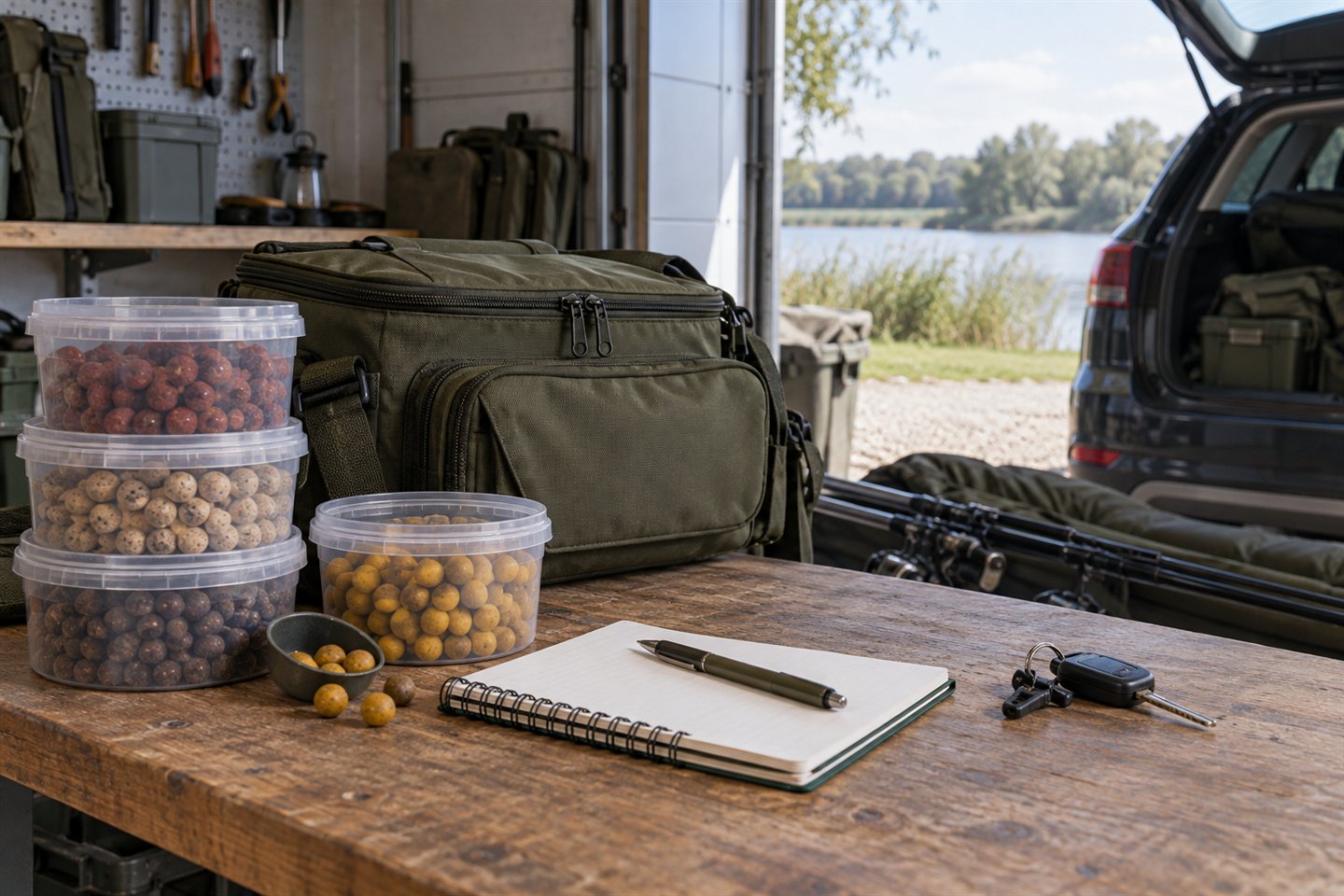
Practical storage can make a confirmed bait plan easier to manage. Clean, secure bait containers help prevent leaks and cross-contamination after local collection, while an organised tackle box keeps needles, stops and spare components away from food. Choose containers for the quantity and storage method actually required.
A document pouch can keep booking details, supplier confirmations and any official correspondence accessible during travel. It is a convenience, not a substitute for required original documents or a guarantee that a product is admissible. Keep digital backups where appropriate and protect the information from unnecessary sharing.
Buy equipment only after deciding how bait will be sourced. There is little value in purchasing oversized transport containers for goods you have not established can travel. A smaller, confirmed local order often makes the car easier to pack and the first day simpler.
Where a purchase is actually needed, the Roddarch four-piece bait-box set (paid link) can organise bait at the destination, and a SPEERO stink sleeve (paid link) can separate the landing net during transport. Ventilated boxes are not spillproof import packaging. Keep the original ingredient labels and any required paperwork for bait, clean and dry equipment between waters, and remember that a retail product or storage accessory doesn't establish permission to take its contents across a border.
Frequently asked questions
Can I take a small tub of pop-ups?
Don't assume a small quantity creates an exemption. Check the exact composition, processing and applicable requirements, or arrange a permitted alternative in France. A product-specific answer is more useful than a general rule based only on tub size.
Does a sealed bag make boilies legal to carry?
No universal permission follows from the seal. Original packaging can help identify a product, but it doesn't replace any conditions, documentation or restrictions that apply to its contents.
Can my lake owner give customs permission?
The owner can explain venue rules and local supply, but cannot issue customs authorisation. Use the appropriate official authority for import questions and keep that decision separate from permission to fish with the bait.
Final thoughts
If the rules for your bait aren't clear, get an answer for that exact product and route before packing it. Someone else's uneventful crossing or a food allowance isn't enough. Arranging suitable bait in France may save the uncertainty. Once that's sorted, check the lake's bait rules and plan how you'll use it.
Sources and review scope
Official sources linked above include the European Commission's personal-import and non-human-consumption FAQs, France's agriculture ministry and Service Public, and APHA guidance for the separate export and return-import questions. Reviewed on 15 September 2026. No official source located establishes one blanket traveller allowance covering every carp bait; this article therefore provides a verification process rather than an invented universal ruling.