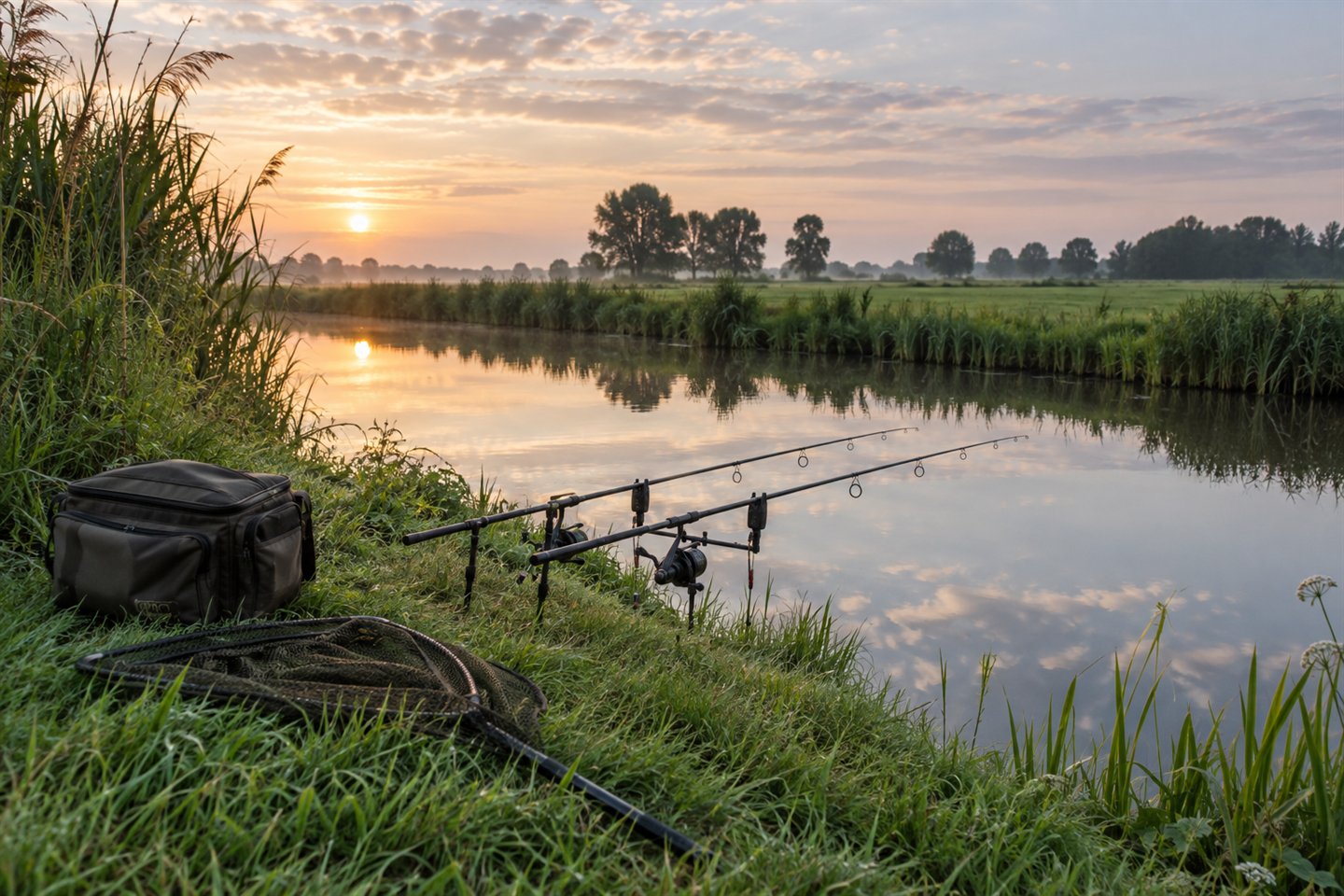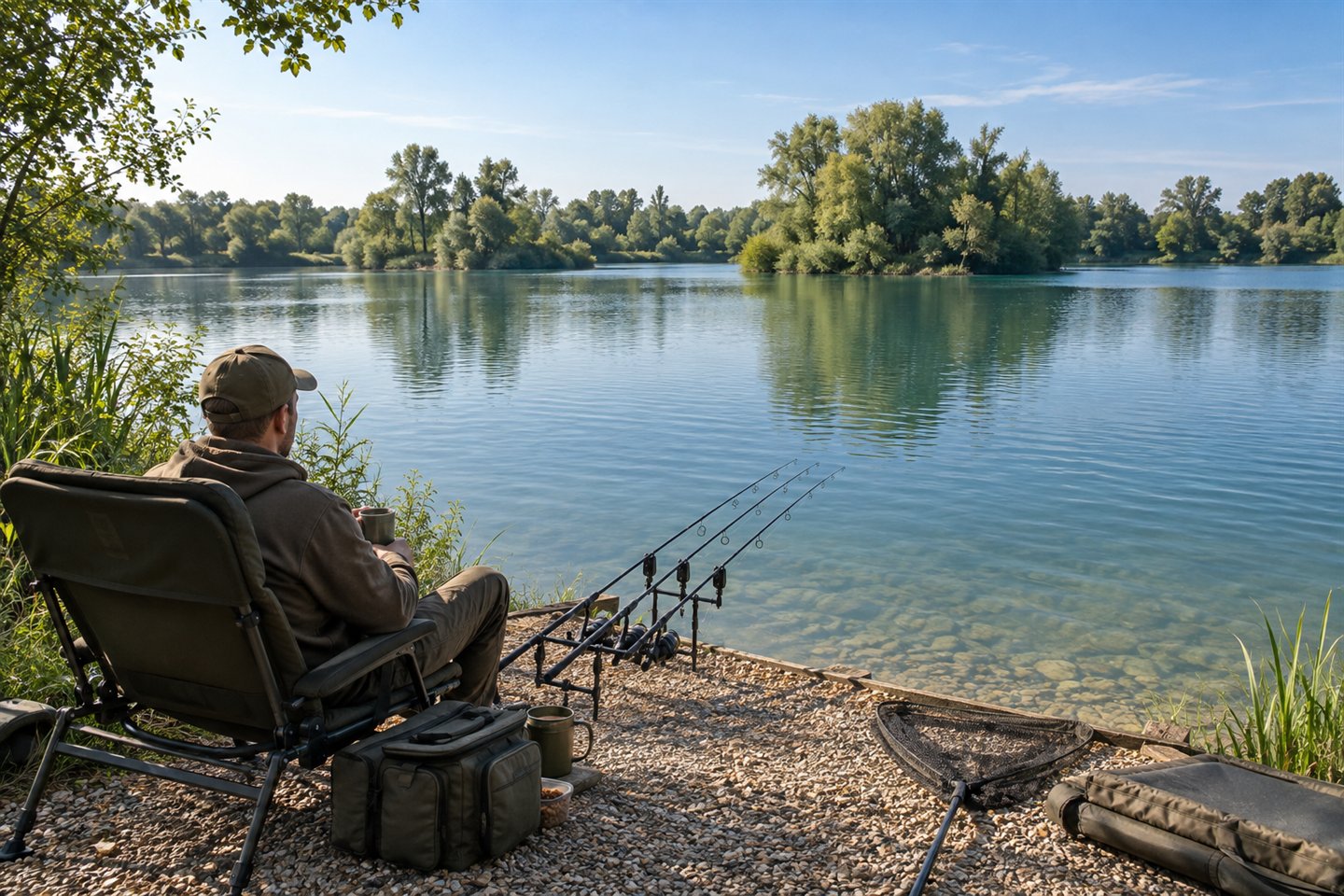
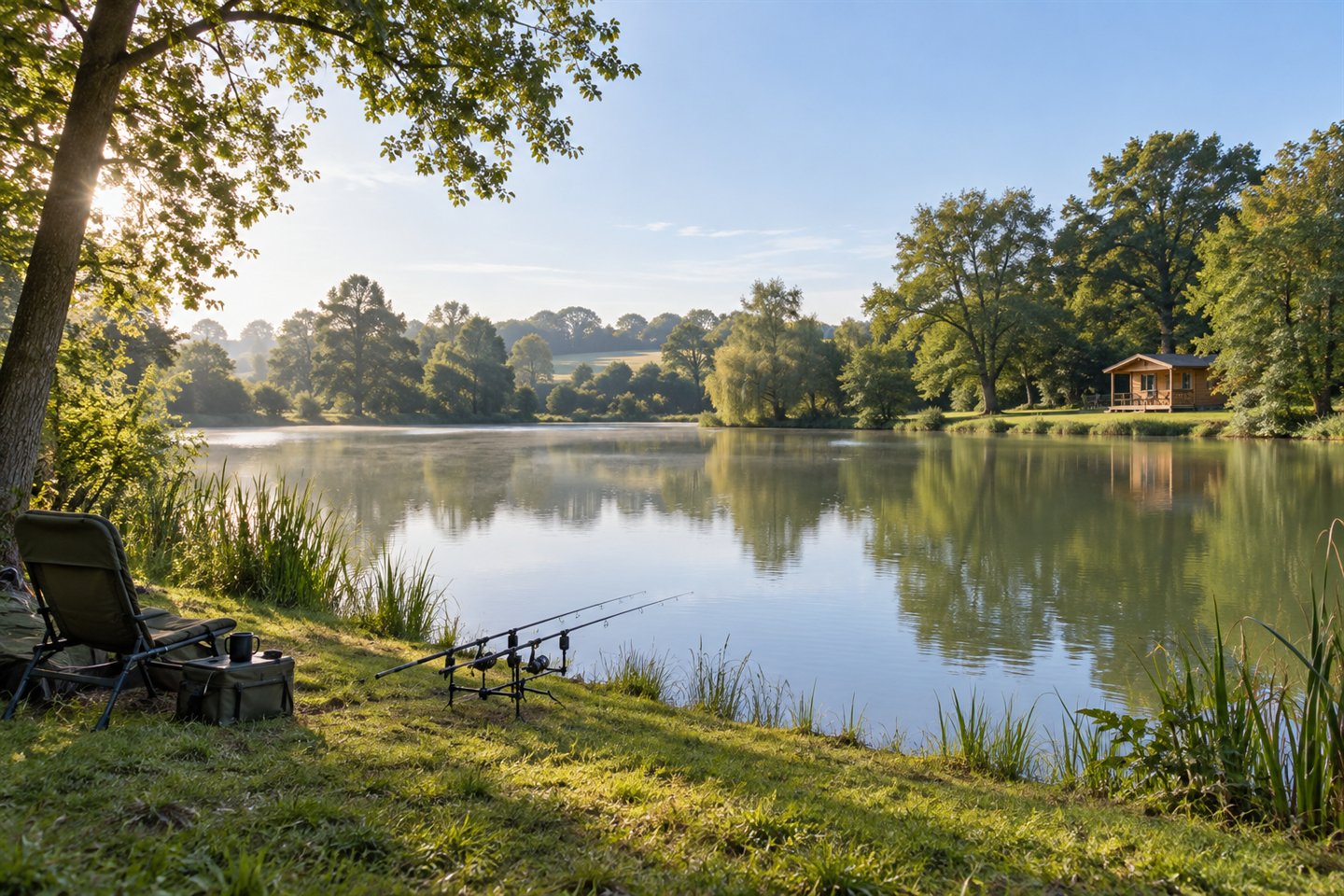
Carp fishing in France offers plenty of choice for beginners, but start with a lake and journey you can manage—not just the biggest fish in the gallery. We'll help you compare venues, ask useful questions and plan a trip that suits you.
The important questions come before paying a deposit. How much fishing experience does the venue expect? Are you booking a named swim, a place in a draw or the entire lake? Can the fish be reached and landed from the bank? What support is available if the weather changes or your tackle is unsuitable? Clear answers prevent expensive surprises.
Once you've chosen the lake, the French carp fishing checklist will help with packing and travel checks. For now, let's make sure the place you're booking offers the fishing and facilities you actually want.
Carp fishing in France for beginners: which lake suits you?
Write down what would make the holiday worthwhile without mentioning a target weight. It might be a manageable week learning a new water, several opportunities to practise good fish care or a relaxed fishing break with a friend. This establishes a useful test for every venue that follows.
Be honest about what you can already do confidently. Consider accurate casting, reading the bottom, tying and testing rigs, responding at night and landing fish without assistance. A lake that requires skills you have not practised may still be an eventual ambition, but it is not automatically the best starting point.
For a complete newcomer to carp fishing, gain basic experience at home first. The first carp session guide provides a simple sequence. An overseas booking should not be the first occasion on which you discover how your clutch works or how to assemble a large landing net.
Choose the holiday model before the lake
A bankside bivvy trip, a cabin beside a reserved swim and a family cottage with optional fishing are different products. Decide which one you want before comparing prices. A photograph of comfortable accommodation may relate to a building well away from the fishing, while a lakeside cabin may offer fewer household facilities than expected.
Think about how you'll eat, wash, sleep and shop during the week. A food package can simplify a first trip, but check meal times, dietary requirements and what happens when fishing or travel disrupts the schedule. Self-catering gives flexibility only if usable cooking, cooling and drinking-water arrangements are available.
If non-anglers are travelling, their requirements belong in the initial brief. Safe places to sit, suitable bedrooms, nearby activities and realistic transport access are not minor extras. A trip that works only while everyone watches the rods is unlikely to feel like a shared holiday.
Don't confuse a famous fish with a suitable stock
A lake record tells you that one fish reached a particular weight. It doesn't explain how many carp live there, how regularly visitors catch or whether the larger fish are currently present. Ask for recent information with dates and context, including typical results across ordinary bookings rather than only exceptional weeks.
Stock figures also need interpretation. A claimed number of fish is not a catch forecast, and acreage alone doesn't indicate difficulty. Feeding areas, depth, natural food, angling pressure and the amount of water available from each swim influence the experience. An apparently small lake can be demanding if access is restricted.
Ask what “beginner friendly” means to the operator. Does it mean straightforward casting, helpful tuition, accessible banks or simply that novices are allowed to book? Useful answers describe conditions and support. A promise that anybody will catch should make you ask more questions rather than end the research.
How to match a French carp lake to my casting ability
Request a map showing swims, boundaries and the main fishable areas. Ask what distance visitors normally need to fish, not merely how wide the lake is. A narrow-looking photograph can hide an awkward angle, an inaccessible far margin or a swim whose useful water begins beyond your comfortable range.
Use the distance you can cast accurately and repeatedly with a safe, balanced setup. Your longest cast on an empty field is not the same as placing a rig beside a feature in a crosswind. If most useful fishing lies outside that comfortable distance, choose another swim or venue.
A bait boat doesn't automatically solve the mismatch. It may be prohibited, unavailable for hire or unsuitable in the conditions. You still need to play and land fish safely along the resulting line route. Confirm the rules and practical limits before allowing an optional device to become essential to the booking.
Ask about depth, weed and underwater obstacles
Find out whether the lake has a mostly open bottom, extensive weed, steep shelves, mussels or significant snags. Ask how those conditions normally change around your proposed dates. A spring photograph of clear water may not describe late-summer weed, and an old catch report may refer to a very different water level.
Explain your experience accurately when asking these questions. “We fish open UK day-ticket lakes and are not experienced in boating fish from weed” is useful information. “We can handle anything” prevents the operator from identifying a mismatch and may encourage a booking that becomes stressful for everyone.
Don't accept a description of difficult retrievals as an exciting feature without understanding the safety arrangements. If boat use is necessary, ask about permission, competent assistance, flotation equipment and the venue's procedure. For a first trip, choosing water that can be fished safely from the bank is often simpler.
Understand exactly what the booking reserves
A place on a lake may involve a draw, an allocated swim or a choice on arrival. An exclusive booking may cover only the fishing, or both fishing and accommodation. Read the terms closely and ask the operator to confirm what your payment reserves, including arrival and departure times.
If you book a specific swim, establish its boundaries and whether it can be changed during the week. A map may show generous space, but two neighbouring swims could share the same feature or have crossing line routes. Ask how disagreements are handled before travelling with expectations that cannot both be met.
For a group, agree a fair allocation method in advance. Friends can have different priorities once one area looks more promising. Deciding how to rotate, draw or share beforehand is easier than negotiating after unpacking. Keep the arrangement within the operator's rules and avoid inventing private rights over communal water.
Assess support rather than assuming it
Find out who is on site and when. An owner living nearby is not necessarily available throughout the night, and an English-speaking booking office may not be the person helping at the lake. Ask for the practical contact arrangement, emergency procedure and how equipment or fish-care questions are handled.
Tuition should also be described precisely. A brief welcome and a map are different from a guided session checking your rigs and casting. If instruction is important, establish its length, price, availability and whether it must be booked ahead. Don't assume unlimited coaching is included in a standard fishing fee.
Support is especially useful when a first French trip includes larger fish than you normally handle. Ask whether the venue demonstrates its landing, transfer and release procedure on arrival. Clear preparation is more valuable than discovering a compulsory cradle rule after you've already put a bait in the water.
Read the rules before comparing tackle lists
Obtain the current full rules, not a short summary copied into an old forum post. Check hook requirements, line and leader restrictions, lead systems, bait limits, rods, boats, retaining fish and any venue-supplied equipment. Make sure your existing tackle can form a compliant, safe setup without a rushed series of purchases.
Rules can reveal the character of the fishing. Restricted baiting, defined casting zones or a ban on particular methods may be entirely reasonable, but they affect whether the water suits your preferred approach. Ask for clarification where wording is ambiguous instead of assuming a familiar UK interpretation.
The safe lead-system guide is useful when reviewing terminal arrangements. A lake's instruction to use a particular style doesn't remove the need for compatible components and an appropriate release path. Have the complete setup checked if you're unsure.
Separate access permission from French fishing rules
Paying a private operator is not, by itself, proof that no French fishing card is required. Official French guidance distinguishes legally open waters, where fish can circulate naturally, from legally closed waters. Those categories are not simply the same as public ownership and private ownership. Ask the operator to identify the water's status and the permissions included in your booking.
Service Public's freshwater fishing guidance explains the distinction and the need to check applicable rules. This article was reviewed on 15 September 2026; verify the exact water and current local requirements before paying. A general holiday description is not a substitute for that confirmation.
Also ask specifically about night fishing and shelter arrangements. Permission to fish a lake doesn't necessarily answer every question about fishing hours, camping or parking. Get a plain-language explanation of what is allowed during your booked dates, especially if the venue uses more than one water.
Look closely at fish-care facilities
Ask which nets, mats, cradles and slings are supplied, which are compulsory and how they are maintained. A requirement to use venue equipment can support biosecurity, but confirm that suitable equipment is actually available for every angler. Bringing your own as a backup may be prohibited, so establish the policy first.
Consider the route between the water and the unhooking area. Steps, steep banks and long carries matter when handling a large fish. Recent photographs of the landing edge and working area can be more useful than another trophy picture. Ask whether help is available for an angler with limited mobility.
Use the principles in our carp care guide to assess the practical arrangement. The aim is a prepared, short and supported handling sequence, not a decorative cradle positioned far from the safest landing point.
Check facilities in detail
“Toilets and showers available” leaves several unanswered questions. How far are they from the swims? Are they accessible at night? Is hot water reliably available, and are there restrictions on use? For accommodation, check bedding, towels, heating, cooking equipment and whether electricity is metered or included.
Drinking water, rubbish disposal, mobile reception and charging arrangements deserve similar attention. A charging point in a locked building is less helpful if it is available only during a short daily window. If you rely on a powered medical device, obtain exact confirmation of the supply and backup arrangements before booking.
Ask about vehicle access in wet weather, unloading and parking security. “Parking beside the swim” may apply only when the ground is dry. A long carry is manageable with the right preparation, but difficult when it is discovered on arrival after loading the car around a completely different assumption.
Make bait supply part of the shortlist
Find out what bait can be bought at or near the lake, whether orders need placing in advance and how it will be stored. Ask about permitted boilies, pellets and particles as well as the operator's practical recommendations. Availability should be confirmed for your dates rather than inferred from a photograph of a shop shelf.
Don't choose a venue on the assumption that you can carry every favourite bait from Great Britain without checking import rules. Our guide to taking carp bait to France explains the product-specific questions. Sourcing suitable bait locally can simplify the trip, provided stock and collection are arranged.
Separate the quantity available from the quantity you should introduce. A venue offering a large bait package doesn't establish that the fish need it on arrival. The final fishing plan should respond to the actual conditions, the water's rules and recent advice rather than an obligation to empty a purchased bucket.
Judge reviews with context
Read recent reviews across several dates and look for recurring practical details. Comments about clear communication, accurate facilities and how problems were handled can be more informative than the number of fish in one report. Check whether the reviewer describes the same lake, accommodation and booking arrangement you're considering.
A blank week doesn't prove a venue is poor, just as an exceptional catch doesn't guarantee an easy holiday. Weather, skill and fish behaviour vary. More useful warning signs are repeated discrepancies between advertised and delivered facilities, unclear rules or unresolved concerns about fish welfare and safe access.
Where something matters greatly, ask the operator directly and retain the answer. A reviewer may have misunderstood a term, or the venue may have changed it since that visit. Written confirmation gives both sides a shared understanding without turning every uncertain comment into an accusation.
Compare total journey and fishing time
Measure the journey from your home to the lake, not only from the French port. Include check-in, likely stops, unloading and a sensible rest plan. A venue farther south may offer an attractive setting but leave less useful fishing time on a short trip and a more demanding return journey.
Consider what time you'll arrive and whether you can inspect the swim in daylight. A late arrival followed by an unfamiliar overnight setup can undermine the benefit of a supposedly cheap crossing. If necessary, price a rest stop or an extra travel day rather than treating exhaustion as part of the adventure.
Use the France carp-trip budget guide to compare the complete cost. The cheapest lake fee can be outweighed by extra fuel, tolls, meals and accommodation. Compare realistic versions of each trip, not a fully costed option against an optimistic headline price.
Equipment worth considering
Before buying specialist tackle, make sure the venue choice justifies it. A reliable headtorch, suitable waterproof clothing and organised storage can support many different French trips. Rods, line and terminal components should follow the actual lake requirements, not a belief that crossing the Channel automatically demands an entirely heavier setup.
A practical document pouch keeps booking confirmations and permission details together, while a compact tackle box protects compatible spares during travel. Check what fish-care equipment is supplied before buying another large net or cradle. Money saved on duplication can support a sensible travel buffer or useful tuition.
Use product specifications to answer a defined need. Extra brightness, capacity or strength is not automatically better if it adds weight without solving a real problem. A shortlist that suits your existing skills and equipment often produces the simplest first holiday.
Before buying fish-care equipment, ask whether the lake supplies or requires its own kit. The NGT 42-inch landing net with 2m handle (paid link) and NGT Jumbo Folding Carp Cradle (paid link) are dimension-checking examples for a venue that permits personal equipment, not a universal French-lake outfit. A lake holding particularly large carp may specify larger equipment. Get the requirements in writing before committing money or car space.
A worked shortlist for a first visit
Imagine two anglers who normally fish open UK lakes at modest range and want a week in bivvies. One candidate has impressive large-fish photographs but normally requires distant fishing and difficult weed work. A second offers straightforward bank access, familiar methods and clearly described support. A third is nearer the port but provides little information about swim boundaries or facilities.
The first option is not necessarily a bad fishery; it is a poor match unless the anglers can safely meet its demands or arrange suitable instruction. The second deserves closer investigation because its practical description matches the brief. The third remains an unknown rather than a bargain until the missing details are confirmed.
Suppose the second lake's latest rules also require a different approved lead arrangement. That becomes a specific preparation task which can be practised at home. Compare it with the first lake's broader skill gap: buying a component doesn't solve unfamiliar boat work or extreme-range fishing. The distinction keeps the decision grounded in manageable changes.
This example doesn't recommend an unnamed venue or imply that easier access guarantees catches. It shows how to rank suitability before excitement takes over. Once the practical requirements are met, scenery, accommodation and the possibility of a memorable fish can help choose between genuinely workable holidays.
Make the final decision with three realistic candidates
Reduce the shortlist to a manageable number and compare each against the same brief: fishing difficulty, journey, booking arrangement, support, facilities, permissions and total cost. Mark unanswered points as unknown rather than giving them an optimistic score. An attractive option with several important unknowns is not yet ready to book.
Imagine a difficult day at each candidate. The fish are quiet, rain has arrived and somebody needs a break from the bank. Which venue still offers a workable holiday? This exercise identifies practical resilience without pretending you can control the fishing itself.
Then confirm the cancellation terms, balance deadline and what happens if the operator closes the lake for fish welfare or safety. Keep the agreed details with the booking. Choosing carefully is not about eliminating every uncertainty; it is about making sure the unavoidable uncertainty is the fishing, not the basic terms of the trip.
Frequently asked questions
Is a smaller French lake easier for beginners?
Not necessarily. Size is only one factor. Casting distances, stock, natural food, swim boundaries, weed and support all influence difficulty. Ask how the actual fishing works rather than using acreage as a shortcut.
Should I book a lake with the biggest possible carp?
Choose a water you can fish and handle captures safely on. A lake record is not a likely result, and a manageable first trip can be more valuable than a difficult booking chosen solely around a trophy photograph.
Is an exclusive booking always better?
No. It can suit a group that wants shared space, but the cost, swim allocation and facilities must still work. A solo beginner may prefer a supported booking with other responsible anglers nearby.
Final thoughts
Choose the lake for the holiday you want, not just the biggest fish in the gallery. Ask about the fishing, facilities and help available, and compare the whole cost and journey. Get those answers before booking and you can look forward to the trip without relying on a promise of a personal best.
Sources and further reading
French permission distinctions were checked against Service Public. Angling Lines' first-trip planning article provides an operator perspective on matching a venue to the angler. The selection framework and examples here are editorial guidance, not endorsements or reports of visits to individual lakes.