Which carp lead system suits your spot? We'll compare the four main options, show how they fit together and explain what must release or slide free if the main line breaks. Start with the whole setup, not just the lead.
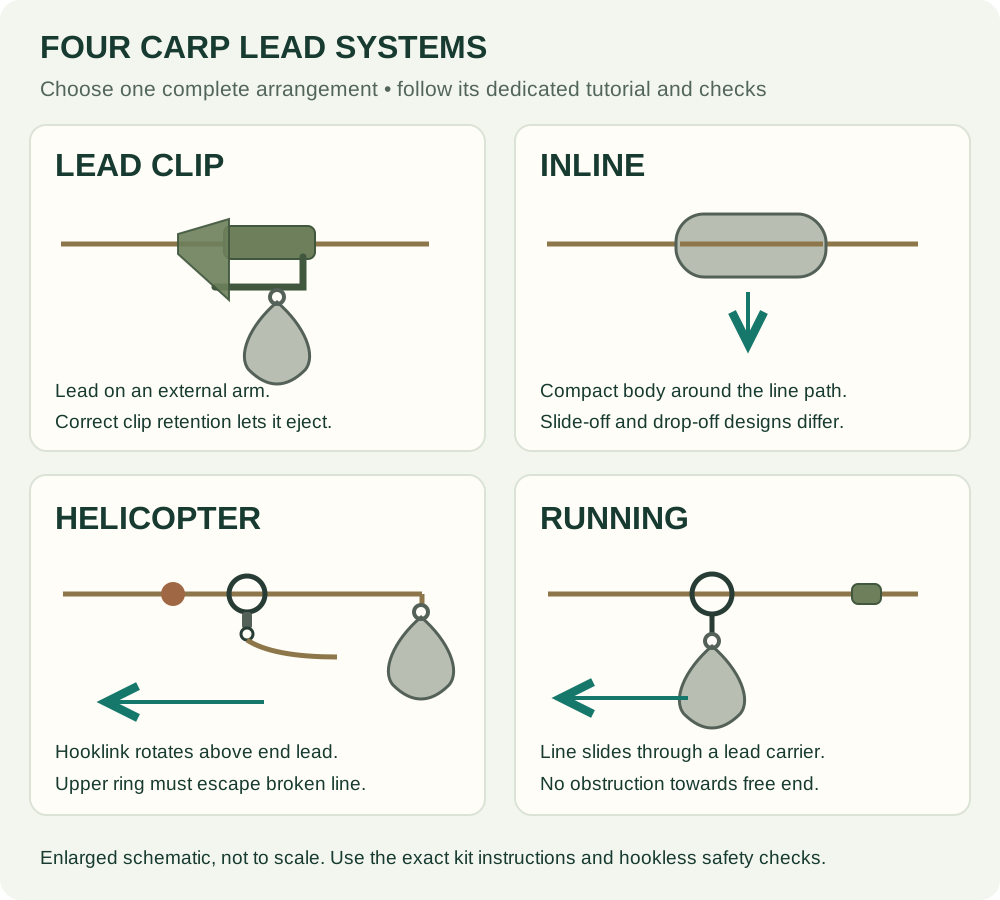
A lead clip is a versatile choice when the lead may need to release in weed. An inline lead gives compact, direct resistance and suits firm ground or solid PVA bags. A helicopter system casts well and can present over softer silt or light debris, provided the hooklink swivel and top-bead arrangement can separate after a break.
The correct choice depends on the lakebed, range, weed, snags, leader rules and the exact components being used. Follow fishery rules and the manufacturer's complete instructions. This guide explains the principles and comparison; it is not a licence to combine parts from different systems because they appear to fit.
Choose a complete setup, then build it step by step
The lead system is the connection between your main line, lead and bait-presenting hooklink. A hair rig or Ronnie rig describes the hook end; it doesn't tell you how the lead is attached. Learn those two parts separately, then test them together. Start with one complete, permitted system that suits the swim rather than buying several bags of similar-looking clips.
- Lead-clip tutorial: a matched clip, swivel, tubing and tail rubber, with the lead attached to an external arm.
- Inline tutorial: a specific Inline Safety Kit rig, plus the difference between a retained lead and a separating lead body.
- Helicopter tutorial: a naked-mainline example, with separate upper hooklink-release and lower lead-release mechanisms.
- Running-lead tutorial: a low-friction sliding carrier, buffer and terminal swivel, with no upper stop.
If you're learning at a clear, open-water venue, ask which of these arrangements it permits before choosing. Some fisheries insist on genuinely free-running tackle, while others require particular tubing or leader arrangements. There's no benefit in mastering an elegant setup that you can't use on your chosen water.
What makes a carp lead system safe?
Imagine the main line parting several metres above the lead. A safe arrangement gives the carp a reliable route away from the heavy lead and any leader, tubing or remaining line that could catch an obstacle. Exactly what must move depends on the design. A slogan such as “drop-off” cannot replace understanding that route.
With a conventional lead clip or compatible inline setup, the lead and related components are intended to come free or slide away under defined pressure. With a helicopter arrangement, the essential escape route is normally for the hooklink swivel to pass the upper bead and leave the broken main line or leader. A separate device may also eject the lead when weed or snags justify it.
The lead doesn't have to fall off during every normal fight to make every setup safe, and dropping it unnecessarily leaves metal in the lake. What matters is predictable behaviour for the conditions and breakage scenario. In dense weed, losing the lead can help a hooked carp rise and reduce snagging; on clear open water, a correctly assembled retained-lead system may be appropriate.
Safety is affected by every obstruction between the hooklink and the broken end. Knots, shock leaders, leadcore, fused leaders, beads, swivels, tubing and putty can block a component that moved freely on bare line. Test the complete permitted arrangement, not a lead clip on its own.
Safe carp lead systems must use compatible components
Use a designed system with the specified swivel size, clip, insert, bead, sleeve and tail rubber. “Size 8” is widely used but is not a promise that every brand has identical dimensions, tolerances or release pressure. A swivel that jams inside a clip or an insert that grips a leader knot can defeat the escape route.
Don't glue components, cut retainers, add extra stops or force a tail rubber farther on to prevent nuisance lead loss. If a correctly assembled system releases too easily, first check casting technique, lead shape, component damage and whether it suits the situation. Altering the safety mechanism to save leads transfers the risk to the fish.
Venue rules can prohibit leadcore, leaders, braided main line, fixed leads or particular clip arrangements. They may require tubing or a minimum line diameter. Read the current rules and ask the bailiff when wording is unclear. A safe setup elsewhere can be unsafe or unlawful under local conditions when a required component has been removed.
Lead clip systems explained
A lead clip holds a swivel at one end and accepts the lead swivel or loop on an external arm. A tail rubber covers the arm with controlled grip. During a take, snag or break, the lead can pull from the clip when resistance reaches the intended level. The hooklink remains attached to the swivel.
This system is popular because it casts neatly, changes lead size quickly and can be adjusted for open water or situations where shedding the lead is important. It can work with coated hooklinks, many bottom-bait and pop-up rigs and anti-tangle tubing where the complete combination is permitted.
When a lead clip is a sensible choice
Consider a lead clip over mixed ground, moderate weed and general fishing where a lead could become buried or trapped. It is useful when you want the lead to release during the fight so the carp rises above weed. The decision must be balanced against unnecessary lead loss and the venue's environmental rules.
The clip also suits anglers learning a straightforward semi-fixed arrangement, but only when they understand it. Our beginner carp-rig guide explains simple presentations; the lead system still needs its own maker's instructions and a separate breakage check.
Lead clip safety checks
Confirm that the specified swivel is retained as the particular clip requires. With the standard Korda Lead Clip Action Pack, the lead must leave the arm before the swivel pulls from the clip; an integral Hybrid swivel doesn't pull free. Don't use swivel release as a universal test for all clips. Check the retaining arm for damage and fit the correct tail rubber only as far as instructed. Wet parts when recommended rather than forcing them dry.
Thread leaders and tubing exactly as designed. If a knot or thicker leader is present, confirm the relevant parts can pass over it or detach before reaching it. Make a safe dummy assembly without a hook to understand the movement before taking it to the lake.
Common lead clip failures
Pushing the tail rubber hard against the clip to stop lead loss is a serious mistake. So is using an oversized swivel that cannot move, wrapping putty around the clip or replacing a purpose-made pin with an improvised stop. Damage can also occur after repeated casting, so inspect the arm and rubber rather than trusting an old setup indefinitely.
Inline lead systems explained
An inline lead carries the line or leader through its centre. The hooklink swivel normally sits in a compatible insert at the nose of the lead, creating direct resistance when a carp moves the hookbait. Compactness makes the arrangement particularly useful in a solid PVA bag.
On firm clay, gravel or a clean spot, an inline lead can sit close to the hooklink and provide efficient hooking mechanics. Over deep silt, the lead may sink and pull a short hooklink into an awkward angle. A different insert, longer hooklink or completely different system may suit that lakebed better.
When an inline lead is a sensible choice
Choose it for short to medium-range fishing on relatively firm ground, close-range margin work where everything can be placed accurately, or compact solid-bag fishing. The lead shape and total payload must remain suitable for the rod; test-curve labels don't state a guaranteed casting weight, as explained in our carp rod test-curve guide.
Inline lead safety checks
For a conventional retained inline lead, check that the specified connection releases as intended and that the lead can travel over every obstruction towards the broken end. A standard bare-line insert may not be appropriate with a leader knot. A dedicated separating design, such as the Korda Inline Safety Kit used in our tutorial, works differently: its lead body separates from its matched stem. The ring swivel is integral, so don't try to pull it out. Test the actual mechanism rather than applying one rule to every inline product.
A drop-off inline conversion is different from a normal retained inline lead. It is designed to separate the lead while retaining the line path, often for weed or bag work. Follow the exact instructions and confirm that the lead cannot remain trapped around a bulky leader join.
Common inline failures
The greatest danger is creating a fixed obstruction through the lead. An oversized knot, incompatible insert, bead, ring or damaged bore can prevent the lead passing. Gluing the insert or wedging the swivel more tightly to increase bolt effect can also turn a controlled semi-fixed setup into an unsafe fixed one.
Inspect the central bore after the lead strikes gravel or concrete. Damage and embedded debris can catch the line. If the lead, insert or sleeve is distorted, replace it rather than trying to open the bore with an improvised tool.
Helicopter lead systems explained
In a helicopter arrangement, the lead sits at the end of the line or leader while the hooklink swivel rotates around it between a lower position and a top bead. The hooklink can settle above the lead rather than being dragged directly behind it, which helps with long casts, soft silt and light debris.
The name describes how the hooklink revolves in flight; it doesn't guarantee breakage safety. If the main line parts, the hooklink swivel must be able to move past the top bead and off the remaining line or leader. A top bead fixed permanently above a large knot can leave the fish tethered to everything below it.
When a helicopter system is a sensible choice
It is valuable at range because the rotating hooklink resists tangles. Over soft silt or low weed, the upper bead can be positioned so the hooklink settles above the material rather than being pulled into it by the lead. The distance between lead and bead should reflect what is actually on the lakebed, not an arbitrary measurement copied from a video.
Chod-style hooklinks are often used on rotary systems, but a helicopter can also carry other suitable hooklinks. Rig choice, hookbait buoyancy and bead position must work together. Compare presentations in our guide to carp rigs for different situations.
Helicopter safety checks
Follow the instructions for the bead and leader material. Some safety beads are designed to release from a small collar; others must slide over a particular tapered sleeve. Verify that the hooklink swivel can pass every remaining item and the broken end without relying on the lead to pull it through.
If using leadcore or another leader is permitted, splice and assemble it only as its manufacturer specifies. Knots, thick splices and putty above the top bead may block release. When fishing directly on monofilament, check that line diameter still matches the chosen beads and sleeves.
Should a helicopter lead eject?
Not in every open-water situation, provided the hooklink has a dependable route off the broken line. In heavy weed or near safe-to-fish obstructions, a purpose-made helicopter lead-release device may help a hooked carp rise. This is a condition-led choice rather than permission to make every lead drop on every take.
A helicopter setup with a lead-release device still needs a releasing top bead. Ejecting the lead doesn't help if a fish remains attached to a leader that can catch a snag. Test both parts of the safety logic separately.
Running lead systems: the fourth useful option
A running lead is carried on a large, smooth eye or ring that can slide along the main line. A buffer protects the terminal knot and swivel, with the hooklink attached beyond it. As the fish moves, line can travel through the carrier without having to move the whole lead first. That is different from a semi-fixed arrangement that releases only after initial resistance.
The simple version suits a known clear spot in open water, where the carrier remains free and the line is not pinned through weed. It is also useful where the venue requires running leads. Don't add an upper stop to improve the bolt effect: that changes the arrangement and may create a trap after a break. A running setup doesn't automatically eject its lead; its escape route depends on the carrier passing off the broken line.
Use a purpose-designed carrier and buffer rather than expecting every lead's small swivel eye to slide equally well. Our running-lead assembly guide shows the order, the additional terminal swivel required and the two checks: free line movement in use, and unobstructed separation after a simulated break.
Which carp lead system suits your lakebed?
Firm gravel, clay and clean spots
An inline lead can give compact presentation and direct resistance on hard ground, while a lead clip remains a versatile alternative. A helicopter also works but may offer no special advantage when the hooklink can lie cleanly behind the lead. Choose based on range, bait delivery and the rig you can assemble reliably.
Which carp lead system suits a silty lakebed?
A helicopter system allows the lead to enter silt while the hooklink settles higher on the leader, provided the upper bead is adjusted to a sensible position. A lead clip or inline arrangement can still be used with a suitable lead and hooklink, but avoid a short rigid connection that is dragged into the sediment.
Weed
Where the area can be fished safely, losing the lead during the take may help direct the carp upwards. A correctly adjusted lead clip or compatible drop-off inline system can do this. A helicopter requires both a reliable top-bead release and, when necessary, a designed lead-ejection component.
Dense weed is not made safe by dropping a lead. Main line, hooklink, hook, rod angle and distance must allow control, and rods need constant attention. If a fish is likely to become buried or tethered before you can respond, don't fish that spot.
Solid PVA bags
An inline lead is commonly used because the hooklink and feed pack tightly around it. Use a compatible bag stem or insert and verify the breakage path after adding any leader. A short supple hooklink may behave well inside the parcel, but check the finished bag in the margin where possible.
Long-range casting
Helicopter systems are naturally resistant to tangles and suit aerodynamic leads. Lead clips can also cast effectively with anti-tangle tubing or an appropriate permitted leader. Inline systems remain possible, but a compact bag or carefully tied arrangement needs a casting load within the rod and line limits.
Leaders, tubing and naked setups
Anti-tangle tubing can protect fish from direct line contact and reduce tangles, yet its outside diameter can stop other parts passing after a break. Leadcore and fused leaders add abrasion resistance, weight and stiffness, but also create joins and thicker sections. None should be added automatically.
A “naked” setup uses the main line without a separate leader. It removes one join but still needs components sized for that line. Thin monofilament can pass through a bead that would release correctly on a thicker leader, so follow the stated diameter range and test the exact materials.
Never use a leader banned by the fishery. If shock leaders are mandatory for long casting, select a system designed to pass its knot or release below it. The safe response to uncertainty is to shorten the range or ask an experienced fishery or tackle-shop team member, not to improvise a smaller knot.
A Korda-led shopping list without buying four systems
Choose the single system that solves your immediate problem. The Korda Lead Clip Action Pack (paid link) includes its clips, tail rubbers, swivels and tubing; add a suitable swivel lead (paid link) and your finished hooklink. The Korda Inline Safety Kit (paid link) is a different complete lead, numbered insert and tail-rubber combination, not an extra part for the clip.
For the naked helicopter rig, the Korda Naked Chod Safety System (paid link) supplies the upper release components, but you also need the specified size-11 ring swivel (paid link) and a suitable terminal lead connection. The Korda Heli-Safe (paid link) controls the lower lead release; it cannot replace the upper safety bead. The Korda Running Rig kit (paid link) is the sliding-carrier option, with a separate matched terminal swivel as explained in its tutorial.
Amazon links are affiliate links; we may earn a commission from qualifying purchases. Check the exact model, contents and compatibility before ordering.
How to test a complete lead system safely
Start with the hook removed or protected and work on a short offcut of the exact main line and leader. Assemble every bead, sleeve, swivel, knot and tube used in fishing. Following the manufacturer's instructions, simulate a break above the system and watch whether the intended components detach or travel off the free end.
Use knot pullers or protected tools rather than wrapping line around fingers. Keep the lead low over a soft surface and direct components away from your face. High-strength line and spring-loaded parts can cause injury. The purpose is to confirm the route, not to perform an uncontrolled breaking-strain experiment.
Repeat the check after changing line diameter, leader knot, swivel brand, lead insert or bead. Test a wet assembly because some elastomers and knots behave differently after immersion. On the bank, inspect for grit, cracks, stretched rubbers and line damage before each cast.
Common unsafe lead-system mistakes
The first mistake is assuming every lead must eject or, at the other extreme, trying never to lose one. Safety is a designed response to the breakage and conditions. Understand whether your system releases the lead, the hooklink or both.
The second is mixing parts without testing. Similar-looking swivels and clips can have different tolerances. A top bead that releases on one collar may jam on another, and an inline sleeve intended for bare line may not pass a leader knot.
The third is adding putty, sinkers or stops in the escape path. Keep every required moving section clear. Putty used for presentation belongs where its failure cannot prevent the fish leaving the lead and leader.
Finally, no terminal arrangement compensates for weak main line, poor knots or an unfishable snag. Inspect line after every contact, pull-test knots using safe tools and move the rig when the landing route is doubtful.
Frequently asked questions
Which carp lead system is safest?
There's no universal winner. A lead clip, inline lead or helicopter can be safe when all parts are compatible, correctly assembled and suited to the venue. The essential question is what happens to the lead, hooklink and leader if the main line breaks.
Does a safe lead system always drop the lead?
No. Some safe arrangements allow the lead to pass off the line or the hooklink to leave a helicopter leader. In heavy weed, purposeful lead ejection can be beneficial, but automatic lead loss is not required in every open-water situation.
Can I mix lead-system brands?
Avoid doing so unless the manufacturers explicitly confirm compatibility and you can verify the complete escape route. Matching systems reduce uncertainty over swivel sizes, grip and release pressure.
Is a helicopter rig safe with leadcore?
It can be when the venue permits leadcore, the leader is correctly constructed and the hooklink swivel can release over the top bead and off the broken leader. A fixed bead or obstructive join can make it unsafe.
Final comparison
Choose a lead clip for versatile general fishing and controlled lead release, an inline lead for compact presentation on firm ground or in solid bags, a helicopter for suitable soft or lightly littered bottoms, and a running lead for a clear sliding line path in open water. Then verify the whole setup with the exact line, leader and parts rather than relying on the category name.
Before casting, make sure you can explain what releases if the line breaks. Check that the parts fit, the knots hold and the setup meets the fishery rules. If you're unsure, ask someone qualified to look at it with you. Getting one simple lead system right is more useful than carrying several you haven't properly checked.