
Start with the bottom, the hookbait and how you will land the fish. If you’re fishing a sinking bait on a clear spot, start with a simple hair rig. Here are 12 options for when you need a different bait height, a different casting method or more control of where the rig settles.
Clear bottom: start with the simplest presentation
- Knotless-knot hair rig: fish a sinking bait on confirmed clear gravel, sand or firm silt. Learn the hair rig first.
- Stiff bottom-bait rig: try a suitable stiff hooklink if you want the bait to settle away from the lead over clean, firm ground. Check that it can settle naturally.
- Claw-style bottom-bait rig: use a known pattern and kicker arrangement on a clean spot. See the kicker and line-aligner guide for how the exit angle changes.
- Blowback: try a blowback rig when you want the moving hair ring. Check the ring can travel and the point remains clear. It cannot guarantee that the rig resets after every disturbance.
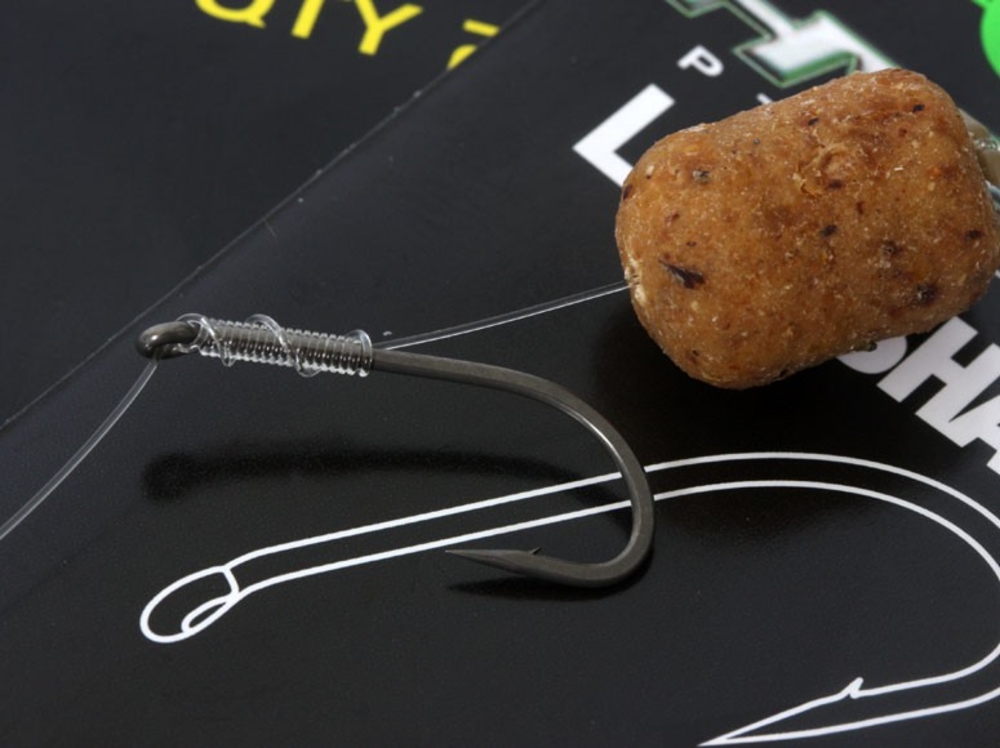
When the choice is between a basic hair rig and a blowback, look at what holds the hair beside the hook. On the blowback, the ring has room to travel on the shank. Fit the actual bait and move the hair ring gently along the shank. If the hair has wrapped round the hook on the retrieve, clear it and check the length and movement again. If the bait is sitting cleanly on an ordinary hair and the spot is firm, you have a good reason to keep fishing it.

Claw or stiff hooklink? A stiff bottom-bait hooklink helps hold a sinking bait out from the lead. Over a clean, hard patch you can test that with a plain boilie and watch whether the hooklink settles straight. A claw-style kicker does a different job: it changes the angle where the hooklink leaves the hook eye. Check the kicker has stayed in place after changing the hookbait. Adding the kicker does nothing to help a rigid hooklink lie flat across a twig.
A slow-settling bait or a small parcel of feed
- Snowman: match a sinking bait and a smaller buoyant bait so the pair settles as expected. Check the actual hook and hair in water and make sure the baits don’t hide the point.
- KD: the hair leaves high near the eye. Try the wafter KD where the hook can sit on a clean spot, or follow the separate counterweighted pop-up instructions.
- Solid PVA bag: use a dry solid bag to cast the feed and a short rig together. Choose a spot it can land on and open cleanly; it can bury in soft silt or hang up in thick weed. The Korda Solidz medium PVA bag system (paid link) is an example to compare if you want to practise filling a small bag.
The snowman describes the pair of baits. Thread the sinking boilie first and put the smaller buoyant one above it. Test the pair on the hair in water; the lower boilie should still settle where you mean to fish it. A solid bag solves a different problem: it takes a compact parcel of feed and the rig to the spot together. You can try a different hookbait without changing how you deliver the feed.
Hold a pop-up above light debris
- Spinner or Ronnie: use a purpose-made spinner swivel for a low pop-up over suitable clear ground or very light debris. The traditional 360 uses a different construction.
- Multi rig: a multi rig gives you a way to change a hook while keeping a sound hooklink. Confirm that the bait and loop stay put when you cast and retrieve.
- Hinged stiff rig: see the hinged stiff rig when a pop-up hook section on a boom suits the spot. Give the chosen hinge room to settle and check the bait supports it.
- Chod: use a chod for a short stiff pop-up section on a compatible, permitted setup over light weed or debris. Check that the hooklink can escape after a break. No rig makes a dense weedbed safely fishable.
Lay an unbaited chod and a hinged stiff rig side by side before choosing between them. For a ready-tied example, the Korda long barbed size 6 chod section (paid link) is the short hook section only. Check that your water permits barbed hooks before considering it. The hinged rig has a separate boom between the hook section and the lead end; give that boom somewhere it can settle without straddling a clump of weed. On a compatible chod arrangement the short hook section instead moves along its permitted length of main line or leader. For either choice, the test is whether the pop-up clears the debris you found and the full system can release as designed.
Spinner or multi rig? Pick up the baited spinner by the boom and check the hook can turn on its purpose-made swivel. Counterweight pressed over the moving joint defeats that movement. On a multi rig, the useful feature is the loop that lets you change a dulled hook. Check the hooklink for damage first; if it is sound, fit the replacement hook, form the D again and retest the bait height. A fresh hook is no remedy for a frayed hooklink.
When carp are above the bottom
The twelfth choice is the zig rig. Use it at a measured depth in clear water if you have signs the carp are above the lakebed. Learn one fixed or adjustable system and follow its own instructions and venue rules. You can return to the bottom if that is where the signs are.
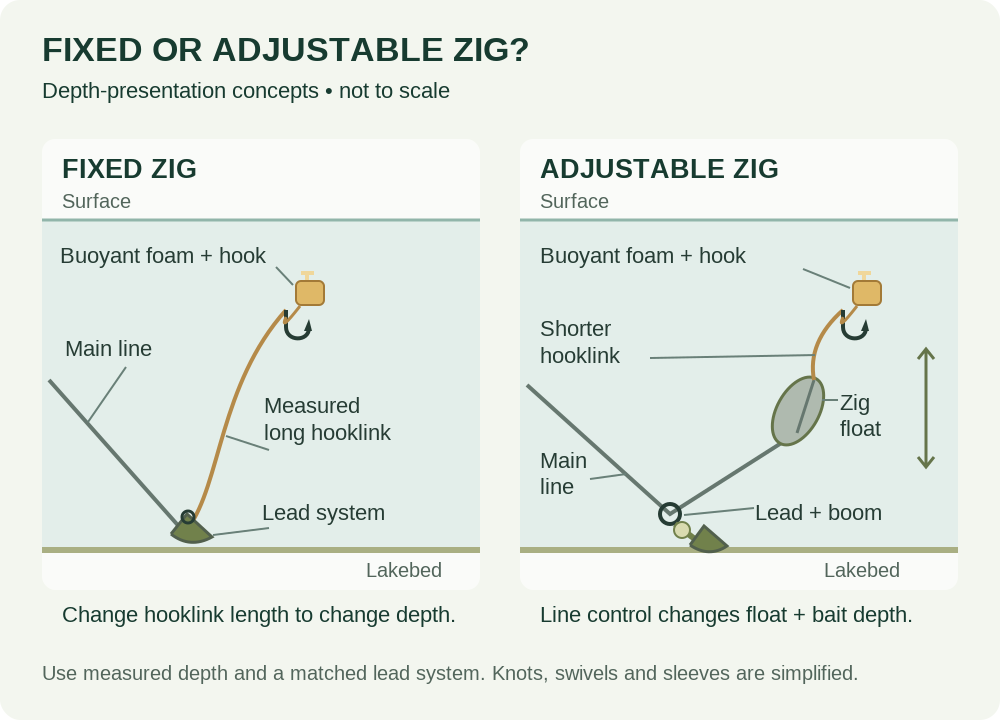
Keep the reference point in your notebook. In water measured at 8ft, a 6ft fixed zig held upright places a buoyant hookbait roughly 2ft below the surface. With an adjustable setup, the float is brought to the surface first and the bait depth is set down from there, following that system’s instructions. Once the lead is on the bottom, you can try another depth without winding the whole rig in and casting again. Write “2ft below the surface”, not just “2ft”; that way you can repeat the presentation with either system.
Make the final check with the complete setup
Compare the bait height, point clearance and line-break behaviour for the full arrangement. Use the illustrated beginner rig guide if you want component lists, and the lead-system guide to check how the other end works. If you can’t get a reliable test or land a fish from the spot, choose a simpler place to fish.