
A chod rig holds a pop-up on a short, stiff hooklink above light weed or debris. It can be useful if that is what your spot needs and you still have a safe route to the net. Choose a complete, permitted system first. Then check the bait’s buoyancy and how the hook section could get free if the line breaks.
Try this in good light with the hook point protected. Look at the hooklink swivel and trace its route up the line. Follow the maker’s line-break check: the swivel must be able to leave the broken line or leader as the system intends. A lead dropping at the other end proves nothing about a trapped swivel. If it cannot get past a bead or junction, don’t cast that setup.
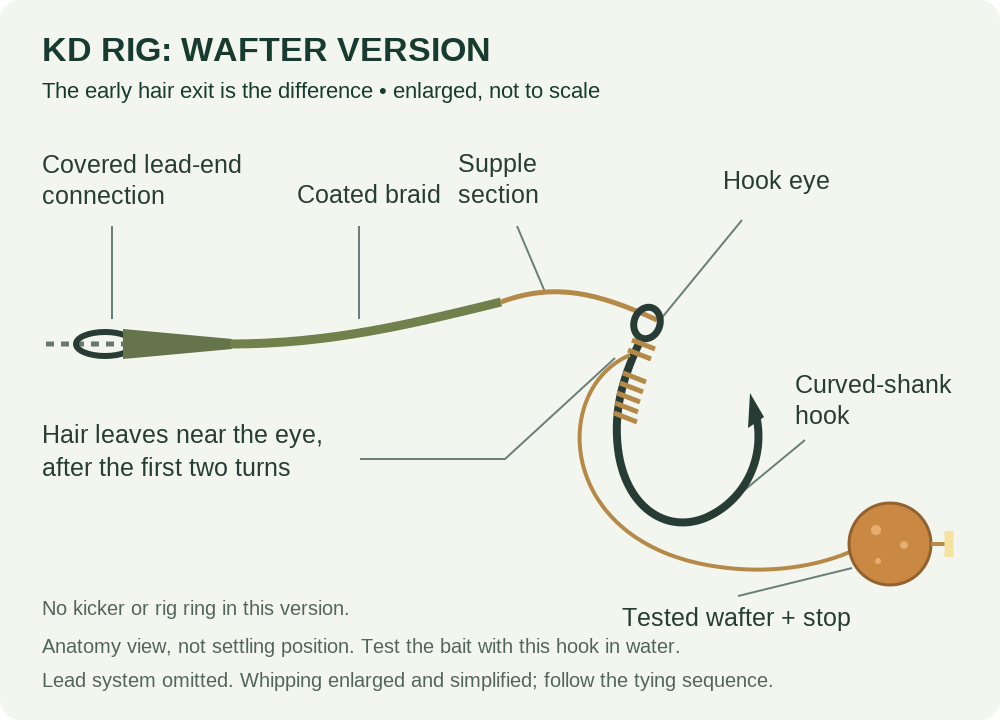
For a labelled anatomy reference and the current Korda-led component checklist, see the illustrated dedicated chod-rig guide in our beginner overview. Check which version of the chod rig you’re tying before changing the hooklink material, knots or swivels.
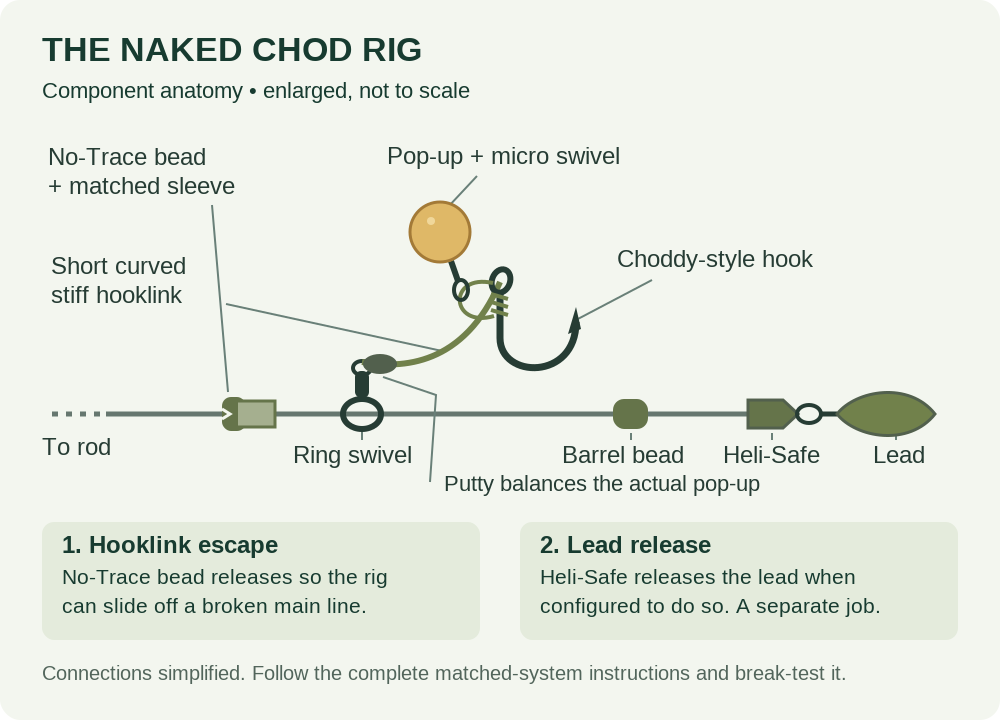
When is a chod rig a good choice?
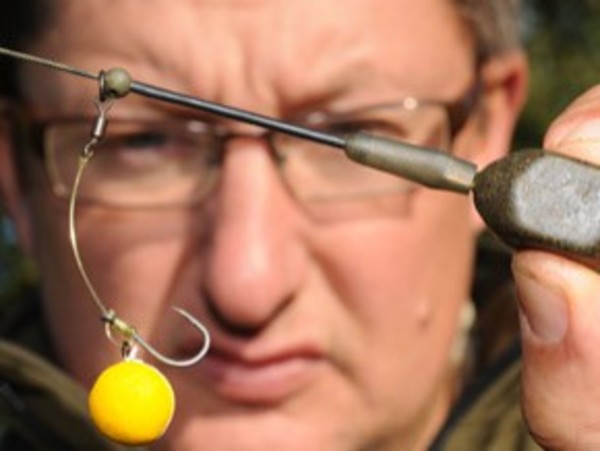
A chod rig is worth considering when a pop-up needs to sit above light leaves, low debris or a suitable soft bottom. The short hook section moves on a helicopter arrangement, with the lead at the end of the line. That lets the lead settle separately from the hookbait.
It is not a way to avoid learning about the spot. A rig that sits above debris can still leave a hooked fish facing roots, thick weed or an unsafe landing route. If you cannot bring a fish to the net safely, choose another area.
| What you find | A useful next step |
|---|---|
| Light leaves or a soft, fishable patch | Consider a chod, then check its balance and complete release arrangement. |
| A confirmed clean, firm spot | A familiar hair rig may be simpler. A chod is an option, not a requirement. |
| Dense weed, roots or a blocked landing route | Find another spot. Changing the rig does not solve the landing problem. |
| You do not know what is below the surface | Watch and investigate where safe and permitted. Use our marker-float guide to help. |
What do you need for a chod rig?
There are two parts to get right: the short hook section and the system carrying it on your main line or leader. Buying a ready-tied hook section only takes care of the first part.
- A chod hook with an out-turned eye, matched stiff chod filament and the ring swivel specified for that version.
- A buoyant pop-up, a suitable bait attachment and any counterweight the finished setup needs.
- One complete, compatible chod or helicopter safety system, with the correct bead, sleeve and line-protection parts.
- Suitable main line, a permitted lead arrangement and a clear route to land the fish.
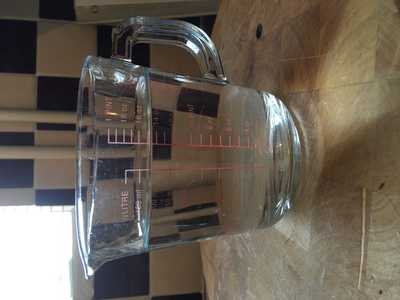
- Scissors, knot-testing tools and a container of lake water for checking the finished presentation.
Our illustrated chod component list shows one version. Follow that version throughout. A generic swivel assortment is not a substitute for the specified ring swivel and safety-system parts.
If you are new to tying chods, a Korda ready-tied chod hook section (paid link) is one option. This linked variant is long, size 6 and barbed: use it only where that hook type and size are allowed. It still needs a suitable pop-up and a correctly assembled complete system.
Naked chod or leader: what is the difference?
A naked chod runs on the main line; the other version uses a purpose-made leader. For either one, check the line diameter and use the beads, sleeves and swivels listed in its instructions. For the naked version, the Korda Naked Chod Safety System (paid link) is a dedicated set. Follow its instructions for the main line and bead arrangement.
Start with the fishery rules. If leaders are banned, do not use a leadcore version. A naked arrangement needs its own compatible parts to protect the main line and let the hook section escape after a break. Fluorocarbon is not compulsory for every naked system; follow the maker's line requirements.
How to put a chod setup together
- Choose one complete version. Lay out its instructions and parts. Keep naked and leader components separate.
- Prepare the hook section. Use an undamaged ready-tied section or follow the manufacturer's illustrated tying sequence. Check knots, the curve, hook point and free movement of the bait attachment.
- Mount it on the matched safety system. Follow the exact component order and line limits. The upper bead must release as intended; do not glue or jam it to make it stay in place.
- Fit the permitted lead arrangement. Check how the lead is attached and whether the rod and line can handle the full casting load. Lead release and hooklink escape are separate checks.
- Add the pop-up and test the balance. Use the actual bait, hook and counterweight you will cast, not a bare hook section.
Set the bead position for the system you are using and the bottom you have found. If you are unsure how the bait will settle or how the hooklink comes free, ask the fishery or an experienced angling coach to check it with you.
On a ready-tied hook section, look along the filament from the swivel towards the hook eye. You want to recognise the smooth curve intended for that pattern. Stiff chod filament holds its shape, so a sharp kink from storage may still be there after casting. Compare it with an undamaged section of the same pattern before fitting a bait. The out-turned eye on a dedicated chod hook lets that stiff filament continue along the curve.
How do you balance a chod rig pop-up?
The pop-up must support the hook section. The finished presentation should settle gently rather than float away or plunge into the debris. Test it in a clear container of lake water so you can see what happens.
If a bait works straight from the tub but the hook section lies flat when you retrieve it, keep a second bait from the same batch soaking in a tub of lake water. Test that one on the same hook section. You can then see whether lost buoyancy over time accounts for the change before adding or removing putty. When fishing over light debris, a small scattering of permitted whole boilies also lets you fish the pop-up among separate mouthfuls without building a heap around the hook.
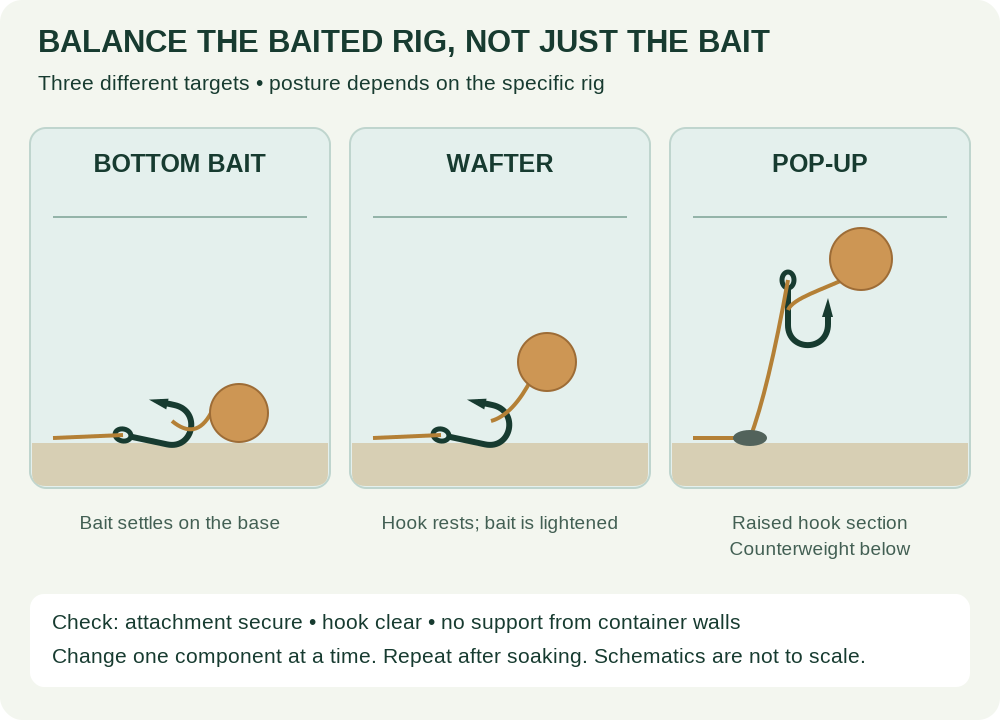
Start with the complete baited section and its intended counterweight. If it sinks heavily, reduce the counterweight or choose a more buoyant bait as appropriate to that version. If it remains floating, adjust the counterweight in small steps. If the rig calls for tungsten putty, Korda Dark Matter putty (paid link) is one example. Keep it clear of moving and releasing parts.
Leave the bait soaking long enough to see whether it still supports the hook section later. Keep checking it as you fish too, since a clear container can only show part of what happens on the lakebed.
Five checks before you cast
- Spot: you understand the bottom well enough to choose the presentation, and the landing route is clear.
- Hook and line: the point is sound, the knots hold and there are no damaged or kinked sections.
- Movement: the bait attachment and rig swivel move as the design requires, without trapped putty or debris.
- Balance: the soaked pop-up still supports the hook section and the presentation settles gently.
- Escape: on a spare, unhooked test length, follow the system maker's broken-line check. Check that the hooklink can escape the upper bead and leave the broken main line or leader, including past any knot joining the main line to a leader. Dropping the lead alone is not enough.
Remake the test length afterwards; do not fish with a line you have cut or damaged for a demonstration. If any release part sticks or its compatibility is uncertain, stop and correct it. Our lead-system guide explains the different escape routes.
Common chod-rig problems
| Problem | What to check |
|---|---|
| The pop-up sinks hard | Its buoyancy after soaking, the hook size and the amount of counterweight. |
| The hooklink cannot leave the line | Bead and sleeve compatibility, line diameter, knots and trapped components. Do not fish it until the escape check works. |
| The rig comes back tangled | The bait attachment, damaged filament and casting control. Chods can tangle; use the tangle checklist rather than assuming the rig name rules it out. |
| It looks right but there are no bites | Look for fish and feeding signs. A well-presented rig cannot make fish visit the spot. |
Chod-rig questions
How long should a chod hooklink be?
Use the length specified for the version you are following and the bait height you need. Short and long ready-tied versions exist. Making it as short as possible is not a useful rule for every bait, hook and spot.
Should you always fish slack lines?
No. Avoid pulling the presentation out of place, but keep effective bite indication and control. The right tension depends on the range, line route and conditions. A large slack loop near a hazard is not a solution.
Does a chod rig stop tangles or guarantee a fish?
No. It offers a useful way to present a pop-up on suitable ground. Balance, assembly, casting and finding fish still matter. Inspect what comes back and make one useful adjustment at a time.
Sources and how to use this guide
We’ve put this guide together from the manufacturer instructions linked below. Use those for the exact parts and tying sequence, alongside the diagram here to identify the components. We haven’t carried out a new tackle or catch test. The references were checked on 7 November 2026. Korda's chod-system explanation; naked chod instructions; No-Trace bead guidance.