Buying a carp landing net? A 42-inch net is a common UK starting point, but check your fishery's rules before ordering. Soft mesh, a sound spreader block and a handle that safely reaches beyond the margin matter too. Here's what to look for.
A larger number doesn't automatically make a net safer. The angler must be able to move the frame accurately, draw a tired carp over the cord without chasing it, collapse the frame and transfer the fish while its body remains fully supported. A huge flexible frame or over-extended handle can be harder to control than a well-proportioned all-round net.
Affiliate disclosure: this guide contains three Amazon UK affiliate links. CarpAnswers may earn a commission from qualifying purchases at no extra cost to you. Check current dimensions, materials, warranty and seller information, and treat the fishery's rules as the controlling requirement.
What size landing net for carp suits your venue?
Start with a 42-inch carp net if you want one conventional net for mixed UK stillwaters. Choose a rigid two-piece or one-piece handle that reaches the fish without leaning dangerously, medium-depth soft mesh that contains the carp without excessive drag, and a block that lets the arms be removed smoothly at the water's edge.
Move away from that default only for a defined reason. A water may mandate another minimum, a compact stalking swim may require a shorter handle, a high or heavily vegetated bank may need more reach, and a boat requires a different safe geometry. Never select a swim where the intended fish cannot be landed and transferred safely.
What does 42 inches actually describe?
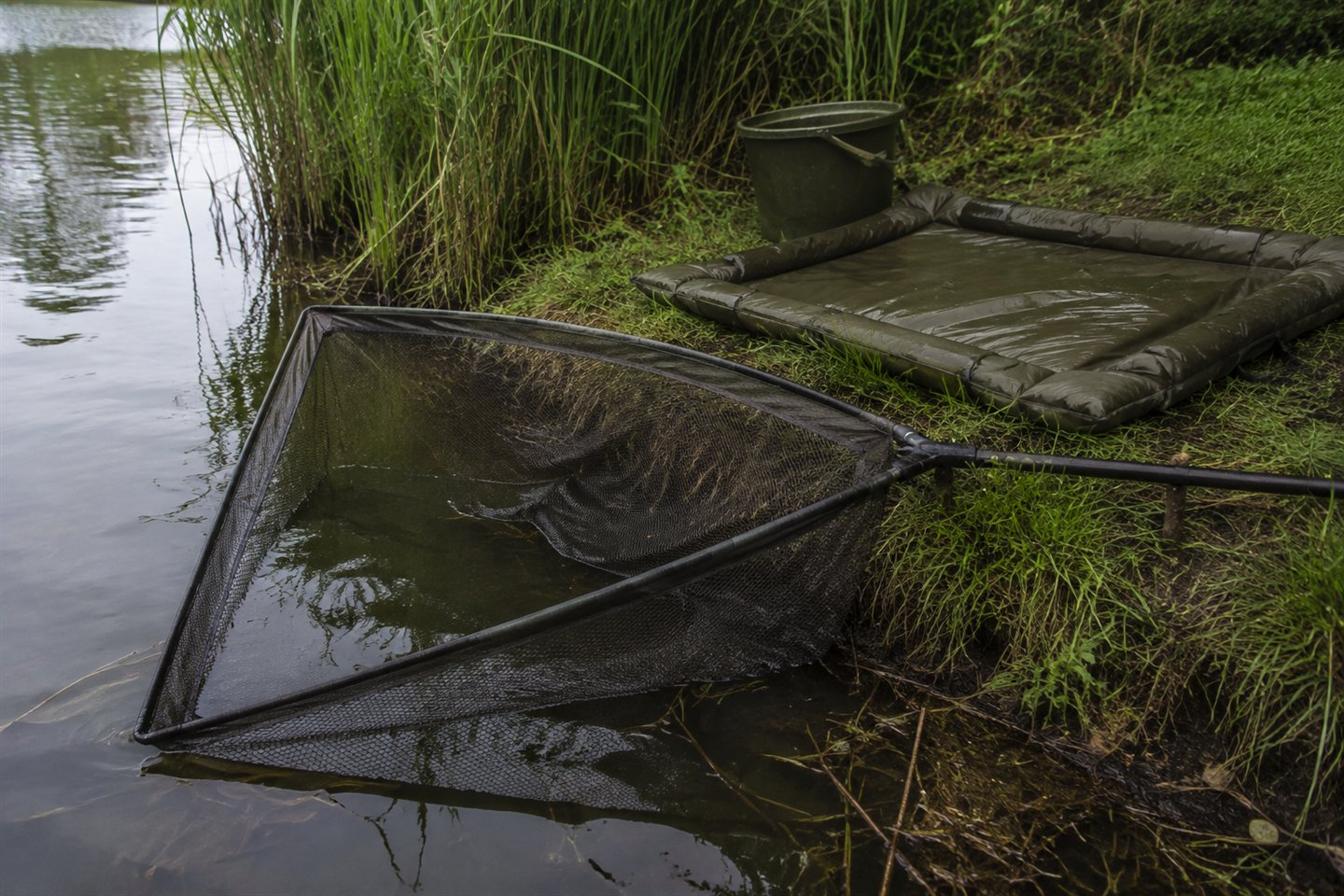
In carp tackle, the quoted size normally refers to the approximate length of each landing-net arm rather than the width of a rigid circular hoop. Two arms enter a central spreader block and are joined by a front cord, creating a triangular opening. Actual mouth width and depth vary with the arm curve, cord and mesh.
That's why two products labelled 42 inches may not feel identical. Compare official assembled dimensions where provided, then consider mesh depth and block design. Check the assembled dimensions and handling, not just the size printed on the bag.
Don't estimate suitability from a carp's weight alone. Body length, depth, condition, water access and control at the cord all matter, while a fish can turn as it reaches the net. The goal is an opening that accepts the carp without folding fins or forcing repeated attempts.
Is a 42 inch landing net big enough for carp?
For the carp encountered on most UK commercial and club waters, a sound 42-inch carp net is widely used as an all-round size. Korda's current landing-net guidance describes 42 inches as sufficient for almost all UK carp fishing, while still directing anglers to the rules and practical requirements of their venue.
That statement should not become a promise about every fish or location. Specialist waters may set a larger minimum, and access can make an otherwise adequate frame unsuitable. Check the rulebook before travelling and ask the fishery if the wording is unclear.
A smaller specimen or coarse net may look adequate for a modest carp, but short arms, shallow mesh or light fittings can make a late surge difficult to contain. If carp are a realistic target rather than an accidental capture, use purpose-suited tackle from the start.
Fish-friendly mesh matters
Choose soft knotless mesh intended for landing fish. It should contain the carp without rough material, damaged seams or openings likely to catch fins and terminal tackle. Run damp hands over the mesh and cord before use, checking for stiff repairs, sharp debris and split stitching.
Fine mesh reduces the chance of fins or small components entering large openings, but it creates more water resistance. Coarser mesh moves more freely through water but deserves careful inspection around pectoral and pelvic fins. Many carp nets combine finer mesh around the lower section with freer-flowing material elsewhere.
Depth is a balance. Sufficient mesh helps keep the fish contained in water after netting, while an excessively deep bag can twist, collect weed and complicate a supported transfer. A very shallow mesh gives less enclosure when a carp rolls near the cord.
Dark mesh may be less visually intrusive, but colour cannot establish fish safety. Softness, condition, seam quality, appropriate opening size and clean use are the important checks. Replace a mesh that has become brittle, torn or contaminated rather than waiting for it to fail during a landing.
How long should a carp landing net handle be?
Around six feet is a common all-round handle length because it gives reach from an ordinary bank without becoming unwieldy. A two-piece design can be used at its shorter length for tight stalking swims if the maker permits, then assembled fully for open banks. One-piece handles remove a central joint but require more transport length.
More reach increases leverage. Extending a telescopic handle beyond its marked or instructed limit, or lifting downwards against the bank, can damage it. Use the handle to guide the frame through water, not to raise the full weight of a carp clear of it.
On a high bank, a very long handle doesn't make an unsafe edge acceptable. Find a lower landing point, arrange competent assistance where allowed or choose another swim. Don't lean out, step into unknown depth or climb unstable reinforcement to reach a fish.
Transport also matters. Measure the closed section against a rod holdall, car and barrow. Check joint type, locking action and replacement availability before you NGT 3m landing-net handle (paid link). The longest listed handle is not the best if its joints move or the angler cannot place it accurately.
Spreader blocks, arms and front cords
The spreader block connects the handle and arms while carrying considerable load as the net changes direction. Moulded composite blocks can be light; metal blocks may feel more substantial. Material alone doesn't establish strength, so inspect the sockets, thread or quick connector and the junction with the handle.
Arms should flex enough to form the opening without feeling cracked, crushed or uneven. Seat both ends fully in their sockets before casting. The front cord must be intact and at the correct length, because an altered cord changes the frame shape and the depth at which the mouth can be presented.
Practise removing an arm from the block while the empty mesh remains in the water. Some blocks release easily after tension is relaxed; others have a defined mechanism. Follow the product instructions rather than forcing carbon or composite arms sideways.
Match the net to the venue
Read the fishery rules for minimum net size, approved mesh, net-dip procedures and whether nets must arrive dry. Some venues supply landing and unhooking equipment to manage biosecurity. Their local rule overrides a generic recommendation and may change at short notice.
Walk from the rods to the intended landing point before fishing. Look for reeds, sharp stones, wire, steep mud, drop-offs and platform edges. The handle must reach open water while the angler remains on stable ground, and there must be a clear route to a wet unhooking mat or cradle.
At a small open commercial lake, an ordinary 42-inch frame and six-foot handle may be straightforward. Dense marginal lilies can require a controllable longer reach, but only where a hooked carp can be guided into a clear channel. If every approach drags the fish through stems, change the fishing position.
On rivers, flow increases pressure on the mesh. Present the opening so water doesn't balloon the net uncontrollably, and bring the carp into a quieter accessible margin. Never enter strong or unknown flow merely because the handle will not reach.
Bank fishing, stalking and boat use
A standard bank setup benefits from full reach and a prepared net lying where it can be picked up without stepping over rods. For close stalking, a shorter or two-piece handle may be easier among vegetation. Retain a full carp-sized frame unless the actual rules and expected fish make another choice appropriate.
From a boat, long handles can be cumbersome and place leverage against the gunwale. Use only equipment and procedures approved for that water, wear the required buoyancy aid and keep the frame controlled inside the safe working area. Boat access is never permission to pursue a fish into an unsafe hazard.
Where snags complicate the landing route, solve the route before placing a rig. The safe snag-fishing guide explains buffer distances and stop rules. A larger net cannot compensate for a line from which hooked fish repeatedly reach branches or cables.
Check the net before every cast
Assemble the handle, block and arms and pull gently on each joint. Inspect mesh seams, front cord and arm ends. Confirm that a replacement joint or repaired area doesn't have a sharp edge, then wet the mesh before it contacts a fish.
Place the open net beside the chosen landing point with the handle accessible and the mesh free of hooks, forceps and luggage. Prepare a properly wetted unhooking mat or cradle, water container, forceps and sling at the same time. Our complete carp-care guide covers the full sequence.
Keep spare rods and lines away from the path. At night, establish the route in daylight and keep a headtorch ready. A net still tied in a stink bag after a bite is not ready, regardless of its specification.
If you're assembling a first complete setup, NGT 42-inch carp landing net (paid link) by mesh, handle reach, spreader-block design, replacement parts and packed length. Confirm that the listing includes every component pictured.
How to net a carp safely
Play the carp until it is under control and ready to come over the cord. Place the net in the water early, with the opening below the surface and enough mesh behind it to receive the fish. Keep the frame relatively still rather than chasing every movement.
Guide the carp towards the opening head first. Draw it over the front cord using the rod, then raise the arms only enough to close the route out once the whole fish is above the mesh. Don't stab at the fish or push the cord into its flank.
If the carp turns away strongly, let it move under controlled pressure and prepare again. Forcing a green fish over the net can lead to tangles around fins, broken tackle or an angler losing balance. The final approach should be deliberate rather than rushed.
Keep the line and lead outside the mesh where practical, but never place hands near a loaded hook while the carp is moving. Once the fish is contained, reduce tension and secure the rod safely. Check where the hook and lead have settled before reaching around the frame.
A companion can net the fish, but communicate the intended approach. The person holding the rod guides the head; the netter maintains the opening. Sweeping the frame independently against the line creates avoidable confusion.
Never lift a carp in an assembled landing net
A landing-net handle and spreader block are designed to guide a frame through water, not to act as a crane. Lifting a carp with the handle horizontal concentrates weight at the block and allows the fish to fold in hanging mesh. It can break equipment and injure the fish.
Once the carp is secure in the water, lay the handle safely, release the tension in the arms and remove them from the spreader block as designed. Roll or gather the mesh so the carp's body is supported, ensure fins lie flat against the body and use both hands for a short controlled transfer.
If the route to the mat is more than a safe step or two, transfer the carp into a wetted retention or weigh sling in the water according to the fishery's practice. Don't drag loaded mesh along gravel, and never carry the fish by the front cord.
From landing net to unhooking mat
The unhooking area must already be wet, level and free from stones or tackle. Place the supported fish centrally, keep it low and cover its eyes with wet material if that helps calm it without obstructing the gills. Stay beside it throughout.
Locate the hook before pulling line or mesh. If the rig has tangled, cut line or mesh when that is the safest way to remove tension; replace damaged equipment later. Support fins flat to the body as the net is withdrawn.
Use suitable forceps and minimise air exposure. Wet hands before touching the carp and never stand while holding it. The guide to carp unhooking cradles explains how different mat designs contain movement and protect the fish from hard ground.
If the carp needs weighing, zero a wet sling and use sound scales. Don't weigh in the landing net; its mesh and frame are not designed as a secure weighing enclosure. See the carp-fishing scales guide for suitable features.
Return the fish promptly in a proper sling or supported mesh, following local rules. Hold it upright in well-oxygenated water until it maintains balance and swims away strongly. Don't use the landing-net handle to suspend it during recovery.
Clean, dry and store the net
Wet nets can transfer organisms and fish disease between waters. Follow every venue's dip or quarantine process and the Check, Clean, Dry approach. The Environment Agency advises keeping tackle clean and dry between trips, while some fisheries require nets to arrive fully dry or provide their own.
Remove weed, mud and fish debris, clean as directed and hang the mesh open until every layer is dry. Pay attention to seams and the bottom of deep mesh. A zipped stink bag contains water and odour in transport but is not a place to leave a damp net between sessions.
Store arms without crushing or bending them and protect the handle thread and block. Keep mesh away from rodents, hooks and direct heat. Before travelling to another water, inspect the dry equipment again and follow any stricter site-specific treatment.
If transport is the problem, SPEERO landing-net stink sleeve (paid link) by fully opened drying access, seam construction and packed length. A waterproof carrier helps the journey home; it doesn't replace cleaning and complete drying.
When to replace the mesh or hardware
Replace mesh with torn seams, brittle fibres, holes that can catch fins or repairs that leave rough edges. Use the exact compatible replacement where possible because depth, arm sleeves and front-cord length affect the assembled frame.
Stop using arms that are split, crushed or separating at the ends. Check a loose spreader block and moving handle joint against the manufacturer's service advice. Don't rely on tape to carry the load of a live fish beside deep water.
Inspect after an accidental snag, heavy weed or a dropped bag even if no damage is obvious. Assemble and pull-test the empty frame at home. Replacement before failure is less costly than losing control during a landing.
Common buying mistakes
The first is buying a net-size label without checking what is included. Some listings are complete sets; others are a mesh, handle or net head only. Read the contents, assembled dimensions and replacement-part information.
The second is choosing maximum handle length without considering stiffness, joints or bank safety. Reach is valuable only when the frame remains controllable. A planned accessible landing point is better than extending weak equipment from a dangerous edge.
The third is treating fish-care accessories separately. Net, mat or cradle, forceps, sling and water container form one landing system. A premium frame cannot protect a carp if the mat is folded away or the route crosses hard debris.
Finally, don't assume an online recommendation overrides local rules. Check the venue before each trip, especially when visiting a water with supplied nets, disinfection procedures or a stated minimum size.
Frequently asked questions
36 inch or 42 inch net for carp fishing?
It may contain smaller carp in suitable conditions, but it is not the most versatile dedicated choice for general UK carp fishing. A 42-inch carp net gives a more useful all-round opening and is more likely to satisfy venue rules. Check the specific water.
Do I need a 50-inch carp net?
Not for most ordinary UK situations. A larger specialist frame can provide more opening but also adds mesh, wind and water resistance and may be harder to control. Use one where the fishery, expected fish and access provide a clear reason.
Is a one-piece or two-piece handle better?
A one-piece handle removes a joint and can feel direct; a two-piece handle packs shorter and may offer a compact stalking length. Build quality, safe reach and transport decide. Never use a detachable section in a way the maker doesn't permit.
Can I weigh a carp in the landing net?
No. Transfer it to a suitable wetted weigh sling, ensure fins are positioned safely and zero the sling before weighing. Landing-net mesh, arms and cords are not a controlled weighing system.
Can I keep a carp in the net while I prepare the camera?
All care equipment should be ready before casting. Any brief in-water pause must keep the fish upright, attended and safe, but it should not become avoidable retention. Follow the fishery's rules and prioritise a prompt unhooking and return.
Final verdict
A 42-inch, soft-mesh carp landing net with a dependable block and roughly six feet of controllable reach is the practical UK default. Confirm the venue rule and choose another size or handle only when access, expected fish or a defined fishing method requires it.
Have the net ready before casting. Guide the carp head first over the cord, then collapse the arms for a fully supported transfer. Follow the venue's cleaning rules and dry the mesh completely between waters. A suitable net and a calm landing routine are far more useful than buying a bigger frame you struggle to handle.