A size 4 carp hook is usually bigger than a size 8, but the number doesn't tell the whole story. Patterns and brands vary. Here's how to compare the gape, wire and shape with your bait, so the finished rig works as it should.
Choose a hook by looking at the complete presentation rather than copying a number from a catch report. It must be permitted by the fishery, suit the hooklink and rig mechanics, balance the hookbait, remain sharp on the lakebed and be strong enough for the water without becoming unnecessarily heavy. The safest decision is made with the exact components in front of you and the finished rig tested before casting.
Which carp hook size should you use with your bait?
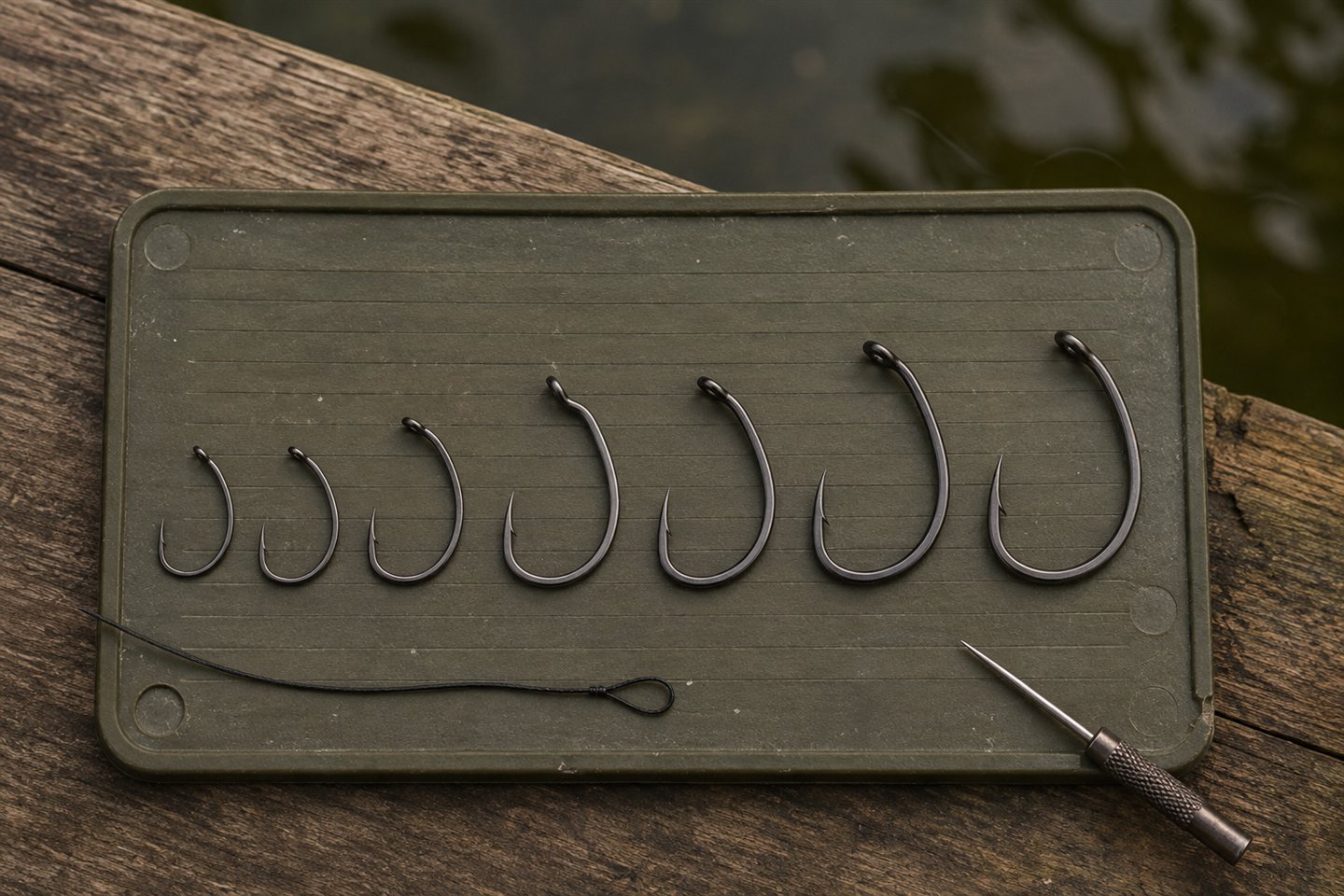
Carp hooks are commonly sold in numbered sizes such as 2, 4, 6, 8 and 10. Within a single pattern and manufacturer, the lower number generally means the larger hook. That inverse scale is useful when comparing two sizes of the same model, but it should not be treated like millimetres. There's no guarantee that every maker's size 6 has the same gape or length.
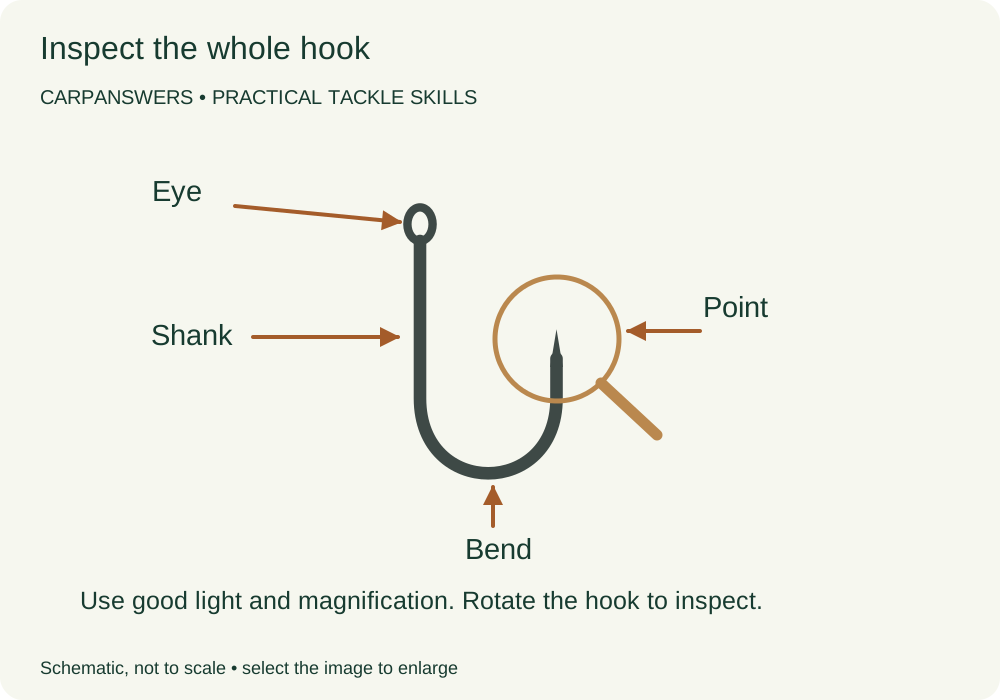
The pattern is at least as important as the number. It brings together the gape, shank, bend, point and eye. A short-shanked wide-gape hook presents differently from a long, curved pattern even when their packet sizes match. An out-turned eye can continue the curve of a stiff hooklink, while an in-turned eye changes the angle at which a supple hooklink leaves the hook.
Wire gauge adds another variable. Standard and heavier X versions of the same pattern may share the outline but not the weight or diameter. A stepped-up hook can be appropriate with balanced strong tackle in weed or demanding conditions, yet the extra metal can alter a critically balanced pop-up. Stronger is not automatically better when the whole setup and fishing situation don't require it.
Why hook sizes are not standard across brands
Hook numbers are a rough guide, so compare the actual hooks as well. Manufacturers develop hooks around different bends and proportions, so a compact size 4 can have a footprint close to a more open size 6 elsewhere. Even within one brand, a wide-gape pattern and a long-shank pattern will not occupy the same space.
Compare the actual hooks side by side whenever you change range. Look at the distance from point to shank, the length from eye to bend and the thickness of the wire. Then tie one on the intended material and test it with the real hookbait. Buying only from the packet number can create a presentation quite different from the one you meant to reproduce.
This also explains why there's no honest chart saying that a 15 mm boilie always needs one size and a 20 mm boilie another. Bait diameter matters, but so do buoyancy, hair length, rig style, nuisance species, lakebed and the mouth size of the carp likely to be encountered. Use a chart as a starting point at most, then judge the assembled rig.
The parts of a carp hook that change its behaviour
The gape is the opening between the point and the shank. A generous gape leaves room for the hook to take hold after the bait and rig enter a carp's mouth. However, calling one pattern wide gape doesn't describe its point angle, bend or shank, so the name alone cannot tell you how it will sit with every presentation.
The shank runs from the eye towards the bend. A short shank creates a compact shape and is common in general bottom-bait and pop-up patterns. A curved or longer shank can encourage rotation, but it may also need careful choice of hooklink, kicker and hair position. Avoid adding aggressive extensions simply because a photograph shows one; follow fishery rules and consider the potential for mouth damage.
The bend transfers pressure between the point and shank. Forging and wire shape are manufacturer design details, not guarantees that a hook is indestructible. Inspect every hook after contact with gravel, weed, timber or a landing-net frame. A pattern that was suitable before the cast is no longer suitable if the point is turned over or the wire has opened.
The eye controls how line or material exits the hook. In-turned eyes are often paired with supple or coated hooklinks and knotless-knot presentations. Straight eyes are relatively neutral. Out-turned eyes are commonly used with stiff monofilament or fluorocarbon sections because they can reduce an abrupt angle at the knot. Those are functional tendencies, not rules that override the maker's rig instructions.
Beaked points and straight points
A beaked point curves slightly back towards the shank. It is often chosen for hard, clean bottoms because the point is less exposed than a long straight point, although no point is protected from repeated dragging over gravel. Its geometry can also help the hook remain seated once pressure is applied, but any claim about fewer hook pulls should be treated as manufacturer guidance rather than a certainty.
A straight point projects more directly from the hook and can feel very quick to take hold. It may be attractive for clean presentations and rigs intended to turn rapidly, yet the exposed point needs careful inspection. Neither shape is universally sharper. Sharpness depends on the individual point, its finish, storage and what happened during the cast and retrieve.
Check a point gently and consistently without forcing it into skin. Under good light, look for a flattened tip, burr or sideways turn. If there is doubt, replace the hook and place the used one in a rigid sharps container for disposal at home. Never leave hooks, packets or offcuts on the bank.
Wide-gape hooks as a general starting point
A conventional wide-gape, short-shank pattern is a sensible reference point for many bottom-bait, wafter and pop-up rigs. Korda lists its Wide Gape with a slightly in-turned eye, forged bend and beaked point, in sizes 2 to 10 and in several standard, barbless and heavier-gauge variants. Those are maker specifications, so confirm the exact packet rather than assuming every Wide Gape version is identical.
For a straightforward knotless-knot hair rig, begin with the standard pattern permitted by the venue and a size that leaves a clear gap between bait and hook. Our guide to tying a hair rig shows how hair length and separation influence the finished presentation. Test the hookbait in the margin and change one variable at a time.
Korda Wide Gape X hooks (paid link)
Curved patterns and the Korda Krank example
Curved patterns bring the shank and eye around towards the point, changing how the hook and hooklink turn under tension. Korda describes the Krank as having a short curved shank, wide gape, slightly in-turned eye and offset beaked point. Current standard versions are listed in sizes 2, 4, 6, 8 and 10, with barbed and barbless choices; a heavier Krank X also exists.
That geometry can work with a simple knotless knot as well as more specialised arrangements, but it doesn't remove the need to set the hair correctly or test buoyancy. A pronounced curve plus an added kicker may create a more aggressive angle than intended. Start from a recognised rig, observe how the hookbait settles and make sure the hook can move without the hair wrapping around it.
A curved pattern should not be selected merely because it is described as a fast turner. The lakebed, hooklink stiffness and position of any shrink tube all influence the real rig. If you use it for a spinner-style presentation, follow a complete component guide such as our Ronnie rig instructions and check that the swivel and hook attachment are secure.
Out-turned eyes for stiff hook sections
Stiff monofilament hook sections don't fold around an eye like braid. A hook with an out-turned eye can give the material a smoother path from knot to shank and help form the intended curve. The Korda Choddy is one current example: the maker specifies an out-turned eye, slightly curved point, thicker wire than its classic Wide Gape and sizes 4, 6, 8 and 10 in barbed or barbless form.
It is designed principally for chod and hinged-stiff presentations, where the hook section must hold a controlled curve. That specialisation doesn't make it the automatic choice for every pop-up. A supple hooklink, a low wafter or a different rig may work more naturally with another eye angle and pattern.
Stiff materials can crack, kink or be weakened by a poor knot. Steam shaping and lighters introduce heat, so follow the material manufacturer's method and keep flames away from line, bait and dry vegetation. Pull-test the completed hook section with safe rig tools, never by wrapping it around fingers.
Korda Choddy hooks (paid link)
What size carp hook should I use with a boilie?
Begin with the bait's physical relationship to the hook. There should be enough separation for the hook to turn and take hold rather than being masked by the bait. With a hair rig, that means judging the gap between the bend and the boilie as well as the hook's overall size. Our comparison of pop-ups, wafters and bottom baits explains why buoyancy changes this balance.
A small hook can be overwhelmed by a large bait or a long piece of imitation corn, while an unnecessarily large, heavy hook can overpower a delicate pop-up. The answer may be a different hook size, shorter or longer hair, denser hookbait, extra putty or a purpose-made counterbalance. Alter one part and repeat the water test.
For multiple particles or a snowman bait, consider the complete length and how it folds on the cast. Make sure the point remains clear when the bait settles. PVA tape, foam or a small mesh parcel can protect the hook during delivery, but it should be tested in the actual water temperature and must dissolve before the presentation is judged.
Match hook size to rig mechanics
A blowback rig relies on the ring or tubing moving along the shank, so the chosen hook must leave a suitable travel path and the components must match its diameter. The blowback rig guide gives a complete sequence. Changing to a much smaller hook without resizing the ring or tubing can stop the mechanism working as intended.
Spinner and Ronnie rigs need a hook eye and swivel combination designed to connect securely. Chod rigs need a stiff section that forms and retains a curve. Simple bottom-bait rigs need the hair exit and line aligner positioned deliberately. No hook number can correct incompatible components.
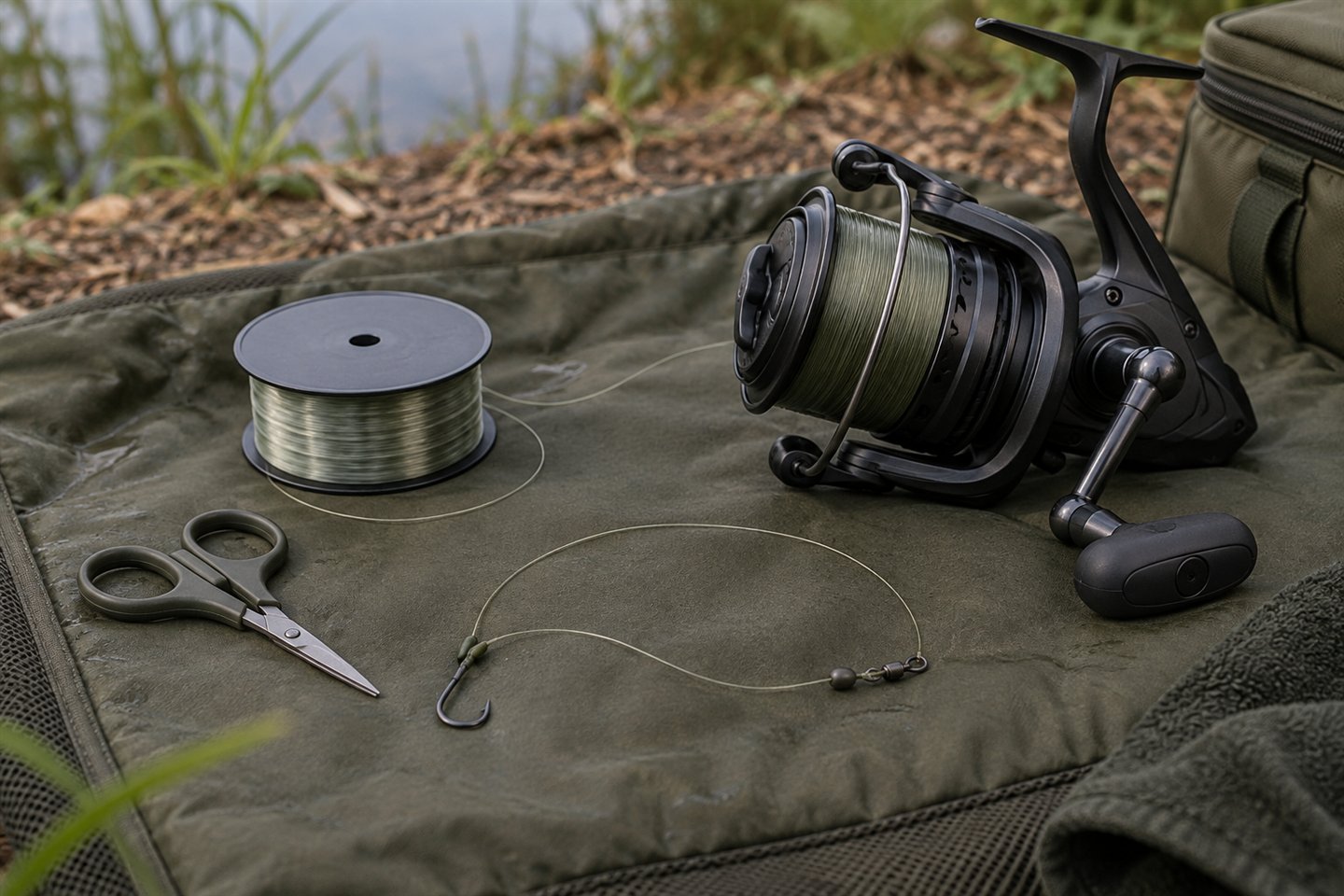
After tying, lower the rig into clear margin water or a container deep enough for it to settle naturally. Move it gently from different angles and watch the hookbait, hooklink and point. A palm test is not a substitute for underwater observation and can put a sharp hook into a hand; use safe tools and visual checks instead.
Wire gauge, strength and demanding water
Thicker-gauge X or XX hooks are offered for situations where the complete tackle is designed to apply more pressure, such as heavy weed or some snag fishing. The decision must start with whether the spot can be fished safely at all. A heavy hook doesn't make an enclosed branch system landable, and our guide to carp fishing near snags safely sets clear stop rules.
Balance the hook with main line, leader, hooklink, knots, rod and clutch. One exceptionally strong component beside worn or underspecified line can worsen the consequences of a break. Follow venue minimum diameters and leader rules, inspect the first several metres after every abrasive contact and never pull line with bare hands.
A fine-wire pattern may help a small or delicately balanced presentation, but it still needs adequate strength for the water. Don't infer wire diameter from hook size alone. Check the named variant and maker's intended use, because a size 6 standard hook and a size 6 X hook are different products.
Barbed, micro-barbed and barbless hooks
The fishery's rule decides what may be used. Some waters require barbless hooks, others allow micro-barbed patterns, and some managers prohibit particular shapes or altered barbs. Check the current written rules and ask the fishery if any wording is unclear before tying rigs.
Barbless doesn't automatically mean harmless, and barbed doesn't remove the need for controlled pressure. Hook size, pattern, tackle balance, playing technique and unhooking all affect mouth damage. Never crush a barb unless the manufacturer and venue permit it and the result can be inspected; a rough, partly flattened projection may be worse than using a purpose-made barbless model.
Keep forceps ready before casting. Support the fish over a wet padded mat, remove the hook without twisting and cut the hook if that is the least damaging option. If a pattern repeatedly creates poor hook holds or visible damage, stop using it and reassess the rig rather than treating the result as normal.
Hook sharpness and safe storage
New doesn't always mean undamaged. Examine the point and eye when a hook leaves the packet. Check that the eye is fully closed for the intended material and that no finish or burr could cut it. Inspect the knot after tying and pull-test it steadily with protected rig tools.
On retrieval, look for weed fibres, silt, corrosion and a turned point. Contact with gravel can dull a hook without making the damage obvious. Replace doubtful hooks instead of repeatedly testing them against skin. If hook sharpening is allowed and you understand it, remember that removing coating can expose metal to corrosion and change the point profile.
Store fresh hooks dry in a secure tackle box. Keep used or rejected hooks in a separate rigid container so they cannot pierce a bag or injure wildlife and waste workers. Hooks and line must leave the fishery with you.
A practical selection process
First read the venue rules. Next decide the rig and hookbait, then choose a recognised compatible pattern. Compare the physical size rather than trusting the number, select a wire gauge appropriate to the balanced tackle and test the finished rig in water. Finally inspect it again after every cast that contacts weed, gravel or an obstruction.
Carry two adjacent sizes of one trusted pattern before carrying many unrelated designs. That makes it easier to respond when a different bait, buoyancy or nuisance-fish problem calls for a change. Record the exact pattern, variant and size when a setup behaves well; writing only size 6 is not enough to reproduce it later.
Judge success by secure, well-positioned hook holds and carp landed in good condition, not by how aggressive a hook looks in a dry test. If bites are missed, review bait separation, hook sharpness, tangles and rig placement before automatically fitting a larger hook.
Frequently asked questions
Is a size 4 carp hook bigger than a size 8?
Within the same hook pattern, yes: the size 4 is normally larger. Across different brands or patterns, compare the actual gape, shank and wire because the numbering is not a shared dimensional standard.
Size 4 or size 6 hooks for carp fishing?
There's no universal best size. Sizes around 4 to 8 are common reference points in many ranges, but bait size, rig, pattern, wire gauge, carp, lakebed and venue rules determine the sound choice. Test the exact combination rather than buying from a generic answer.
Should a pop-up use a smaller hook?
Not necessarily. The hook must balance with the pop-up and rig, but buoyancy can be adjusted in several ways. A smaller hook may help one bait sit correctly, while a larger hook may be right for a different pop-up or presentation. Test it in water with every component fitted.
Are beaked points only for gravel?
No. They are commonly associated with firm bottoms and offer a less exposed tip, but beaked-point hooks can be used in several presentations. Inspect them after every abrasive retrieve and choose by the complete pattern, not one feature.
Can one hook pattern cover every rig?
A versatile wide-gape or curved pattern can cover many bottom-bait and pop-up arrangements, but stiff hook sections, specialist spinner connections or very delicate baits may benefit from another eye angle or shape. Compatibility and testing matter more than minimising the number of packets.
Final thoughts
Understanding carp hook sizes starts with accepting that the number is only a relative label. Pattern, real dimensions, wire gauge and point condition decide how the hook behaves. Choose from the rig and bait outwards, follow the fishery's barbed or barbless rule and inspect the finished presentation in water.
A wide gape, a curved Krank-style hook and an out-turned-eye stiff-rig hook all have different jobs. Choose the pattern your rig needs, in a size the venue permits, then check and pull-test the finished setup. Replace a damaged hook straight away. You don't need a packet of every pattern to fish confidently.