Thinking of buying a bait boat for carp fishing? Check that your fishery allows one and that you can safely land fish from the spots it could reach. Then compare the useful features, from a straightforward boat to GPS and sonar, with how you'll actually use it.
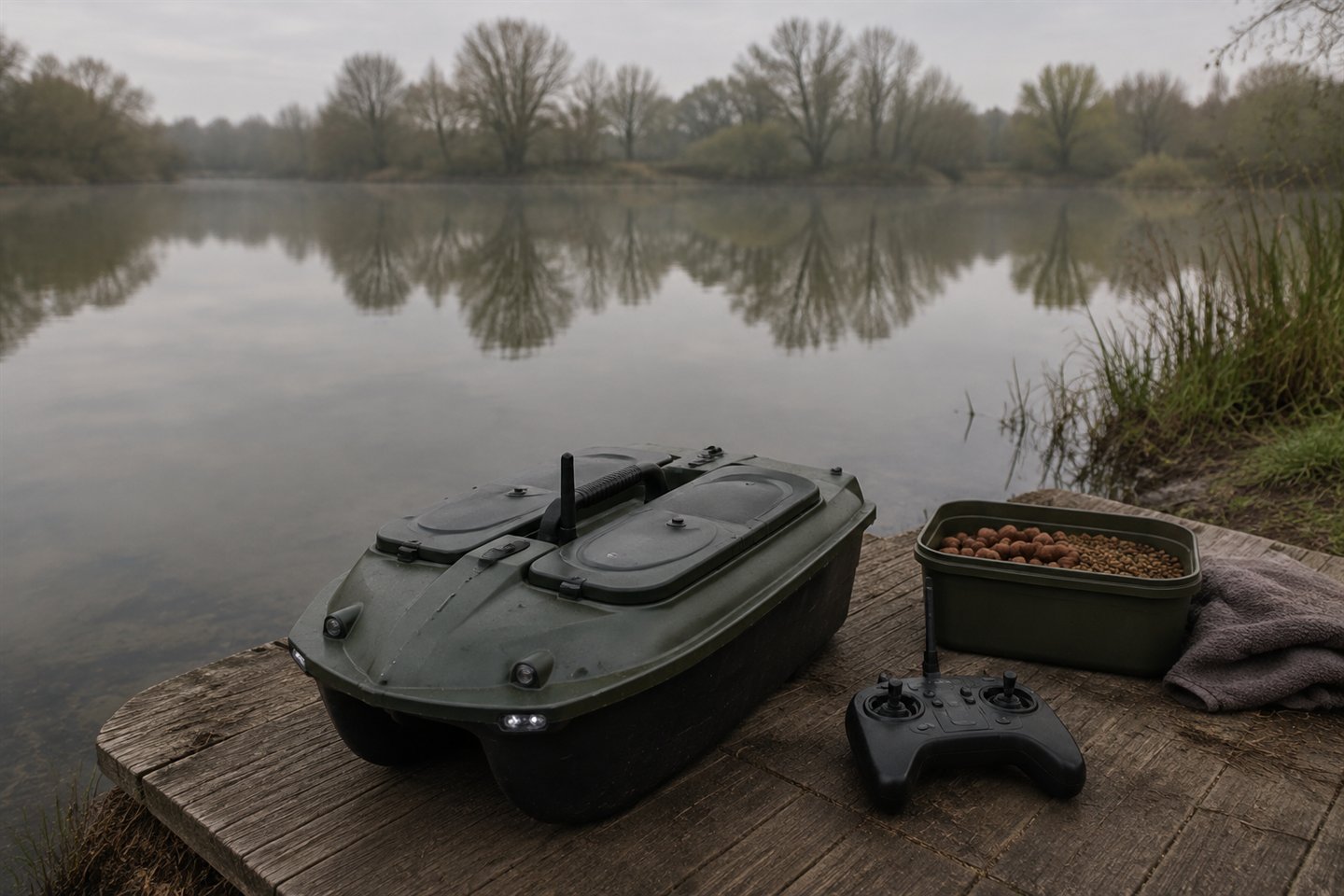
A good bait boat matches the water and the angler. Compact boats are easier to carry and launch on canals or intimate lakes; larger twin-hull models can carry more bait and may feel steadier on open water. The important comparison covers hull stability, hopper layout, actual loaded weight, battery system, weed protection, lights, control ergonomics, service support and spares. A headline range figure is much less useful than reliable operation at the sensible distances permitted in the swim.
We'll also look at when GPS or an echo sounder is worth paying for, and how to deliver the rig without tangling it. If you're still learning what's under the water, read the marker-float guide too. A boat helps you return to a spot; you still need to understand the spot itself.
Bait boats for carp fishing: which features will you use?
For occasional short-range use, prioritise a simple boat with a stable hull, easy top loading, protected propellers, visible lights, a clear battery meter and UK repair support. GPS becomes useful when repeatedly returning to a safely mapped spot, particularly at night or without a distinct horizon marker. Sonar can help show depth and changes in the bottom, but its picture needs interpretation and should never be treated as proof of fish species or a safe landing route.
Choose capacity by the amount of bait you should introduce, not the maximum the boat can carry. A one-kilogram hopper is already far more than many short sessions require. Overloading changes handling, increases motor demand and can bring water closer to openings. Weigh a normal load at home and follow the manufacturer's limit.
Before paying for features, confirm the fishery's exact rules. Some venues ban boats completely; others restrict their use to particular lakes, distances, hours or swims. Permission can change with weed, water level or angling pressure. The bailiff's current instruction takes priority over a retailer description or what happened on a previous visit.
What a carp bait boat can and cannot do
A bait boat can carry a hookbait, lead and loose feed along one controlled line, then open a hopper or release a hook at the chosen point. This avoids the repeated impact of spodding and can place small parcels beneath near-bank cover where an overhead cast is unsuitable. It can also distribute bait in a line or separate two hopper loads if the design allows independent release.
It cannot tell whether a carp can be landed from the swim. A boat may pass beneath branches or round a corner that the line and hooked fish cannot follow safely. It cannot remove the delay caused by a long bow of line, protect the main line from sharp shelves, or make unattended rods acceptable. If the return path crosses anglers, boats, wildlife or a serious snag, choose another spot.
Nor does accurate delivery replace accurate fishing. A rig lowered into weed can still be masked; a hook point can catch debris in a dirty hopper; line can loop around a propeller; and a large mound of bait can reduce rather than improve the chance of a bite. Use the same presentation checks described in the accurate carp casting guide, even when no cast is made.
Decide whether you need a bait boat
A boat earns its place where rules allow it and the controlled delivery solves a genuine problem. Examples include very precise quantities beside reachable marginal cover, heavy but safe presentations that are awkward to cast, repeated feeding to a measured open-water spot, or an angler whose mobility makes conventional casting difficult. It can also reduce surface disturbance compared with many spod casts.
Conventional casting remains quicker for showing fish, moving regularly and covering several areas. A throwing stick or catapult spreads boilies naturally, while a Spomb gives measured bait at range and doesn't add motors, batteries or another large item to the session. The spodding accuracy guide explains that alternative.
Don't buy a boat to compensate for fishing farther than you can control. Long range lengthens response time, increases line exposure and makes a fault harder to recover. Begin close, where direction and release can be seen clearly, and expand only within venue limits after the complete process is dependable.
Hull design and stability
Twin-hull and catamaran-style boats place volume on both sides of the load and often provide a broad stable platform. A compact single body can be lighter and easier to turn. Shape, freeboard, loaded balance and motor control matter more than the label. Compare dimensions and weight with the access route as well as the lake.
The hopper should sit centrally enough that a normal load doesn't make the bow or stern ride low. Independent compartments allow two small drops or separation of the rig from loose bait; one large hopper is simpler to clean. Top loading reduces the need to handle a hook beneath the hull. Whatever the design, practise opening and closing it with the power isolated.
Built-in weed guards reduce the chance of stems reaching a propeller but don't make dense weed safe. Guards can themselves collect filamentous weed or line. Inspect the intake and propellers before every trip, keep fingers away when power is connected and use only the maker's safe method to clear an obstruction.
How much range is useful?
Manufacturers often state maximum remote ranges measured under favourable conditions. RidgeMonkey, for example, publishes up to 200 metres for the Hunter 750 range, while Boatman lists longer figures on some Actor Plus models. These are equipment specifications, not recommended fishing distances. Interference, batteries, waves, rain, aerial orientation and obstacles can reduce reliable control.
The useful range is the shortest distance that reaches the safe spot with a strong control margin. The boat should remain visible, its orientation clear and its lights distinguishable from reflections. Test the fail-safe and low-power behaviour at close range exactly as the manual describes before relying on it farther out.
If a boat occasionally loses connection near the bank, don't send it farther. Check controller charge, boat batteries, pairing, aerial position and local interference. Contact the maker or authorised service centre when the cause is unclear. An unplanned automatic return with a rig still attached can cross snags or other lines.
Hopper size and bait control
Capacity should be viewed as an upper engineering limit. Most drops need much less. Measure bait into a separate tub so every trip has a purpose and the total introduced is known. The how much bait guide offers a condition-led starting point: begin cautiously and add only when carp presence and response justify it.
Distribute the load evenly and keep the release edges clear. Pellets or seeds trapped in a door can stop it closing; sticky groundbait can bridge above the mechanism; liquids can reach electronics or soften PVA before launch. Use a cover where specified, and test any PVA-friendly mix independently.
Don't place a bare hook where it can catch fabric, wiring or the hull. Keep the rig in the designed channel or release, protect the point where appropriate and follow the manual's line-routing diagram. After loading, perform a visual check from lead to rod tip.
Do I need sonar on a bait boat for carp?
A basic boat uses manual steering and hopper controls. It costs less, encourages the operator to watch the route and is often easier to troubleshoot. For close and middle distances with clear markers, it may do everything required. Spend the saving on a sound battery, carry bag and service rather than buying technology without a defined use.
A GPS boat stores a home position and one or more fishing points, then may steer automatically between them. This can repeat a mapped drop, but stored coordinates are not permanent truth. Set the home point in every swim, check the displayed satellite status, approach the spot manually first and confirm the route is still clear. Water level, weed, boats and neighbouring anglers can all change.
Accuracy claims differ by model and conditions. Even a small positional error matters beside a snag. Treat GPS as a way to return to an open safe area, not as justification for placing a hookbait against branches in darkness. Keep watching and be ready to take manual control.
Echo sounders estimate depth from returning signals and may display bottom hardness, vegetation or fish-like targets. Cone angle means the area viewed expands with depth, and the screen compresses a moving three-dimensional scene. Use repeated passes to map a feature, cross-check with a marker lead where safe, and avoid declaring every arch a carp.
Comparing current bait-boat categories
The compact RidgeMonkey Hunter 750 bait boat (paid link) illustrates a lightweight top-loading approach. The current maker specification lists a 2.5kg weight including batteries, a one-kilogram hopper, twin motors with weed guards, front and rear lights and USB-C charging. Echo versions add an integrated sounder and separate display. Verify the exact version because the shared name covers several packages.
The Boatman Actor Plus GPS bait boat (paid link) represents a larger central-hopper format. Boatman UK describes a divider, rear hook release and stored GPS positions. Listings and model generations vary, so match the manual, battery and remote to the exact model code instead of combining specifications from similar Actor versions.
At the serviceable premium end, Angling Technics offers UK-supported boats such as the Technicat and Microcat lines with optional navigation or sonar equipment. A search for an GPS carp bait boat (paid link) can show the breadth of the market, but support, parts and a readable manual deserve more weight than an unknown model with a long feature list.
Battery system and charging
Check chemistry, voltage, capacity, connector and charger as one matched system. Lithium packs save weight and hold useful energy, but must be handled exactly as instructed. Don't substitute a charger because the plug fits. Inspect packs for swelling, damage, heat or water ingress and stop using any suspect battery.
Charge on a stable non-flammable surface, away from bedding and the bivvy, and never leave charging equipment unattended. Protect terminals during transport. Allow a battery to cool before charging if the manual requires it, and follow storage-charge guidance between long gaps. Cold conditions and heavy loads can reduce usable run time.
Keep a simple trip log. Note launches, approximate distance, load and remaining indication. Manufacturer run-time figures are obtained under particular conditions; wind, steering corrections, weed and payload all consume energy. Return with a generous reserve rather than trying to extract one final journey.
Prepare and test at home
Read the complete manual before the first session. Charge all components, fit batteries and identify every control with the propellers safely clear. Learn pairing, trim, lights, hopper release, hook release, cruise control, home-point storage, manual override and fail-safe behaviour for the exact model.
Test the hopper with dry bait over a groundsheet and check that it closes every time. Practise arranging a lead and hooklink without attaching a hook. Label batteries as pairs where required and confirm the charger sequence. Pack the manual offline because signal can be poor at rural venues.
At the lake, repeat the control test a few metres from the bank without a rig. Turn both directions, reverse, open the hopper and watch the return. For GPS, establish home in clear water just beyond the margin rather than on dry land or inside reeds. Never make the first powered journey a fully loaded run at night.
Map a safe route before taking the rig
Walk the bank, speak to the bailiff and watch for marker ropes, islands, weed, aerators, moorings and other anglers' lines. A straight route on the surface can cross a submerged bar that will abrade the main line once it sinks. Consider the angle from rod tip to bait and from hooked fish back to the net.
Use the boat or a marker setup to understand open water, but don't drag tackle through suspected snags simply to investigate them. Save a GPS point only after the route and landing prospects are acceptable. Give hazards a generous buffer that includes position error and sideways movement by a carp.
Agree boundaries with neighbours before launching. A bait boat doesn't reserve water beyond the normal convention of the swim. Keep clear of sailing, paddling and wildlife, slow down near margins and abandon the journey if another user's route becomes uncertain.
Loading the rig safely
Place the rod securely with the bail arm open or drag set exactly as the boat maker directs. Lay the line along the specified guide without loops around alarms, feet or vegetation. Load the lead and hooklink so the hook point cannot catch the boat, and add bait without burying a release joint.
Keep the hopper load below its maximum and balanced. Where the boat has two doors, uneven loads may change steering. Close every door, check lights and battery, then lift the boat with its handle rather than the aerial, lid or hopper edge.
Launch from a stable place where the hull can float before power is applied. Don't wade into unknown water or lean from an unsafe bank. If the swim has a steep edge, ask the fishery about an approved lifting pole or choose a conventional cast.
Control the line during the journey
One person should concentrate on steering while maintaining gentle line control. Let line leave the spool without pulling the stern off course, but prevent large floating loops. Keep the rod tip positioned so the line avoids the propellers and nearby reeds. Never run line through a slipping clutch in a way that creates twist.
Travel at a moderate speed and make smooth corrections. Constant sharp steering consumes battery and can swing the rig. In crosswinds, point the bow enough into the drift to preserve the planned corridor. If control feels marginal, turn back while there is plenty of power.
At the spot, pause and let the boat settle. Confirm orientation, then release the bait and rig using the documented sequence. Watch for the positive indication that the door opened. Pulling line immediately can drag the hooklink through the pile or move the lead from the chosen bottom.
After the drop
Move the boat away before tightening. Return it on a path that keeps clear of the line, then lift it safely and switch it off before touching the propellers or hopper. Back at the rod, take up slack gradually and feel for the lead without moving it. Set the indicator and record the point, load and time.
Inspect the boat after every trip for trapped braid, weed and bait. If a release failed, diagnose it on the bank; don't repeatedly press controls at range while pulling the rig around. Keep wet or oily mixtures away from electrical seals and wipe the hull before the residue dries.
When using several rods, route each line so a take can be managed without crossing the others. Don't send a second boat while the first rod cannot be attended. Legal rod limits and the requirement for control still apply regardless of how the rig was placed.
Wind, weed and night use
Wind affects a small craft long before it makes casting impossible. Waves can wash over a heavily loaded hull, blow it off a narrow route or hide its orientation. Use the conservative operating conditions in the manual and turn back when the return journey is doubtful. A bait boat is replaceable; entering cold or rough water to recover it is not an acceptable plan.
Weed gathers around propellers, guards and rudder areas. Avoid dense beds and floating rafts. If speed drops or steering changes, return immediately under the least demanding route. Never keep increasing power against a fixed obstruction. Use an authorised recovery method from the fishery, not swimming or an improvised wade.
At night, use a route mapped in daylight and keep navigation lights visible. Reduce screen brightness to preserve vision, keep a headtorch ready and don't trust GPS alone. Mist can remove visual references and condensation can affect equipment. If the boat cannot be seen clearly, bring it back.
Cleaning, servicing and spares
Switch off and remove batteries as the manual instructs before cleaning. Empty every seed and pellet, wipe the hopper, inspect seals and clear line from shafts without tools that can damage them. Dry the hull open in a ventilated place before storing it in a bag.
Check propellers, guards, door hinges, release magnets or servos, lights, handles and charging sockets. Replace damaged seals and cables with approved parts.
Common bait-boat mistakes
The most serious mistake is choosing a spot because the boat can reach it rather than because a carp can be landed. The next is overloading the hopper, which changes handling and encourages excessive baiting. Another is saving a GPS coordinate without checking home point and route in the current swim.
Operators also lose accuracy by fighting the line, dropping while the boat is still moving, or tightening before it has cleared the rig. Battery errors include mixing packs of different condition, using the wrong charger and setting off with too little reserve. All are avoidable with a written launch routine.
Finally, don't let a boat replace watercraft. Watch the lake, find carp and choose a presentation for the bottom. Technology can repeat a sound decision very well; it can repeat a poor one with equal precision.
Frequently asked questions
Are bait boats legal in the UK?
There's no blanket permission to use one on every fishery. National rod-fishing rules still apply, while owners and clubs set additional venue rules and may ban or restrict bait boats. Always obtain current permission before launching.
Is GPS worth it on a carp bait boat?
It can be, if you regularly return to safely mapped spots. Manual control is enough for many visible close- and middle-range spots. GPS is useful for repeat journeys to a safely mapped open area, but it adds setup and must be checked in every swim.
Can a fish finder identify carp?
An echo sounder displays interpreted returns and may flag fish-like targets, depth and features. It cannot reliably establish that every icon is a carp. Use it with observation and repeated mapping rather than as a species detector.
How much bait should I load in a bait boat?
Only the amount justified by the session, stock and fish response, always below the boat's rated load. A hopper's capacity is not a feeding recommendation. Measure each trip and keep a running total.
Final thoughts
Responsible bait-boat fishing begins with permission and a safe landing route. Choose a stable serviceable boat, learn it close in, maintain generous range and battery margins, and deliver measured bait only after the spot has been understood. GPS and sonar should reduce uncertainty, not increase ambition.
Keep control of the rods, watch the boat and keep the lines clear. If wind, weed, other people or a fault makes that difficult, bring the boat back and choose a simpler approach. It's a useful tool when it makes bait placement easier—not when every trip out turns into a recovery problem.
Sources and further reading
- RidgeMonkey: Hunter 750 bait-boat range and current specifications
- RidgeMonkey: Hunter 750 full operating instructions
- Boatman UK: Actor Plus GPS product details and support information
- Angling Technics: current bait-boat designs, options and service information
- GOV.UK: freshwater tackle rules and the duty to control rods