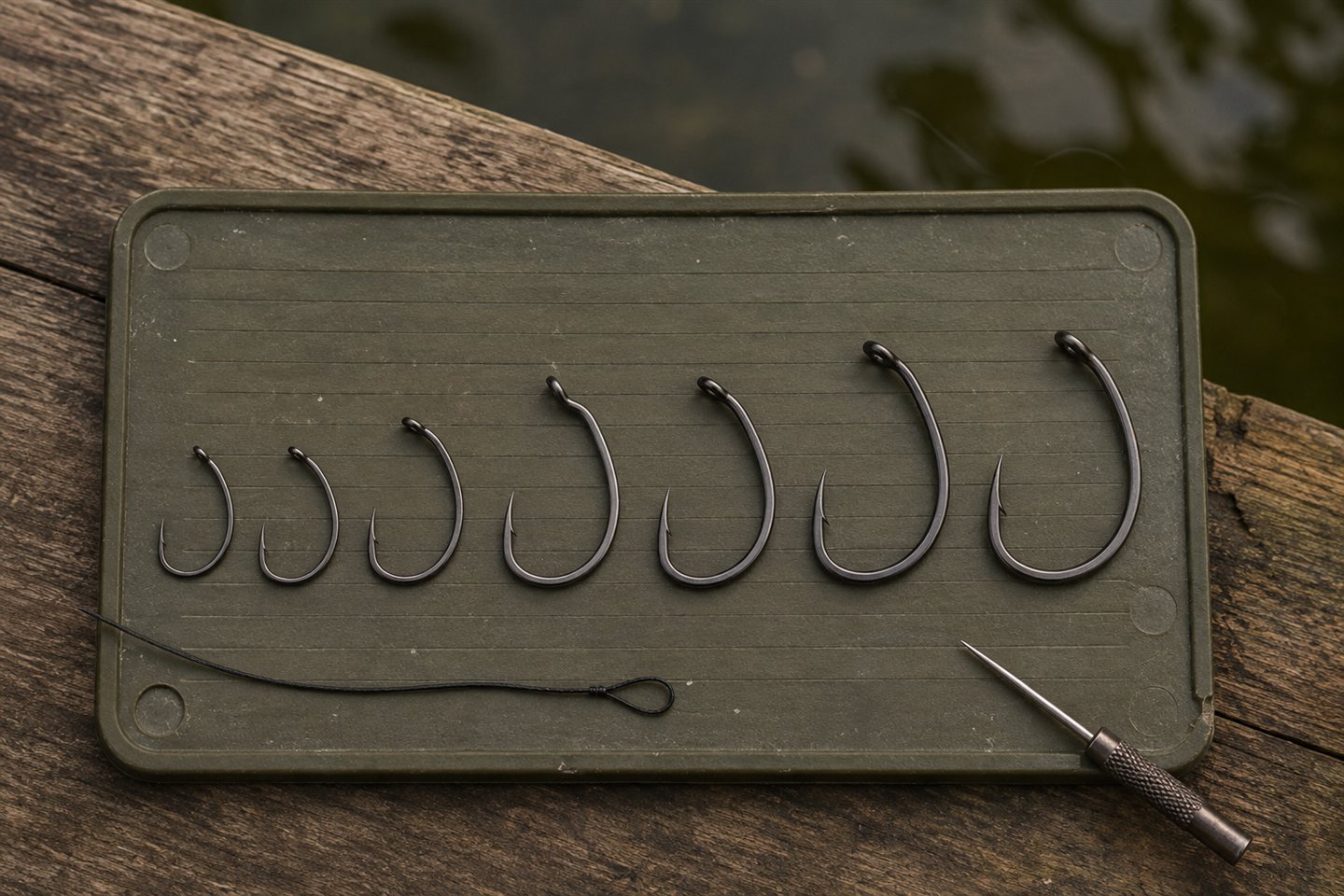
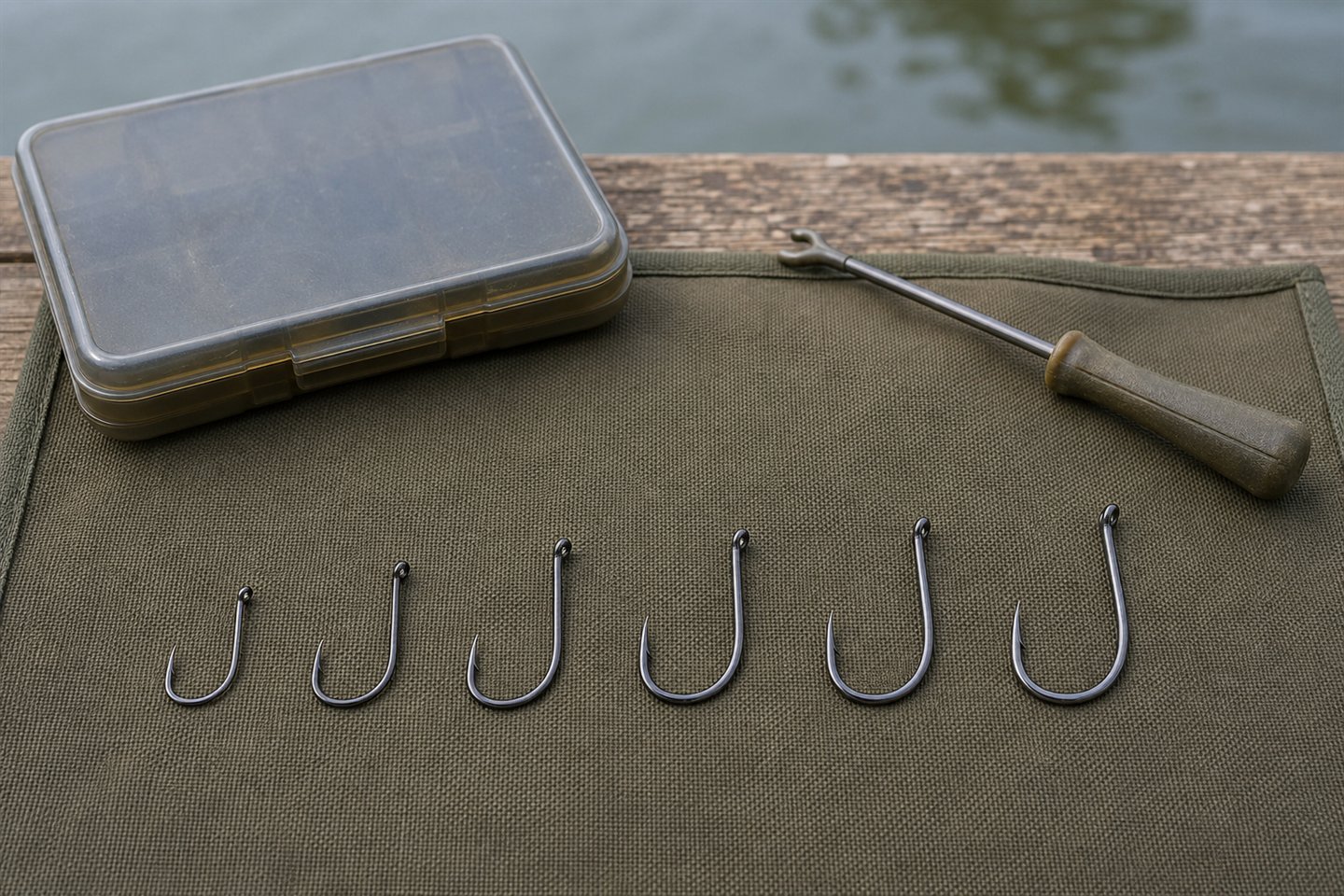
Coarse fishing hook sizes can look confusing at first. A size 20 is smaller than a size 14, and even two size-16 hooks can look different. Start with your bait, then compare the gape and wire as well as the number.
The familiar numbering system also runs in the opposite direction from many beginner expectations: within the normal coarse range, a size 20 is smaller than a size 14. Numbers are approximate categories rather than precise dimensions shared by every manufacturer, so compare hooks side by side or consult the maker’s specifications.
We'll look at eyed and spade-end hooks, barbed and barbless options, mounting the bait and checking the point. Start with the fishery's hook rules, then choose a pattern that suits the bait and fish you're expecting. That gives you a much better choice than reaching for one favourite size every time.
Which coarse fishing hook size suits your bait?
Start with the bait. The hook must leave the point and gape clear while holding or presenting the bait securely. Then check the likely fish and tackle: the wire must withstand the pressure produced by the rod, line or pole elastic without being so heavy that a small bait behaves unnaturally.
For light canal fishing, experienced coaching guidance may use very small hooks such as sizes 20 or 22 with suitably fine line. A commercial pool containing larger fish can require a stronger pattern at a different size even when the bait looks similar. Treat those figures as venue-specific examples, not a national table.
The coarse line and hooklength guide explains the rest of the connection. If you're assembling a first outfit, begin with the coarse tackle checklist and buy hooks only after reading the fishery rules.
How the numbering system works
Common coarse hooks are numbered downwards as they become larger: size 22, 20, 18, 16, 14, 12 and 10 is a progression from small to larger. Beyond size 1, larger specialist hooks can use /0 notation, but that is outside most beginner mixed-fishing needs.
The number doesn't define an exact gape or wire diameter across brands. One pattern may be wide-gaped and short-shanked, another narrow and long. Even within one maker, a heavy-wire size 18 can look more substantial than a fine-wire size 16. Keep packets labelled and never identify loose hooks by guesswork.
Manufacturers sometimes revise a pattern while retaining a familiar name. Use the current packet, official product page and model code. Old charts and forum claims may describe another generation or a discontinued hook.
Size is only one measurement
Gape is the opening between shank and point. A generous gape can leave clearance around bulky corn, pellet or worm, while a narrow hook may suit a slim bait. If bait blocks the gape, the point has less opportunity to take hold, whatever size is printed.
Wire gauge affects strength, weight and penetration. Fine wire can preserve the movement of a maggot or small caster and suit delicate tackle. Medium or heavy wire is appropriate when larger fish, stronger line or forceful methods create more pressure. The rod or elastic must still cushion the system.
Shank length influences bait placement and handling. A longer shank offers room for worms or multiple maggots and may be easier to grip, but adds metal and can lever differently. A short shank makes a compact profile and often accompanies wide-gape patterns.
Point shape and length affect penetration and durability. Straight, beaked and offset points all have specialist uses. A beaked point may resist contact with hard bottom, while a long exposed point can be sharp but vulnerable. Product guidance and local experience are more dependable than declaring one universally superior.
How to match coarse fishing hook size to bait
The bait should sit naturally without hiding the point. A single pinkie or small maggot normally needs a finer, smaller hook than a large cube of meat, bunch of worms or double corn. That doesn't produce one fixed size because baits and hook patterns vary.
Hook soft bait through enough skin to hold it while leaving movement and point clearance. Don't bury the point to make the bait look tidy. With bread, avoid compressing the entire piece into a hard lump around the hook; leave an appropriate flake or punched disc according to the method.
For corn, select a gape that remains open after one or more grains are mounted. Threading a hook through the tough skin can improve hold, but check the point has not become masked. Hair rigs and bait bands can separate hook and bait for some feeder or commercial methods, subject to venue rules.
The coarse bait guide explains common hookbaits. Use its bait ideas only with a hook and line combination appropriate to the fishery.
Fine, medium and heavy wire
Fine-wire hooks reduce the weight attached to tiny baits and can penetrate with light tackle. They are not weak by definition, but they have lower reserves than a purpose-built heavy pattern. Pair them with soft rods or elastic and realistic fish in open water.
Medium wire covers much general float and feeder fishing. It provides more security for bonus bream, tench or chub without turning every bait into a rigid presentation. Pattern geometry and steel treatment still matter, so “medium” is a maker’s description rather than a regulated grade.
Heavy-wire hooks suit stronger hooklengths, large baits and powerful fish, especially where steady pressure is necessary. They can be too heavy for small silverfish baits and may require more force to penetrate. Never solve repeated breakages by increasing hook gauge while leaving an unbalanced hooklength or rod.
A manufacturer may publish actual wire diameter for each size, which is more informative than adjectives. Compare within the same range, then consider the recommended use. A barbless coarse-hook search by size and pattern (paid link) can show current options, but inspect exact specifications rather than buying an anonymous mixed packet.
Barbless, micro-barbed and barbed hooks
Many UK coarse fisheries require barbless hooks, while others allow micro-barbed or barbed patterns in defined circumstances. National rules are not a substitute for the owner’s policy. Check wording carefully; flattening a barb may not satisfy a rule that requires a manufactured barbless hook.
Barbless hooks usually make prompt removal simpler when line remains controlled. They don't remove the need for a landing net, wet handling and a disgorger. Slack line, excessive pressure and poor pattern choice can still cause damage or lost fish.
Micro-barbed and barbed hooks resist reversal but can increase tissue damage during removal if handled badly. Use them only where legal, permitted and genuinely appropriate. Never force a barb backwards through tissue repeatedly; seek competent help and follow the current fishery’s fish-care procedure.
Eyed hooks
An eyed hook has a loop formed at the end of the shank. It can be tied with several established knots and is easy to recognise, making it approachable for beginners. The eye may be straight, turned in or turned out, affecting how certain knots and rigs align.
Check the eye is fully closed and smooth. A gap, burr or rough finish can damage fine hooklength. Thread the line in the direction recommended for the knot and pattern, and test the finished connection with a steady protected pull.
Eyed patterns are common for feeder work, larger baits, hair rigs and specimen fishing, but small eyed hooks also exist. The eye adds some weight and bulk, which may matter with tiny canal baits. That is a presentation choice, not a claim that spade ends always catch more.
Spade-end hooks
A spade-end hook finishes in a flattened plate rather than an eye. Line is whipped around the shank so the turns pull against the spade. Small match hooks often use this format because it creates a compact connection.
Spade-end tying requires the line to leave on the correct side so it pulls along the shank rather than across the point. A hook tyer can make repeatable whippings once learned. Practise with a larger hook and visible line before moving to fine tackle.
Inspect every whipping. Turns should sit neatly without crossing, the tag should be trimmed safely and the spade must not cut the line. If the hook sits at an odd angle or the knot slips under a test pull, retie it rather than relying on the bait to hide the fault.
A spade-end hooks and hook-tyer search (paid link) can compare manual tools and labelled patterns. Confirm the tool accommodates the hook sizes you plan to use and learn from a coach or the maker’s instructions.
Pre-tied hooks to nylon
Hooks to nylon arrive tied to a stated length and diameter, often with a loop. They remove one demanding knot from the first setup and make a quick bank-side change possible. For beginners, they are often more useful than a bulk packet of loose hooks.
Read all three specifications: hook pattern and size, hooklength diameter or strength, and length. Two packets with the same hook size may carry very different nylon. Select for the venue, store them straight and inspect for kinks or packaging damage.
Pre-tied doesn't mean pre-checked. Test the knot gently, ensure the hook point is sound and confirm the loop is formed correctly. Discard an old hooklength that has become brittle or permanently coiled.
Wide gape, round bend and specialist shapes
Wide-gape hooks leave more opening around bulky bait and can suit corn, pellets, worms and hair-rigged presentations. They may also use heavier wire, but shape and gauge are independent. Check both.
Round-bend and classic match patterns can work well with maggots, casters and small natural baits. A long point may offer efficient penetration while a shorter beaked point resists some bottom contact. Product-specific detail matters more than a broad family label.
Circle hooks, offset hooks and aggressively curved specimen patterns require specialist understanding. They are not general upgrades for beginner float rigs. Use only when rules permit and reliable method guidance explains how the rig is intended to hook and release fish.
Hooks for float fishing
Float tackle often uses a directly hooked bait, fine to medium wire and a pattern light enough to move naturally. Small roach and gudgeon in open water may accept very small hooks, while tench, chub and commercial carp require stronger patterns.
The float rod, main line and hooklength must absorb the strike. A violent sweep with a stiff rod can tear a small hook free or break fine nylon. Lift or strike only enough to connect, then let the rod curve.
For the first rig, copy a current local recommendation rather than carrying every even size. Two adjacent sizes in the same known pattern show how a bait or fish response changes while keeping other variables stable.
Hooks for feeder fishing
Feeder hooks need to withstand casting and direct bite indication as well as fish playing. A pattern that securely holds maggot, worm or corn differs from one designed for a bait band or hair. Use the manufacturer’s stated application and the fishery’s permitted rig.
A short hooklength and tight quivertip can transfer movement quickly. Don't compensate for missed bites with an oversized heavy hook before checking bait masking, hook sharpness, hooklength, feeder accuracy and strike timing.
Method-feeder fisheries often publish detailed hook, hooklength and feeder rules. These vary and can change. Obtain the current rules from the venue, not a historic social-media photograph.
Hooks for pole and whip fishing
Pole and whip rigs can present tiny baits with exceptional control, so closely graded spade-end hooks and fine diameters are common. Elastic strength, rig line and hook wire must be matched. An elastic that is too tight can overload small hooks and cause hook pulls.
Ready-made rigs and hooks to nylon provide a safe starting point when recommended by a coach. The canal figures published for introductory sessions apply to light, open-water fishing and should be increased where larger fish or snags make them unsuitable.
Never hand-line a powerful fish or trap stretched elastic in bare fingers. Follow coached pole-fishing technique and use a suitable puller system only as designed.
Species change the pattern, not just the size
Roach, rudd and small bream often call for light patterns that let fine baits fall naturally. Perch have a relatively large mouth, but their spiny fins and tendency to take baits deeply make prompt bite recognition and unhooking tools important. The perch fishing guide provides species context.
Tench and chub can place far more pressure on a hook than their bait size suggests. Use a pattern and hooklength capable of the venue, particularly near weed or flow. Barbel require dedicated river tackle and fish-care knowledge; don't target them with a generic beginner silverfish rig.
Carp may take small coarse baits on commercial waters. If they are a regular catch, choose the stronger venue-approved pattern and matching tackle from the outset. This remains mixed coarse fishing rather than a reason to use carp-only hooks for every roach.
Check point condition
A hook point must be clean, aligned and undamaged. Examine it in good light, ideally with magnification for small sizes. A point turned over by gravel, dulled by repeated fish or corroded in a damp box should be replaced.
Dragging a point across a thumbnail is not a complete or risk-free sharpness test. It can damage the point and place a hook close to skin. Use careful visual inspection and the manufacturer’s guidance, keeping the point directed away from hands and face.
Don't sharpen fine chemically etched match hooks casually. Removing coating and metal can weaken an already small point. Replacement is inexpensive compared with a lost fish or damaged mouth.
Tie and test safely
Use a knot proven for the hook type and line. Moisten it as advised, draw turns together slowly and check that the hook aligns correctly. A knot with crossed turns, whitening line or a trapped tag should be cut off and retied.
Test with steady pressure using a safe knot puller, not by placing the hook in clothing, furniture or a finger. Wear eye protection when tightening strong tackle and keep bystanders clear. Never put line or wet tackle in the mouth.
Carry spare pre-tied hooklengths so fatigue or poor light doesn't force a rushed knot. Store every loose hook in a closed compartment and pick up dropped hooks before continuing.
Unhooking starts before the cast
Assemble the knotless landing net, wet the appropriate unhooking surface and place two sizes of disgorger plus forceps within reach. The Angling Trust advises a disgorger for small fish and forceps for larger species. Learn both under coaching before fishing alone.
A lip-hooked fish can often be unhooked quickly in the wet net by reversing the hook along its entry path. Don't pull upwards or twist blindly. Keep fingers away from the point and support the fish without squeezing.
When a hook is deeper, keep the line controlled and use a suitable disgorger only when the hook can be reached safely. If removal is likely to cause serious injury, stop repeated attempts and follow current fishery or authoritative species guidance; cutting the line close may be preferable in some circumstances. The coarse fish-care guide covers the full decision process.
A SS Instrumentx curved fishing forceps (paid link) can show tool sizes. Choose smooth, sound tools and practise their use; buying them without learning doesn't protect fish.
Storage and disposal
Keep hooks dry, separated by pattern and in original labelled packets or secure compartments. A damp mixed box encourages corrosion and makes unsafe guesswork likely. Replace silica or dry storage aids according to their instructions.
Used hooks should go into a puncture-resistant container, not a thin rubbish bag. Remove line and dispose of or recycle it through an appropriate angling scheme. Never discard hooks, rigs or bait bands on the bank.
Common hook-choice mistakes
The first mistake is matching hook only to bait. The likely fish, line, rod or elastic and snags also decide the required wire and shape. The second is choosing by size across brands as though every 16 were identical.
Another mistake is scaling down after missed bites without checking depth, feed, point masking and presentation. A smaller hook may help, but it can also become underpowered. Change one variable and observe.
Finally, anglers sometimes keep a hook because it “looks all right” after a snag. Magnify the point and inspect the bend and eye. If there is doubt, replace it; don't bend a deformed hook back into shape.
Frequently asked questions
What is the best coarse fishing hook size for beginners?
There's no single size. A coached light-canal setup may use a 20 or 22, while larger baits and fish require larger or stronger patterns. Match bait, fish, hooklength, method and venue rules together.
Are size 16 hooks the same across brands?
No. The approximate overall scale may be similar, but gape, shank, point, wire diameter and strength vary. Compare the exact pattern and maker’s specification.
Eyed or spade end hooks for coarse fishing?
Eyed hooks are straightforward to tie and common in feeder and stronger work. Spade ends make compact connections for fine match tackle but require a correct whipping. Pre-tied hooks to nylon are a practical beginner option.
Must coarse fishing hooks be barbless?
Many fisheries require them, but rules vary. Read national and regional byelaws plus the current venue policy. If barbless is specified, use a compliant pattern and don't assume a crushed barb will be accepted.
Final thoughts
Coarse fishing hook sizes are a starting label, not a complete choice. Bait clearance, gape, shank, wire, point, hooklength and the power of the outfit determine whether a hook presents well and lands fish safely.
Start with two nearby sizes in one or two permitted patterns, plus suitable hooks to nylon if you prefer. Check the point, practise tying and learn to unhook fish properly. Replace anything damaged. A small selection you understand will get far more use than a box full of packets bought just in case.
Sources and further reading
Angling Trust: freshwater fish-care best practice; Canal & River Trust: unhooking and returning fish; Canal & River Trust: beginner canal tackle guidance; Drennan: example hook size and wire-diameter table; and Environment Agency: freshwater fishing rules. The product page is useful for comparing the hook shapes.