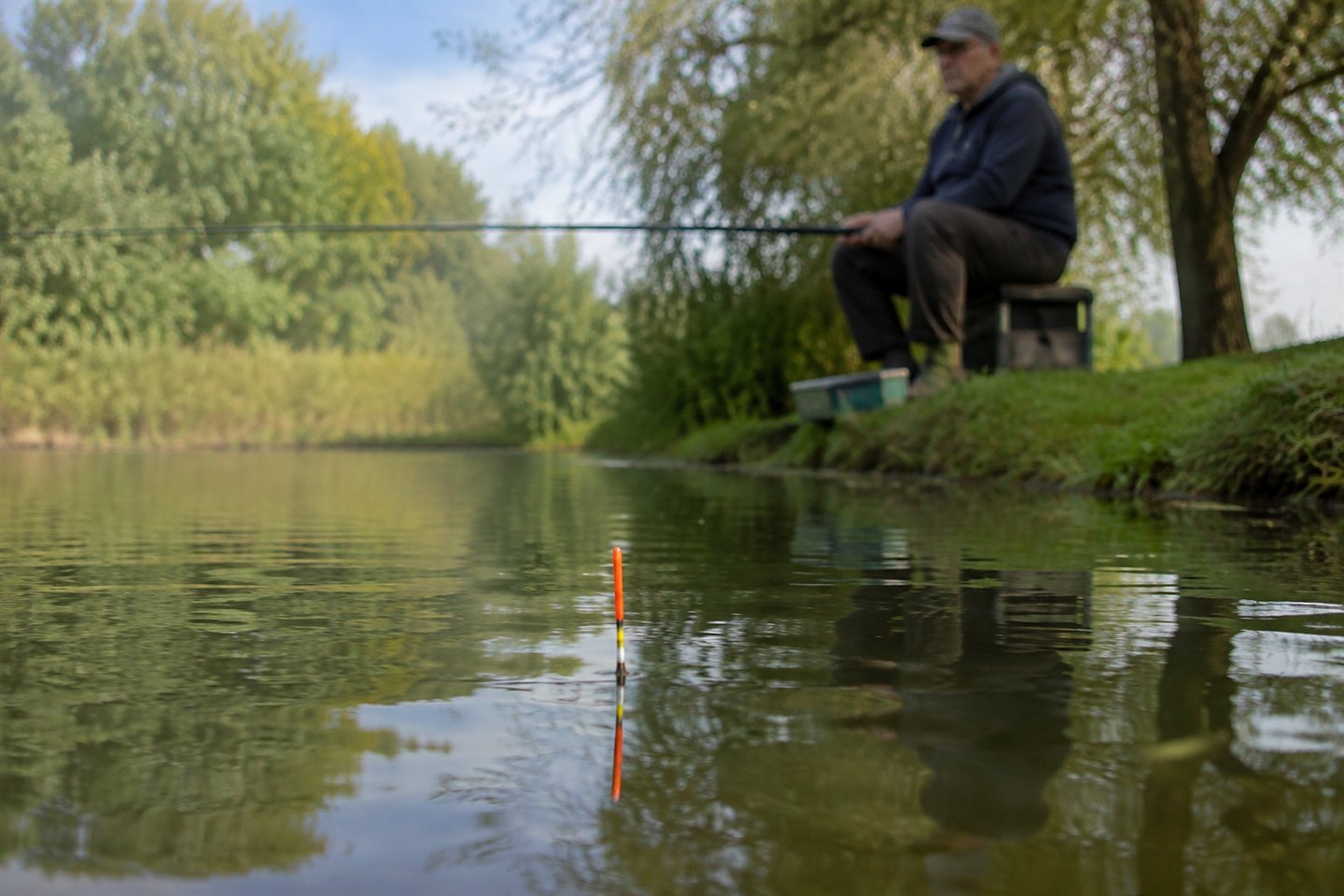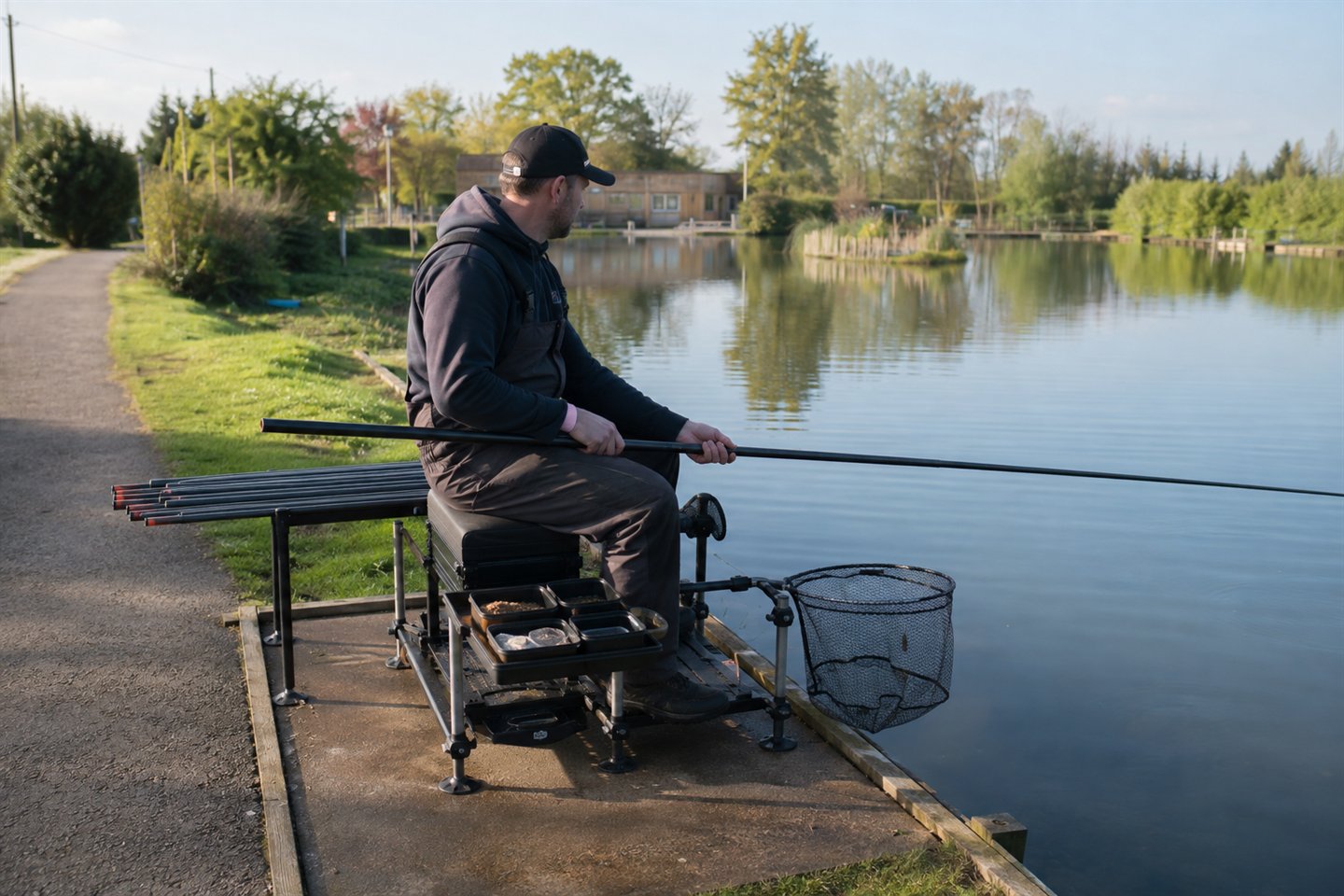
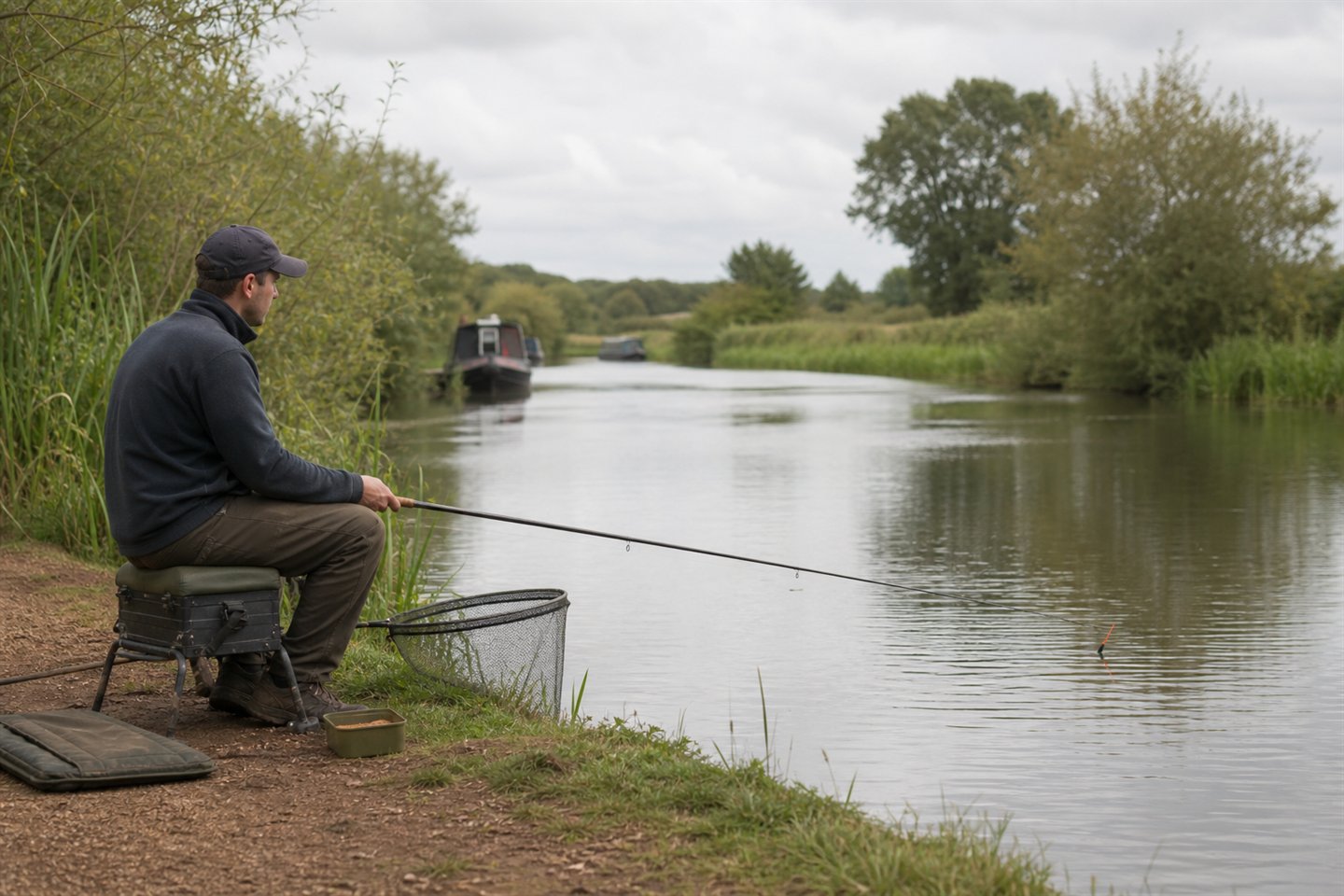
A canal can offer good coarse fishing close to home, but the best-looking stretch isn't always the best place to start. We'll look at choosing a swim, finding the depth and feeding accurately, with room left for boats and other towpath users.
The simplest canal fishing for beginners is a whip, short pole or float rod used from a safe, unobstructed peg. Fish the near slope or a comfortable line across the canal, plumb the depth and feed a few small baits accurately. A beginner doesn't need to reach the far bank if every cast there tangles or conflicts with passing boats.
We'll focus on pleasure fishing for smaller coarse fish: permissions, safe pegs, depth changes and a simple silverfish setup. Check whether a close season applies to your stretch, as well as the club or waterway rules. Then you can plan where to fish and what to do when a boat comes through.
Canal fishing for beginners: where should you fish?
Find a stretch controlled by a club or permit scheme, confirm access and current rules, then choose a level peg away from locks, moving structures, moored boats and overhead cables. Start with a short pole, whip or light float rod, a small sensitive float, a fine but balanced hooklength and maggots, pinkies, bread punch or another permitted bait.
Plumb at several points before feeding. The canal bed often falls down a near shelf, reaches its deepest channel and rises towards the far bank. Pick one repeatable line, feed sparingly and let the rig settle naturally. When a boat approaches, bring the rig and loose line under control, allow it to pass and rebuild the swim with a small feed rather than starting again.
Permission is separate from the rod licence
In England and Wales, an angler aged 13 or over needs the appropriate rod fishing licence, including when fishing a canal. The licence doesn't grant access to a stretch. Fishing rights may be held by an angling club, a private owner or a permit scheme, and the angler must obtain that separate permission before setting up.
The Canal & River Trust explains that much of its network is let to local clubs, while its Waterway Wanderers permit covers specified stretches. Check the exact bank and boundaries because permission can change at a bridge, lock or junction. A ticket for one pound doesn't automatically include the opposite bank or an adjoining length.
Use the rod licence guide as an introduction, then confirm current information with GOV.UK and the controlling club. Carry the licence and ticket confirmation in the form requested. Signs at the water may add temporary closures, match bookings or access instructions that are not obvious from a map.
Check whether the coarse close season applies
Most canals in England have no statutory coarse close season, but “most” is not “all”. Some waterways are legally canalised rivers and some named canal lengths fall within regional exceptions. The national coarse close season runs from 15 March to 15 June inclusive where it applies.
Read the regional rod-fishing byelaws for the actual stretch. Don't decide from appearance: a straight, lock-controlled waterway can still be treated as a river for close-season purposes. A club may also impose or extend its own closure even where national rules permit year-round fishing.
Wales has separate regional guidance, while Scotland and Northern Ireland use different licensing and permission systems. This article cannot turn a UK-wide method into one national legal rule. Check the authority for the country and the fishery owner before every first visit.
Understand the shape beneath the surface
A typical canal cross-section has a shallow ledge beside the towpath, a sloping shelf, a deeper central boat channel, another rising shelf and shallower water towards the far bank. Dredging, piling, junctions and old structures interrupt that pattern. Fish use those changes as routes, feeding areas and shelter.
The near shelf is frequently overlooked. Loose bait, disturbed silt and natural food collect where the slope meets deeper water, and fish may move close once footsteps settle. This line is easy to feed and control with a whip or pole, making it an excellent place to learn.
The far shelf can hold fish beside reeds, boats and cover, but accuracy matters. A rig landing in vegetation or against a hull cannot be fished safely. Begin at a range where the float can be placed softly and recovered without snagging. Distance should be earned through control rather than treated as the default.
Choose a safe, considerate peg
The Canal & River Trust advises beginners to avoid lock chambers, areas close to locks, water points, swing bridges, overhead power lines and positions directly beside boats. Local signage may create larger exclusion zones. These are operating waterways, so a quiet-looking space may still be needed by boat crews.
Select firm, level ground with a clear route to use the landing net. Keep the towpath passable for walkers, wheelchairs, cyclists and maintenance staff. Rod sections, rollers, chair legs and bait bowls must remain within a compact station rather than creating a slalom across public space.
Look up as well as across. Carbon rods, poles and landing-net handles conduct electricity and must be kept far from power cables. If safe shipping-in or casting would bring tackle near a cable, don't use that peg. Lightning is also a reason to lower carbon tackle and leave the water.
Don't fish directly between closely moored boats or attach tackle to somebody's craft. Keep noise low, respond politely when access is required and accept that a boat may need the water in front of the peg. The shared character of a canal is part of the venue, not an interruption to a private swim.
A whip is the simplest short-range option
A whip is a telescopic or take-apart pole, normally fished with a fixed length of line and no reel. It makes accurate presentation close to the bank straightforward and allows a beginner to concentrate on depth, feeding and bite detection. Choose a length that can be handled without blocking the towpath.
A search for a canal fishing whip and ready rig (paid link) shows common starter formats. Check whether the whip has a flick tip or elasticated section, its closed length, the included rig strength and the largest fish expected. A ready rig still needs to meet club hook and line rules.
The detailed whip fishing for beginners guide explains attachment, rig length and landing. Use a landing net for fish too large to swing safely. Fixed-line convenience never makes lifting a substantial bream or chub through the air acceptable.
Short pole fishing adds control
A take-apart pole can fish the near shelf, central line and far slope with very precise feeding. Elastic in the top kit cushions the hooklength and helps control larger fish. For a first canal trip, there's no need to use the pole at its maximum length; a short line that can be shipped smoothly is more useful.
Set the roller behind the angler only where the towpath remains open and sections cannot be struck by people or bikes. On a narrow public path, a long pole may be the wrong tool regardless of its fishing advantage. The beginner pole guide covers elastic, top kits and safe handling.
A float rod covers wider water
A light float rod and small fixed-spool reel suit wider canals and pegs where a whip or pole cannot reach the chosen line. Use a waggler or another pattern appropriate to the tow, depth and club rules. Keep spare line behind the float under control so it doesn't drift into navigation.
The Hunter Pro 10ft carbon float rod-and-reel combo (paid link) is one current option. Check its rod length and reel size. Prioritise a balanced outfit, replace unknown old line and confirm that any included hooks, floats and shot suit the fishery. The cheapest large bundle is not automatically the simplest setup.
The float-rod setup guide shows how reel line, float, shot, hooklength and hook connect. Practise an underarm swing only when the area behind and above is clear. On a confined towpath, a compact controlled cast is safer than an ambitious overhead movement.
How to set up a simple canal fishing rig
A canal float needs enough stability to settle through tow and boat movement while remaining sensitive to small bites. Select the float by depth, wind and bait rather than by the smallest visible tip. Shot it so only the intended bristle remains, using legal non-toxic sizes and a pattern that presents the hookbait naturally.
Place a controlled lighter hooklength between main rig and hook when appropriate. This provides a replaceable section and can protect the main rig, but it must still be strong enough for chub, bream, tench or an incidental larger fish in that stretch. Abrasion beside piling may require a different balance from an open soft bank.
Small barbless or permitted micro-barbed hooks suit common canal baits, but numbers vary between patterns. Match gape and wire to the bait rather than copying a size in isolation. The hook point should remain exposed, undamaged and allowed by the controlling club.
Plumb before feeding
Attach a suitable plummet or use an accepted depth-finding method and test the near shelf, base of the slope, central channel and far rise within comfortable range. Lower the rig vertically with a whip or pole. With a rod, cast gently and avoid dragging the plummet through snags or towards boats.
Depth is not just a number. A sudden change can mark the shelf; a soft, hesitant feeling may indicate silt; repeated catching can reveal weed or debris. The depth-plumbing guide explains the process and how to set a bait on, just off or through the bottom.
Mark or remember the productive top-kit section, pole joint or far-bank feature. Repeating the line makes feeding meaningful. If every cast lands at a different depth, it is impossible to know whether a bait or presentation change worked.
Where should a beginner fish on a canal?
Cover is a useful starting clue. Reeds, overhanging vegetation, bridge shade, moored-boat edges where fishing is permitted, turning bays and junctions can interrupt a featureless length. Fish also use the bottom of shelves and the boat channel, especially when light, temperature or disturbance changes.
Observe signs rather than casting immediately at the most obvious object. Small dimples may reveal roach or bleak; pinprick bubbles and coloured water can indicate bottom-feeding bream or tench. A feature with lost tackle hanging from it is also warning that landing a fish there may be unsafe.
Boat traffic can concentrate fish away from repeated propeller disturbance, then release food as silt settles. After several passages, the near shelf or far-side cover may recover sooner than the central track. Test those lines instead of insisting that the deepest water must always be best.
Baits for a first canal session
Pinkies and maggots suit small hooks and can be fed a few at a time. Bread punch creates a neat pale bait for roach and skimmers, while worm sections can interest perch, bream and chub. Casters, hemp, sweetcorn and small pellets can work where permitted. Two compatible baits are enough for the first visit.
The existing coarse bait guide introduces these options. Ask the club about bait bans, quantities and the use of groundbait. Never bring live fish or crayfish as casual bait, and don't move aquatic animals or water between venues.
Keep bait boxes closed because canal towpaths attract birds, dogs and rodents. Clean spilled bait immediately. At the end, take leftovers home rather than tipping them into the cut; responsible quantity begins when packing, not when the session has already finished.
Feed a small, accurate swim
Begin with a few loose baits or a small pinch of fine groundbait where allowed. Use the same near-shelf or across-canal marker each time. A large ball that rolls down the slope can take the fish away from the hookbait, while a broad scatter makes the shoal difficult to hold.
When small roach respond, frequent tiny feeds can maintain competition. If bites slow immediately after feeding, reduce the dose. Bream may respond to a more bottom-focused introduction, but a beginner should build towards it after signs appear rather than emptying groundbait into an unknown swim.
Feed after boat disturbance only when the original swim was producing. A few baits restore the signal; a full restart risks overfeeding. When boats pass every few minutes, use a rhythm that accepts the navigation rather than trying to create a perfectly static lake.
Present the bait through tow
Canal water can move because of lock operation, wind and boat displacement. Set the rig so the hookbait travels or holds in a controlled way. A slightly heavier float or bulked shot may improve stability, while smaller droppers allow a slower fall when fish feed above the bottom.
Avoid pinning the rig motionless by adding excessive depth and shot without understanding the result. The float may look stable while the hooklength drags, catches debris or hides bites. Change one element, watch several runs and compare the bite pattern.
With a pole, follow the float and keep the line off the surface where possible. With a rod, mend gently to prevent a bow from pulling the float. Strike into the direction of controlled line rather than lifting metres of slack.
How to fish a canal when boats are passing
Watch and listen along the canal. When a craft is approaching the fishing line, retrieve or lift the rig in good time and keep rod or pole sections out of its path. Never try to leave line on the bottom for a boat to pass over; propellers and hulls can catch it.
Be courteous to the crew and protect the peg from wash. Move bait boxes and loose items back if water rises against the bank. Once the wake settles, check the rig for weed or damage, confirm the depth if the bottom was disturbed and make one accurate feed.
A passing boat doesn't necessarily ruin the swim. Fish living in navigated canals experience traffic regularly and may return quickly. The important response is to restore safe presentation, not to cast frantically while the water is still moving.
Recognise common canal bites
A float that dips, lifts, slides sideways or stops travelling naturally may indicate a bite. Strike with a short controlled lift, especially on a fixed line. Repeated rapid dips with no contact can mean the bait is too large, small fish are attacking its tail, or the shot pattern is not registering takes cleanly.
Bream bites may lift the float as a fish raises the lower shot, while roach often produce positive dips or quick movement. These are tendencies, not promises. Respond to any repeatable change that differs from the float's normal behaviour in that swim.
After every missed bite, inspect the hookbait and point. A folded maggot skin, masked hook or blunt point can create several failures. Don't reduce hook size automatically if the tackle would then be unsuitable for the likely fish.
Land and return fish safely
Set a soft knotless landing net within reach before fishing. Small fish may be brought to hand only when the rig, fish size and bank allow it without swinging or dropping. Net bream, tench, chub and any fish too heavy to control safely on the line.
Wet hands and keep fish low over an open net or wet unhooking mat. Use a disgorger of the correct size for small hooks and forceps where appropriate. If uncertain about a deep hook, seek competent help promptly rather than pulling or keeping the fish out of water.
A search for a canal fishing landing net and disgorger (paid link) shows compact options. Check that the mesh is soft and knotless, the handle reaches the water safely and the tool fits the hooks used. Venue-supplied net rules still take priority.
Adjust through the year
Spring conditions can change quickly, but statutory and club close seasons must be checked before tactics. On open stretches, sunlight may draw fish towards shelves and cover. Avoid disturbing spawning fish even on a water where fishing is legally open; move away and report concerns to the controlling body.
Summer can bring weed, boat traffic and low dissolved oxygen. Fish early or late where permitted, handle every catch quickly and obey temporary restrictions. If fish are visibly distressed, stop and contact the fishery or relevant authority rather than trying to catch them from an apparent concentration.
Autumn often offers stable silverfish sport as vegetation thins. In winter, fish may collect in deeper, steadier areas and feed for shorter periods. Reduce feed, search depths patiently and protect hands from cold so unhooking remains controlled.
Biosecurity and litter
Canals connect catchments and can carry invasive organisms. Check nets, mats, boots and pole sections for plant fragments or animals, clean them according to official guidance and dry them thoroughly before another water. Don't move bait fish, crayfish or buckets of canal water.
Take home every piece of line, hook and package. Cut waste line into short lengths and contain it. A towpath is public space and wildlife habitat; leaving it cleaner than it was found is part of holding permission to fish there.
A repeatable three-hour session
Spend the first part walking only as far as the permit allows, checking safety and plumbing two likely lines. Set up fish care, choose the most repeatable line and make a restrained initial feed. Fish it consistently long enough to see whether bites develop.
During the middle period, vary one detail: depth, hookbait, feeding rate or a second line. Keep the original line available rather than changing everything. In the final period, return to whichever approach produced the clearest response and practise accurate repetition.
Frequently asked questions
Is canal fishing free?
Usually not. In England and Wales an eligible angler needs a rod licence, and everyone needs permission from the holder of the fishing rights. This may be a club day ticket, membership or a named permit. Check the precise stretch and bank.
Can canals be fished all year?
Most English canals have no statutory coarse close season, but some canalised rivers and named lengths do. Clubs can add closures. Check the regional byelaws and current permit instead of assuming from the word “canal”.
What is the easiest canal bait?
A few maggots or pinkies are versatile where allowed, while bread punch is clean and effective for silverfish. The easiest bait is one that suits the hook, can be fed accurately and is permitted. Carrying two options is enough.
Should the far bank always be fished?
No. The near shelf and central channel often hold fish and are easier to control. Fish the far side only when it can be reached accurately, clear of boats and snags, and every hooked fish can be landed safely.
Final thoughts
Choose a considerate peg on a stretch you have permission to fish, and check whether a close season applies. Start close, find the depth and feed a little at a time. Watch what changes when boats pass. You don't need to reach the far bank to learn a lot about your canal.
Sources and further reading
Canal & River Trust: beginner's guide to canal fishing covers permits, basic tackle and suitable starter baits.
Canal & River Trust: setting up a canal rig and choosing a safe place explains towpath-side setup and areas to avoid.
Environment Agency national rod-fishing byelaws set out licences, close-season scope, tackle and net rules.
Angling Trust: Best Practice Guide to Freshwater Angling provides current fish-care, safety and biosecurity guidance.