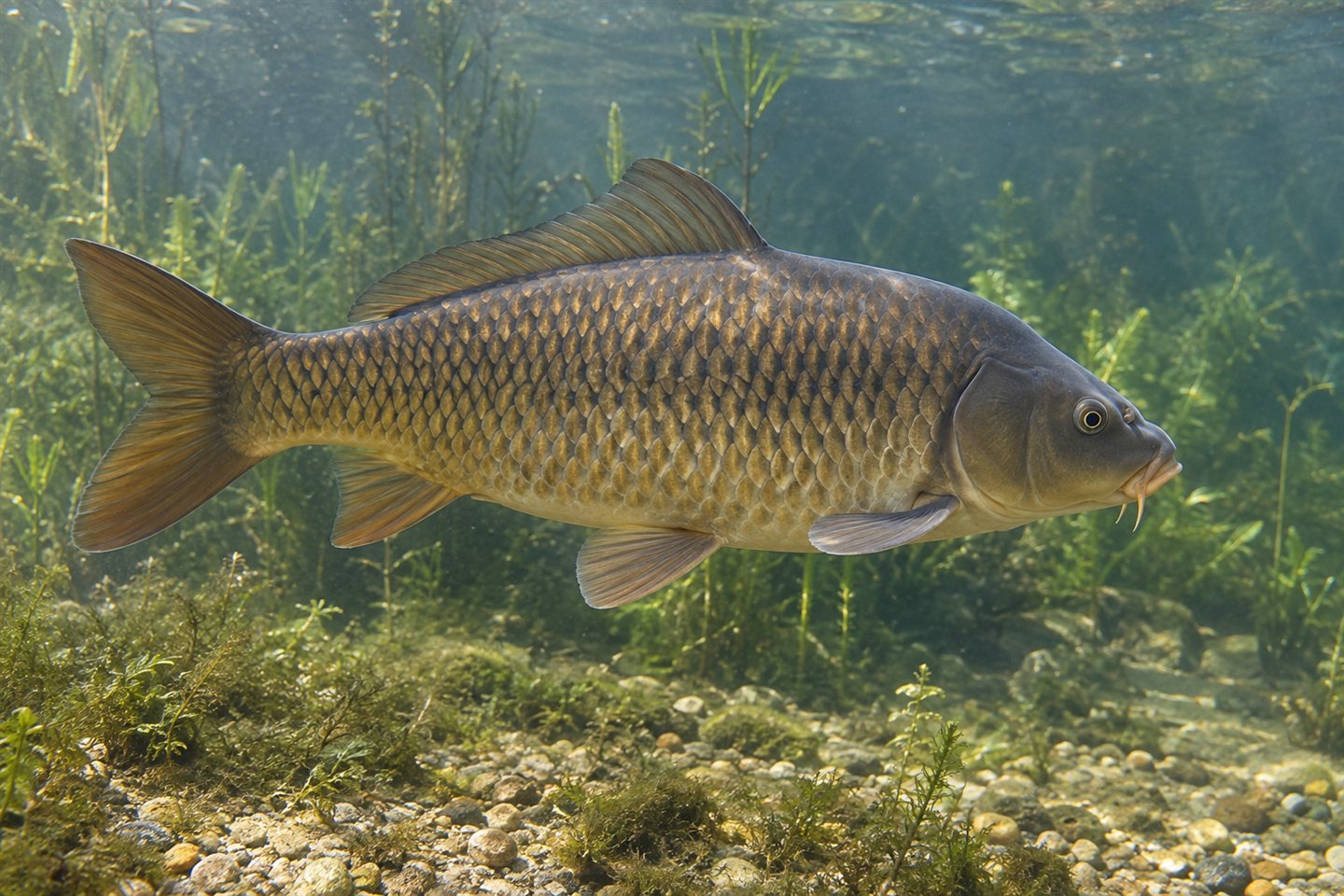
Common, mirror or leather carp? Start with the scales: commons have a regular covering, mirrors an irregular pattern of larger scales and leathers look largely unscaled. They're forms of the same species, Cyprinus carpio. We'll look at the tell-tale features and the cases a photograph can't settle.
That simple distinction is a useful beginning, not a complete identification test for every fish. Sparse mirrors can resemble leathers, photographs can conceal important features, and other fish carrying carp in their everyday name are not necessarily the same species. The best approach is to observe carefully, record what is visible and avoid claiming more certainty than the evidence supports.
This guide explains the features a beginner can use without turning fish handling into a prolonged inspection. Learn the patterns from reliable reference material at home, then keep any examination on the bank brief and gentle. A fish should be returned promptly rather than held out of water while an online discussion decides its label.
Common, mirror and leather carp: what should you look for?
The Canal & River Trust's carp species guide provides the basic distinction between fully scaled common carp, partly scaled mirrors and virtually scaleless leathers. It also identifies the characteristic mouth barbels. Use those visible features together rather than relying on colour, weight or a fishery's informal nickname.
In ordinary angling conversation, common can mean the fully scaled form specifically. In a species reference, common carp can mean the species as a whole, including its domesticated scale forms. That difference in usage explains why a scientific description may call a mirror a common carp without contradicting the angler who calls it a mirror.
For a catch note, a sensible description might be common carp, fully scaled form, or mirror carp with irregular scales along the flank. You don't need elaborate terminology for an ordinary session. Clear description is more useful than an impressive label borrowed from a photograph of a different fish.
Recognising a common carp
Look for a fairly regular covering of overlapping scales across the sides, rather than scattered oversized plates separated by broad bare areas. View the whole flank when that is possible within normal careful handling. A close crop of one small scaled patch can mislead because mirrors also carry scales in particular areas.
Scale coverage is the main feature for the common-versus-mirror question; body shape is not. A long, lean fish and a deeper-bodied fish can both be commons. Don't label a carp wild, ancient or a particular strain solely because it has an elongated shape. Those are stronger claims about history or breeding than a casual view can establish.
Notice whether the apparent pattern is genuinely regular or merely looks regular at low resolution. Water reflections, a bright flash and compressed images can hide scale boundaries. If the photograph is unclear, record the fish as a carp and retain the original image for later comparison rather than guessing confidently from a blurred thumbnail.
Recognising a mirror carp
Mirror carp show an irregular scale covering, often with noticeably large scales and areas of exposed skin. The pattern can vary greatly between individuals. Some carry only scattered scales; others are richly scaled and visually elaborate. A mirror is not defined by having exactly one line of scales or a fixed number of large plates.
Look at the distribution as well as the size of individual scales. A few large scales beside the dorsal area, an uneven patch on the flank or a distinctive arrangement near the tail can help describe what you see. Keep the fish's orientation clear in any notes so a later comparison is not confused by photographs of opposite sides.
Mirrors are often recognisable as individuals from their patterns, but use that possibility carefully. Similar-looking fish can exist, and a single partial image may omit the distinguishing area. If a fishery maintains a capture record, let its experienced staff compare the original photographs rather than declaring a named fish solely from one familiar-looking scale.
Linear, fully scaled and other mirror descriptions
Anglers use terms such as linear, scattered and fully scaled mirror to describe striking arrangements. These descriptions can be useful in conversation, but they are not a set of separate species. Nor does every informal use map neatly onto a formal genetic category. Ask what the speaker means when the label matters.
The FAO's discussion of carp scale forms explains that mirror patterns can resemble other forms and that visual scaliness has a genetic background. For an ordinary angler, the practical lesson is modest: a descriptive pattern name doesn't by itself establish a fish's breeding history or genotype.
A richly scaled mirror may at first glance look like a common. Examine the visible regularity and size of scales rather than the amount of shiny surface alone. If you remain unsure, describe the pattern in plain language. There's no need to force every attractive fish into a very precise category to appreciate the catch.
What is the difference between a mirror and leather carp?
A leather carp appears largely unscaled, which makes the beginner's distinction seem straightforward. However, a very sparsely scaled mirror can look similar, and a photograph may conceal the few scales present. Treat almost scaleless appearance as a useful observation rather than automatic proof of an exact genetic form.
Look at the fish normally and briefly, without scraping, lifting scales or manipulating fins to settle an argument. If an experienced fishery identifies a known stocked fish as a leather, that background can support the everyday label. It still doesn't require the angler to perform a detailed biological examination on the mat.
For a new or uncertain fish, wording such as sparsely scaled carp or apparent leather is honest and useful. You can ask for an informed opinion using a clear existing photograph after release. The difference between a cautious description and a definitive label is not pedantry; it is the difference between recording evidence and inventing certainty.
Mouth and barbels help separate broader lookalikes
Carp have a protrusible mouth and barbels around it, features described in the FAO's Cyprinus carpio profile. These are useful when distinguishing a likely carp from some other coarse fish. Observe visible features during normal handling rather than pulling at the mouth to make a photograph more convincing.
A folded or hidden barbel in an image is not the same as an absent barbel. Hands, net mesh and the angle of the head can obscure the mouth. Before drawing a conclusion from a photograph, ask whether the relevant area can actually be seen. A confident answer based on an invisible feature is still a guess.
Don't use one feature alone to identify an unusual fish or a possible hybrid. Mouth shape, body proportions, fins and scale arrangement can contribute together, but the combination may still be inconclusive. For a routine catch, uncertainty is acceptable. For a conservation or stocking question, involve people qualified to assess the evidence.
Colour is interesting but not a reliable shortcut
Carp may appear dark, bronze, pale or strongly coloured in photographs, and lighting can change that impression substantially. The colour of surrounding water, reflections and camera processing can also affect what the viewer sees. A dark common is still identified primarily by its structure and scales, not by whether its colour matches a favourite reference picture.
Compare images taken under reasonably similar conditions when trying to recognise a fish. Avoid dramatic filters, excessive contrast or a flash reflection that removes visible detail. Keep an unedited original for any identification enquiry. An attractive social photograph and a useful reference image are not always the same thing.
Don't diagnose a fish's health, origin or age from colour alone. A pale image is not proof that a fish is ill, and a dark fish is not proof of a long history in a particular lake. Report genuine concerns to the fishery with factual observations rather than attaching a story to a single visual impression.
Body shape doesn't reveal everything about a fish
A deep body, broad shoulders or an elongated outline can make a catch distinctive, but shape alone cannot confirm age, sex or exact lineage. The FAO material on cultured carp describes variation in body form among strains. An angler's photograph rarely contains enough controlled information to turn that variation into a dependable pedigree judgement.
Be particularly cautious about claims based on a fish being small or slim. A small carp is not automatically young enough to assign a precise age, and a long fish is not automatically a wild strain. If age or stocking history matters, ask the fishery what documented information exists rather than estimating from appearance.
Weight is similarly separate from identification. Common, mirror and leather labels describe form, not weight classes. A large carp is not necessarily a mirror, and a modest fish is not necessarily an F1. Identify visible features first and record a weight only if it was measured appropriately rather than guessed from a photograph.
Crucian carp are not small common carp
Crucian carp are a different species, Carassius carassius, and should not be treated as miniature commons. Identification can become difficult when feral goldfish and hybrids are involved. The Environment Agency and Angling Trust's detailed crucian identification guide uses several features and explicitly addresses those difficulties.
For a beginner, the useful warning is that a rounded golden fish without obvious barbels is not automatically a confirmed crucian. Photographs can hide features, and lookalikes exist. If the venue is managed for crucian conservation or the identity is otherwise important, pass clear observations to the fishery rather than making a firm claim from colour alone.
Avoid performing scale counts or repeated fin examinations on a lively fish out of water simply to satisfy curiosity. Learn from authoritative diagrams and existing photographs at home. Any formal assessment should follow an appropriate process led by competent people, not a prolonged improvised inspection during an ordinary fishing session.
What does F1 mean on a commercial fishery?
F1 is a term referring to a first-generation hybrid in breeding, and it is widely used for particular stocked carp hybrids in commercial angling. The everyday label doesn't mean every small, deep-bodied carp is an F1, nor should an angler assume that every fish called F1 has an identical appearance or documented parentage.
The specialist crucian identification resource discusses carp, goldfish and hybrid combinations and the limitations of simple visual features. The practical response is to ask the fishery what it stocks and use several observations. Don't decide parentage from one barbel count in an unclear photograph.
If you catch an uncertain fish while targeting carp, handle it carefully and record the uncertainty. A useful note might say stocked hybrid according to the fishery, rather than asserting a specific cross you can't verify. Correctly describing the source of the identification is more informative than repeating a confident label without context.
Goldfish, ornamental fish and other carp names
Goldfish are not simply a colour form of common carp. The detailed crucian guide distinguishes them and their hybrids, which is why a bright or pale fish should not be identified solely by its colour. Common names can conceal meaningful biological differences; use a reliable species reference when the fish doesn't fit the familiar carp forms.
Ornamental labels and fishery nicknames can add another layer of confusion. If someone describes a ghostie or another unusually coloured carp, ask which visible features and known history support the description. For ordinary catch records, describing the appearance and retaining a clear photograph may be sufficient without making a claim about the exact breeding cross.
Likewise, the word carp in another species' name doesn't make it a common, mirror or leather. If an unfamiliar fish appears, don't force it into this three-way comparison. Seek an appropriate identification resource or assistance from the fishery, while keeping handling brief and following the rules applicable to the water.
How to identify carp by their scale patterns
Start with the original image, not a compressed screenshot of a social post. Look for a clear view of the flank, head and tail, and check whether hands or net mesh obscure the feature being discussed. If the useful part of the fish is hidden, state that limitation instead of treating image enhancement as a way to invent missing detail.
Compare like orientations. A distinctive mirror's left and right sides may present different visible patterns, so note which side is shown. Cropped images can also reverse or conceal context. Ask for an existing alternative image when available, but never suggest recapturing or retaining the fish merely to obtain a more convenient identification angle.
The fish-care guide explains how a brief photograph fits into a prepared release routine. Identification should be done afterwards whenever possible. A careful original image taken during normal handling can answer many questions without adding a separate period out of water.
A short, useful catch-note format
Record the date, venue and your best supported description, then add one or two distinctive visible features. For example, mirror with a large irregular scale patch near the tail is more useful than stunning old warrior when the aim is identification. Keep the language factual and let any personal appreciation sit alongside it rather than replace it.
If a weight was measured, record the unit and any relevant weighing detail consistently. Don't add an estimated weight to a fishery record as though it came from scales. The same principle applies to length, age and known identity: distinguish measurement, documentation and impression so later comparisons remain meaningful.
Ask before publishing a named fish, venue location or another angler's photograph. Some fisheries have specific reporting or publicity rules. The fishery-rules guide explains why these conditions should be checked with the actual venue. A useful private observation doesn't automatically need to become a public location tip.
Three common identification mistakes
The first is treating every lightly scaled fish as a definite leather. A sparse mirror can create the same initial impression, especially from one angle. Describe what you see, compare a reliable reference and keep any uncertainty visible. You lose nothing by making a careful identification after the fish has returned to the water.
The second is using size as a species test. A small common can resemble the general outline somebody associates with a stocked hybrid, while a photograph can make a fish appear larger or smaller than it is. Weight and body shape can inform a wider assessment, but neither replaces the visible identifying features.
The third is accepting a fishery nickname as biological evidence. Names such as the linear, the leather or the ghost may be convenient labels attached to known individuals. They can help communicate locally without proving a formal category. Ask what the nickname refers to and avoid exporting it as a scientific conclusion.
Does the form change the tackle you need?
Choose tackle for the size and power of fish you may encounter, the venue and the hazards, not simply the scale pattern you hope to catch. A common and a mirror in the same lake may both demand the same sound setup. There's no sensible reason to weaken equipment because one form is imagined to fight less strongly.
The main-line guide and lead-system guide explain the practical decisions. Fish location, presentation and proper control remain more useful considerations than buying a rig marketed around the appearance of a target fish.
Handle all forms with the same care. Don't assume a heavily scaled common can be placed on a rough surface or a small mirror needs no mat. Prepare suitable landing equipment and a wet padded unhooking area, minimise handling and return the fish promptly. The identification label never reduces the basic welfare requirement.
Build identification confidence between sessions
Study several clear photographs from reliable sources rather than memorising one ideal example. Look for the feature that supports the label and notice where it is hidden or ambiguous. This is particularly helpful for richly scaled mirrors and sparse fish, where an oversimplified three-picture comparison can create false confidence.
Compare your own catch notes over time and ask experienced fishery staff to explain their reasoning. A helpful answer identifies visible features or documented stock history rather than merely announcing a name. Learning that reasoning makes the next observation more accurate and reduces dependence on instant online votes.
The beginner's guide provides the broader fishing context, while the watercraft guide helps you recognise fish in their environment. Both skills improve with patient observation. Identification is another part of learning to look carefully, not a competition to sound certain first.
Equipment worth considering
A suitable landing net, padded mat and accessible unhooking tools support brief, controlled handling while you observe a catch. Choose their working size for the fishery rather than the smallest fish you expect. The equipment should make a prompt release easier, not encourage a longer inspection or an unnecessary series of photographs.
A phone or camera you already know how to use is generally enough for an ordinary catch record. Prepare it before lifting a fish and retain the original image. Polarised glasses can help with safe bankside observation, but they don't establish species or lineage from a distant shape. Better observation matters more than buying specialist photography equipment immediately.
Fortis Bays polarised sunglasses (paid link) may help you observe a fish's scale pattern through surface glare without disturbing it. When a fish is legitimately caught, a suitably sized padded option such as the NGT Jumbo Folding Carp Cradle (paid link) supports the normal unhooking routine, subject to the water's rules. Neither item makes identification certain or justifies keeping a fish out while inspecting every detail. Use a brief photograph from normal safe handling if needed, return the fish promptly and examine the image later. Follow the venue's supplied-equipment policy where one applies.
Frequently asked questions
Are common, mirror and leather carp different species?
No. In this familiar UK angling usage, they are forms of the same carp species, distinguished mainly by scale covering. The word common can refer either to the species generally or specifically to its regularly scaled form, so context explains apparently conflicting descriptions.
Is every carp without obvious scales a leather?
Not necessarily. A very sparsely scaled mirror or an incomplete photograph can create that impression. Use a cautious visual description when uncertain and ask an informed source afterwards. Don't prolong handling to prove a label that has no immediate bearing on safe release.
Can a carp's colour tell me its age?
No reliable age can be assigned from colour alone. Lighting and appearance can mislead, and documented history is different from a visual impression. Record what you can actually observe and ask the fishery whether a known stocking or capture history exists if the question matters.
Do commons need different bait from mirrors?
Choose bait and presentation for the venue, conditions and fish behaviour rather than the scale form. There's no dependable beginner rule that one form requires a special flavour or rig. A sound, permitted presentation in a suitable location is more useful than a tackle change based on appearance.
Appreciate the fish without forcing a label
Start with scale coverage, use other visible features carefully and separate appearance from breeding history or species claims. A cautious description is a good result when evidence is limited. References were checked on 15 September 2026; the linked biological and identification sources support further learning without making a prolonged bankside examination necessary.