Your first fishing match doesn't have to be about winning. It's a chance to learn, meet other anglers and get used to fishing within a set time. Here's how to prepare, check the rules and avoid making the day harder than it needs to be.
A sensible first-match plan uses two familiar methods at most. One line might target small coarse fish reliably, while a second offers a chance of better-quality bream, tench or chub where the venue holds them. Neither line helps if its rigs, bait limits or keepnet arrangements have not been checked before the start.
We'll use a friendly club or fishery match as the starting point. Your organiser will confirm the timings, bait limits, eligible species, keepnets and weigh-in arrangements. Ask before the day if anything is unclear—it's far easier than trying to work it out while everyone else is setting up.
Match fishing for beginners: what happens on the day?
Choose an open or club match described as suitable for newcomers and contact the organiser before entering. Obtain the current rules, venue details, draw and fishing times, entry cost, bait limits and required nets. Confirm licence and fishery permission, prepare two simple setups at home and arrive early enough to register without rushing.
At the draw, fish the peg allocated. Set up fish care first, plumb or assess the permitted lines, and wait for the official start signal before feeding or casting unless the rules explicitly allow an action. During the match, protect a dependable catching line, make changes one at a time and stop immediately at the finish signal.
Find the right first match
A small club match, novice event or friendly open on a familiar mixed fishery is usually a better introduction than a large qualifier. Look for clear contact information and a named organiser. Ask whether somebody can explain the draw, signals and weigh-in, and whether the event expects specialised pole or commercial-fishery tackle.
Tell the organiser honestly that it is a first match. This is not a request for tactical advantage; it allows practical guidance about parking, registration, carrying distance, accessibility and required equipment. Many problems happen because a newcomer is too embarrassed to ask what “draw at eight, all-in ten” actually means.
Don't enter solely because the advertised winner's prize or recent top weight is large. A beginner-friendly event with a manageable walk and varied coarse fish offers more learning. Read cancellation and pools arrangements before paying, and never assume optional side pools are part of the basic entry.
Read the match and fishery rules separately
The match rules govern the competition; the fishery rules protect the water and may add stricter tackle, bait or net conditions. Both apply. The event information may set bait limits, eligible species, maximum pole length, number of rods assembled, permitted help, feeding times and how ties are resolved.
Fishery rules may specify hook type, feeder arrangement, minimum line, net treatment, restricted banks, platform use and banned baits. A method permitted in another match is irrelevant. Photograph or download the latest rules and ask the organiser to resolve any apparent conflict before travelling.
National and regional rod-fishing byelaws continue to apply during a competition. A match cannot waive licence limits, close seasons or legal net requirements. The rod licence guide provides background, while the current official pages remain decisive.
Licence, permission and seasonal legality
In England and Wales, an angler aged 13 or over needs the appropriate rod fishing licence. A match entry normally provides or confirms fishery permission only for the event and stated water; it doesn't replace the licence. Junior licensing and rules elsewhere in the UK differ, so check the country being fished.
River coarse matches in England and Wales must respect the statutory close season from 15 March to 15 June inclusive. Some canals and designated stillwaters are also covered, and clubs can impose further closures. A date in an informal message is not enough if it conflicts with official or controlling-water rules.
Carry required proof and arrive through the authorised access. Don't practise on a closed match length or outside a permitted period. Championship rules sometimes close waters before an event, while local clubs may have their own practice convention.
What happens at your first club fishing match?
Most club matches have a registration or meeting time, a peg draw, a preparation period, an official start, an official finish and a weigh-in. Exact timings and signals vary. Record them in the phone or on paper and confirm whether a whistle, horn, shouted call or message is used.
The draw assigns a peg by the organiser's system. Once drawn, use only the authorised bank space and water. Don't swap because another peg looks easier unless the organiser makes an accessibility or safety decision. The random element is part of match fishing and teaches anglers to solve the water in front of them.
During preparation, rules may permit plumbing, mixing bait and assembling tackle while prohibiting loose feed, groundbait or a cast with a feeder. National events publish detailed distinctions, but a club can use different ones. Ask exactly what may enter the water before the start signal.
At the finish, stop fishing immediately. The rules explain whether a fish already hooked may be landed and how time is called. Don't decide privately that one more cast or another minute is harmless; a fair match depends on everybody observing the same boundary.
What tackle should I take to a first fishing match?
Pack around familiar methods and the likely peg, not every item owned. A float rod, feeder rod, short pole or whip may form the core. Add suitable reels, line, prepared rigs, floats or feeders, rests, disgorger, forceps, scissors, plummet, bait containers, landing net, permitted keepnets and an unhooking mat where larger fish may be caught.
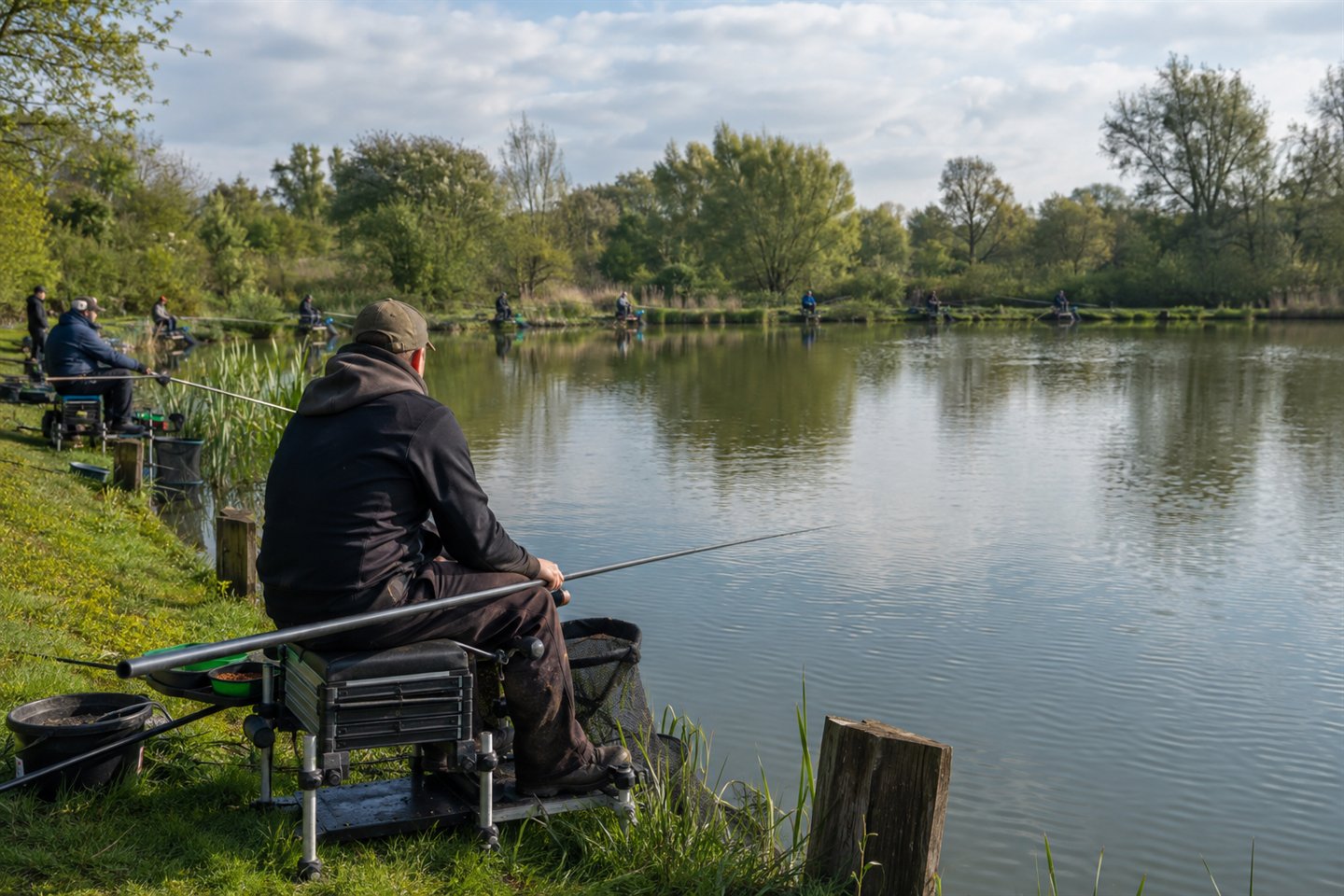
A seat box or stable chair keeps tackle organised, but it must fit the platform and carrying plan. A search for a match fishing seat box and accessories (paid link) shows very different systems. Compare stability, footplate, leg diameter, attachment compatibility and packed weight rather than counting drawers.
Carry waterproofs, layers, drinking water, food, medication, sun protection, a charged phone and a small first-aid kit. A match clock doesn't stop changing weather. Keep electrical and carbon tackle clear of overhead cables, and leave if lightning or an unsafe platform removes safe control.
Prepare rigs before the day
Tie or inspect a small set of rigs at home and label their line, hooklength and float or feeder purpose. Pull-test knots and replace aged line. Ready preparation saves time after the draw and prevents small hooks being handled hurriedly on a cold or wet bank.
For pole fishing, prepare a shallow or margin option only if the venue and fish plan justify it, plus a main bottom rig. For rod-and-line work, carry a float setup and a simple running feeder rather than several complex variations. The beginner pole guide and beginner feeder guide explain those foundations.
Don't make every rig extremely fine because a match rewards weight. Balanced tackle lands fish efficiently and avoids losing hooks or trailing line. Use the fishery's minimum strengths where stated and account for the largest likely accidental fish.
Keepnets are controlled fish-care equipment
A keepnet allows fish to be retained for weighing, but it is not automatically permitted in every match or for every species. National byelaws specify construction and minimum dimensions in England, while event and fishery rules may require multiple nets, set weight limits, separate species or ban retention in hot conditions.
Obtain the required number and type before entering. A search for a coarse match fishing keepnet (paid link) can show lengths, ring shapes and materials. Verify soft knotless construction, dimensions and venue policy; a seller's word “match” is not evidence of compliance.
Dry nets thoroughly between waters and follow dipping or on-site-net procedures. Place each net where it is fully extended with good water exchange, secure it without crushing rings and avoid shallow hot margins. Never exceed an event limit while waiting for somebody else to suggest a second net.
Plan two lines, not six
After drawing, assess depth, visible cover, wind, neighbouring anglers and safe landing space. A main line at comfortable range should offer repeatable feeding and presentation. A second line can differ by depth or method, such as a closer float line and a farther feeder line.
Give each line a clear job. The reliable line may aim for regular roach and skimmers; the second may use a larger bait for bream or tench. If both receive every bait and constant disturbance from the start, neither supplies useful information.
Mark each line with a far-bank feature and exact pole section or clipped distance where appropriate. Accuracy matters more in a match because neighbouring anglers create competing feed signals. The beginner should not fish beyond repeatable range simply because the next peg does.
Plumb and map the peg
Use the preparation period to find depth changes, shelves, firm areas and snags within the rules. With a pole or float, plumb methodically. With a feeder, some competitions permit only a plain weight before the all-in; follow the event instruction precisely.
The guide to plumbing the depth explains how small changes affect presentation. Record the depth on the rig or pole section. A correctly plumbed ordinary area is more valuable than an attractive feature that cannot be found again.
Check the landing path at the same time. Move attachments and spare rods so the net can travel freely. A hooked fish should not be threaded between pole sections, bait bowls and an open box lid.
Choose bait within the limit
Match rules may cap groundbait, worms, leam, pellets or total bait, and they may define how quantities are measured. Prepare within the actual limit and carry containers that let a steward inspect it. Don't rely on an online conversion or assume liquid is excluded.
For a first club match, maggots, casters, worms, permitted pellets and a suitable groundbait cover many situations without creating a complicated menu. The groundbait beginner guide explains mixing and release. Choose baits used successfully at that venue, but don't copy quantities without considering the peg and weather.
Keep some bait in reserve. A heavy opening feed commits the whole match before a bite has been seen. Smaller introductions let the angler respond if the peg contains fewer fish, the water is cold or the quarry is feeding above the bottom.
The opening phase
At the all-in, make the planned initial feed calmly. Begin on the line most likely to produce useful information rather than automatically reaching for the largest-fish option. Early small fish establish depth, feeding response and whether tackle is working correctly.
Repeat the same presentation for several casts or runs. A single missed bite doesn't justify changing hook, float, bait and depth together. Inspect the bait and hook, then alter one variable only after a pattern appears.
Keep the peg quiet and organised. Avoid dropping pole sections, slamming lids or recasting a heavy feeder repeatedly without purpose. Other anglers' activity may move fish, but a beginner controls only the disturbance created from the assigned peg.
Build a dependable catching rhythm
When bites arrive regularly, decide what must be repeated: bait amount, cast interval, depth, hookbait or location. Feed before unhooking only if the rig and bait can be left safely and rules allow it; otherwise finish fish care first. Speed never excuses poor handling.
A simple rhythm is cast or lower, settle, recognise the bite, land, unhook, retain correctly, rebait and repeat. Place every tool in the same position. Seconds saved by organisation accumulate without rushing a fish.
If roach are the main catch, the roach-on-the-float guide explains shotting, depth and loose feeding. In a match, small fish can build a useful weight, but only when the capture rate remains efficient and the retained fish have suitable net space.
When to try the second line
Leave the main line because evidence supports a test, not because the neighbouring angler has caught. A planned time, a clear slowdown or signs of larger fish can justify ten to twenty focused minutes elsewhere. Continue any minimal feed needed to preserve the first line only if the plan and bait limit allow it.
Judge the second line by response and fish size together. One better bream can outweigh several small fish, but an hour without indications may not. Return to the dependable line before confidence and time disappear.
Don't alternate so rapidly that each line is disturbed just as fish arrive. Match pressure can make bites develop slowly. A watch supports disciplined trials, though rigid timing should yield to obvious feeding activity.
Respond to the anglers nearby
Neighbouring catches provide clues, not instructions. If several pegs catch shallow, testing a shallower depth may be rational. If one angler lands a large fish on a specialised method, copying immediately without the tackle or feeding history usually is not.
Stay within peg boundaries and cast straight unless rules or the organiser define another line. Don't let a hooked fish run through a neighbour's swim without communicating. Courtesy resolves tangles more effectively than arguing about whose fish crossed first.
Information rules vary. Some matches allow advice; others restrict assistance or communication. A beginner may be permitted help with a practical safety issue but not tactical coaching. Ask before the start and involve the steward when uncertain.
Make changes in a useful order
When bites fade, first check hookbait, hook point and presentation. Then reconsider depth and feeding rate. Only after those basics should a different bait or line be introduced. This order prevents tackle changes from masking a simple blunt hook.
Reduce feed when bites stop after each introduction; increase carefully when the fish respond immediately and competition is building. If foul-hooked fish or liners appear, the shoal may have moved in depth or feed may be falling through too slowly. Adjust shot or feeding before reaching for a new rig.
Keep a mental note of what happened. “No bites” is not enough: note whether the float settled, whether bait returned untouched, whether small fish topped and when the wind changed. Match craft grows from specific observations.
Fish welfare during the match
Use a soft knotless landing net for any fish that cannot be brought to hand safely. Wet hands, unhook over the net or a wet mat, and place eligible fish gently into the correct keepnet. Never throw fish, slide them across a dry platform or carry several together.
Monitor retained fish and net position. In hot weather, shallow margins may be warm and poorly oxygenated. Follow the organiser's net limits and any decision to shorten, suspend or change the event. If fish are distressed, tell a steward immediately instead of protecting a match result.
The coarse fish care guide covers landing and unhooking in more detail. Competition adds retention and time pressure, but it doesn't reduce the standard owed to each fish.
A timer supports, rather than drives, decisions
A visible watch or timer helps track recast intervals, planned line trials and the approach of the finish. It should be silent or unobtrusive and must not conflict with organiser signals. Never rely on a personal clock to override the official all-in or all-out.
A search for a water-resistant fishing match timer (paid link) shows watches and standalone devices. Compare visibility, simple controls and battery reliability; unnecessary alarms can disturb neighbours and create confusion.
The final hour
Review which line has produced weight and how recently it delivered. The final hour is not automatically the time for a gamble. If a steady silverfish line remains productive, protect it. If the match requires a better fish and a prepared line has shown signs, make a defined trial.
Keep enough bait for the chosen finish and no more. Extra loose feed thrown because it cannot be taken home may damage the swim and wastes bait. Pack unused dry tackle only when doing so doesn't distract from an attended rod or obstruct fish care.
Listen for time calls and stop at the signal. Follow the rule for a fish already hooked and notify the steward clearly. Don't conceal a late fish or pressure a neighbour to accept it; an honest first match is more valuable than one disputed ounce.
The weigh-in
Leave fish in secure, correctly positioned nets until the weighing team arrives, unless instructed otherwise. Remove rods and obstacles from the route. Follow the steward's directions for lifting, transferring and returning fish; don't tip a net from height or crowd the weighing station.
Check that the recorded weight is heard or seen as the procedure allows, then sign or confirm only when satisfied. Results may be decided by total weight, section or points depending on format. Let the organiser calculate rather than debating another peg's catch on incomplete information.
After release, inspect the net and water for any fish left behind. Pack wet nets separately and clean and dry them before another venue. Biosecurity continues after the result is announced.
Etiquette after the match
Congratulate the anglers who framed and thank the organiser, stewards and fishery. Ask one concise question about the peg if somebody has time. Detailed tactical interrogation while equipment is being weighed or packed can wait.
Write down the draw, depths, methods, bait quantities and the times bites changed. Identify one skill to practise before entering again. Buying an entirely new system after one result is rarely the best lesson.
Common first-match mistakes
Too many methods create clutter and indecision. Too much opening feed removes flexibility. Extremely fine tackle loses fish, while unfamiliar complex rigs waste preparation time. All three come from trying to imitate an advanced angler's complete day instead of using a beginner's reliable strengths.
Another mistake is treating the rule sheet as background reading. A bait infringement, wrong net or early feed can invalidate otherwise good fishing. Put required rules beside the tackle list and check each item before departure.
Frequently asked questions
Does a beginner need a pole?
No. Many matches can be fished with float or feeder rods, subject to venue and event. Choose an event suited to familiar tackle and ask the organiser. A pole is valuable for precision but is not a universal entry requirement.
How many keepnets are needed?
The event and fishery specify the number, separation and weight limits, while national byelaws set legal construction in England. Obtain the written rule before the day and bring a spare when advised. Don't guess from another venue.
Can someone help at the peg?
Assistance rules vary. Safety help and junior support may be treated differently from tactical coaching or physical assistance during fishing. Ask the organiser exactly what is permitted before the start.
What should the first target be?
Target a clean, legal match with a repeatable catching method. A modest weight of small coarse fish teaches more about feeding and efficiency than an unplanned wait for one large fish.
Final thoughts
Get the rules sorted, arrive in time for the draw and stick with one or two familiar approaches. Keep the feed controlled and follow the fish-care and weigh-in routine. You don't need an expert's tackle collection to enjoy a first match. Ask questions, take a few notes and see what you'd do differently next time.
Sources and further reading
Angling Trust competition FAQs direct anglers to current competition information and model match rules.
Angling Trust 2026 commercial stillwater championship rules illustrate how draw, preparation and fishing rules are defined for a specific event.
Environment Agency national rod-fishing byelaws cover legal keepnet construction, licences and freshwater tackle rules in England.
Angling Trust: Best Practice Guide to Freshwater Angling covers fish care, safe fishing and biosecurity.