When do carp spawn in the UK? Usually in the warmer part of late spring and early summer, but conditions matter more than a date. We'll show you the signs to watch for. If carp are spawning, leave them undisturbed and follow the fishery's advice.
For a beginner, the difficult part is often recognising what you're seeing. Carp can cruise, feed, bask, roll and chase, sometimes within the same small area. You don't need to identify every movement perfectly. You do need a sensible response when behaviour suggests spawning or when the fish appear distressed.
This guide explains the seasonal picture, useful signs and the practical decisions before, during and after a session. It is about knowing when to stop and how to support good fish care, rather than finding a way to catch fish that should be left alone.
When do carp spawn in the UK, and what should you watch for?
Late spring into early summer is a useful period to have spawning in mind, not a fixed national timetable. A sheltered shallow pond may behave differently from a deep gravel pit, and fish in neighbouring waters need not start together. An unusually warm spell or a change in conditions can also make last year's dates a poor guide.
The FAO common-carp species account describes European carp beginning to spawn around water temperatures of 17–18°C. That is biological background, not a permission threshold for anglers. A reading below or above a particular number cannot establish the condition of all the fish in your lake.
Think of the calendar as a reminder to ask better questions. Has the venue seen spawning activity? Are any areas closed? Has the fishery reopened after monitoring recovery? These answers matter more than whether a general guide labels the month as a good time for carp fishing.
What spawning actually means
Spawning is reproduction: females release eggs and males fertilise them externally. Carp commonly use shallow vegetated areas, where the eggs can attach to suitable material. The splashing anglers notice is only the visible part of that process. There may be eggs and very young fish in an area after the adults become less conspicuous.
This is why disturbing reeds, dragging a marker lead through the margins or walking into a spawning area is not a harmless way to have a closer look. Leave the habitat intact and observe from an authorised bank position. Don't collect eggs, move vegetation or attempt to transfer young fish elsewhere.
Not every carp necessarily follows the same schedule, and not every quiet interval means the whole water has finished. Avoid reducing a complex living process to a countdown from the first splash you saw. The people monitoring the fishery over successive days have information that a single visitor lacks.
The signs worth taking seriously
Look for repeated close chasing, several fish pressing together and vigorous activity through shallow marginal vegetation. Fish may repeatedly return to the same sheltered area rather than steadily patrolling a route. The combination is more meaningful than one isolated roll or a carp briefly breaking the surface.
The Angling Trust's spawning and distress advice recommends leaving such fish alone and contacting the fishery when uncertain. It also highlights the extra risk from catching and handling fish during spawning. Treat uncertainty as a reason to pause.
Watch quietly for a short period without crowding the edge. You're looking for enough information to make a welfare decision, not proof that would satisfy a biology examination. If repeated chasing and contact in the reeds make you suspect spawning, keep hooks and nets away while you ask the bailiff.
How to tell if carp are spawning or feeding
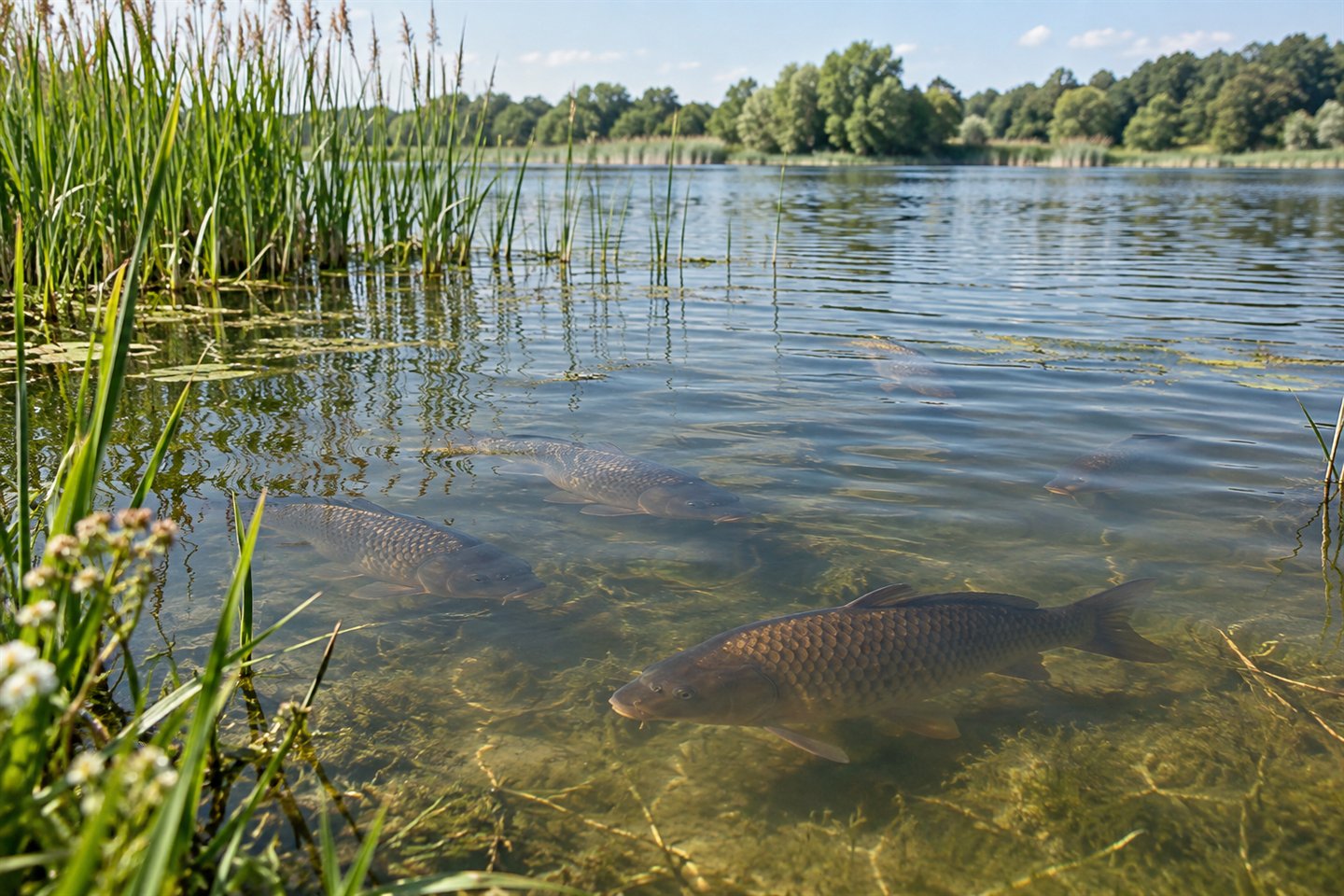
A carp feeding near the bottom may tilt, disturb sediment and change position between mouthfuls. A cruising fish may follow a steady route with little contact with other fish. Basking carp can remain high in the water without taking food. These observations provide context, but none is a foolproof test by itself.
Don't throw bait among a suspicious gathering to see whether the fish eat it. A few fish accepting food would not demonstrate that the rest are ready to be angled for. It could also draw your attention away from activity in an adjacent patch of vegetation.
If you're still learning to read fish behaviour, separate observation from fishing. The guide to finding carp helps with ordinary location clues. During the spawning period, add a further question to every sighting: is this a fishable opportunity, or an area that needs space?
Gasping fish need a different response
Repeated gasping at the surface, unusual lethargy, loss of balance or numerous fish appearing unresponsive should not be dismissed as spawning. Several species gathering around an inlet or aerator can also warrant concern. You can't measure dissolved oxygen by looking, but you can recognise that the situation deserves prompt reporting.
The Environment Agency's heat guidance explains how hot weather and changes in water quality can put fish under stress. Stop fishing, notify the fishery and give a clear description. Don't wait for dead fish to appear before raising a concern.
In England, report distressed fish or suspected pollution to the Environment Agency incident hotline on 0800 80 70 60. In Wales, use Natural Resources Wales, on 0300 065 3000. Use the relevant authority for Scotland or Northern Ireland rather than assuming the English number covers every UK water.
Why a warm day doesn't tell the whole story
Air temperature and water temperature are different measurements. A sunny afternoon can warm a shallow margin while deeper water follows a different pattern. Shade, depth and recent weather affect the conditions fish experience. A weather application cannot tell you whether a particular group of carp has completed spawning.
Likewise, an apparently comfortable day for the angler doesn't prove healthy water conditions. The effects of prolonged heat, low levels and algal changes may remain when the sky becomes cloudy. Let current fish behaviour and the fishery's checks guide the decision, not simply how pleasant it feels on the bank.
The bright, calm-weather guide concerns tactics when fishing is appropriate. Welfare comes before those choices. There's no rig adjustment that converts a fishery under environmental stress into a sensible place to continue trying for a bite.
Check before loading the car
Read the fishery's latest dated update and the rules for the exact lake you intend to visit. On a complex, one water may close while another remains open. Check the date as carefully as the lake name; an old reopening announcement can stay visible long after the conditions it described.
If the position is unclear, ask a direct question: are carp currently spawning, and is the lake open for the type of fishing I have planned? Ask when the information was last checked. A vague statement that the site opens all year doesn't answer a temporary fish-welfare question.
For a booked visit, read the closure and rearrangement terms before paying. Keep some flexibility in your plans rather than treating a deposit as a reason the fish must be caught. The cost of changing a session is frustrating, but it doesn't alter what is appropriate on the day.
Should I stop fishing when carp start spawning?
Retrieve your tackle carefully without casting another rig through the active area. If fish are directly over a line, take a moment to choose a controlled retrieval rather than sweeping a hook through them. Ask the bailiff for help if the line cannot be recovered safely without disturbing the group.
Stop feeding and tell the person responsible for the fishery what you have seen. Explain the swim, the area and the approximate time. Avoid claiming certainty about the whole lake when you have only watched one corner. Accurate observations are more helpful than dramatic conclusions.
Don't simply move ten metres along the bank and cast back towards the same fish. A closed or vulnerable area includes the water you would fish into, not merely the patch of bank where you sit. If there's no clearly appropriate alternative confirmed by the venue, finish the session.
Changing species or lakes is not an automatic solution
Fishing for roach on the same busy spawning margin can still disturb carp through casting, hooked fish and landing-net use. Changing the intended target doesn't make the physical activity disappear. Consider the actual water you would occupy and the likelihood of incidental carp captures.
A separate lake may provide an alternative if the fishery confirms that its fish are not affected and normal fishing remains suitable. Inspect it on its own merits. Don't assume every water on the complex has the same temperature, stage of spawning or management decision.
If moving between fisheries, clean and dry equipment properly and follow any additional local disinfection requirements. A last-minute change should not become a reason to carry wet nets straight from one water to another. Sometimes the simplest alternative is a walk, tackle maintenance or a different day's fishing.
How long should you leave carp after spawning?
There's no universal number of days that an individual angler can apply confidently to every water. The end of visible chasing, the condition of the fish and environmental conditions all matter. Follow the fishery's reopening decision and any further restrictions, while remaining alert to fish that still appear vulnerable.
Don't calculate a reopening date from somebody else's social-media post and assume it overrides the venue. Their observation may concern another lake, a different group of fish or only part of the spawning activity. Ask the people responsible for this water what their current decision is.
If a fishery reopens but you see renewed spawning, stop and report it. Reopening is based on information available at the time; your observation can help the staff respond to a change. Responsible fishing involves paying attention after admission as well as checking the rules before arriving.
The river close season is a separate rule
In England and Wales, coarse fishing on rivers is closed from 15 March to 15 June inclusive. Most enclosed stillwaters and canals can be fished throughout the year, subject to local byelaws and water-specific restrictions. The official close-season guidance explains the distinction.
That legal calendar is not a statement that all carp finish spawning on 15 June. A river can reopen for coarse fishing while particular fish still need to be left alone. Equally, a lake without that general river closure can introduce a spawning closure of its own.
Don't apply England-and-Wales rules indiscriminately across the UK. Check the correct jurisdiction and the controlling fishery. The fishery-rules guide explains how licence conditions, local requirements and the venue's rules sit alongside each other.
If you unexpectedly hook a vulnerable fish
Don't intentionally target fish you believe are spawning. If a fish is already hooked when a concern becomes apparent, keep the situation controlled and obtain help where needed. Avoid extending the fight for entertainment or rushing so aggressively that tackle fails or the fish is injured.
Have the net and wet unhooking equipment ready before any fishing begins. Keep the fish supported, minimise handling and avoid an optional weighing or photograph routine when prompt return is the better choice. If the fish appears injured or struggles to recover, alert the bailiff immediately.
Don't squeeze the abdomen, try to release eggs or apply improvised treatments. These are not jobs for an angler attempting to help on the bank. Nor should you carry the fish to another lake. Let the responsible fishery staff and appropriate professionals decide any intervention.
Make a useful report without making things worse
Describe what you can actually see: several carp repeatedly chasing through reeds, fish of different species gasping, or an individual lying unusually still. Include the exact location and time. A short video from a safe distance may help, provided recording doesn't delay reporting a serious concern.
Keep away from suspect water, unstable margins and electrical aeration equipment. Don't enter the lake to investigate or attempt to connect pumps yourself. Fishery staff need clear access to deal with an incident, so move your tackle out of the way when requested.
Share information calmly with nearby anglers. A simple explanation that the bailiff is checking a welfare concern is more constructive than arguing or publicly accusing people before the facts are known. If someone deliberately ignores a closure, report it to the fishery rather than escalating a confrontation.
A practical plan for a disrupted fishing day
Suppose you arrive for a six-hour session and find a spawning notice at the entrance. The first job is to understand which water it covers, not to unload quickly before anyone notices. Contact the venue using its stated process and establish whether an alternative or rearrangement is available.
If no fishing is appropriate, use the time for work that genuinely helps the next trip. Check the last few metres of main line, replace damaged components, organise fish-care equipment and review your session notes. Keep hooks safely contained if you're working somewhere other people or animals can reach them.
For a future booking, use the Session Planner to record a backup date and the point when you'll check venue updates. Planning for uncertainty makes a changed trip easier to accept. It also removes the temptation to interpret every ambiguous sign as permission to carry on.
Teach children to notice rather than interfere
Spawning can be fascinating to watch from a respectful distance. Explain that the fish are reproducing and need space, just as nesting birds do. A child doesn't need a lesson in every biological detail to understand why casting into the gathering is the wrong choice.
Choose a safe position away from the edge and keep the visit short enough that watching remains enjoyable. Don't encourage children to poke fish with a landing net, collect eggs or lift vegetation to see what is underneath. If they cannot observe without disturbing the area, move on.
Give the day a positive ending that doesn't depend on fishing. Looking for dragonflies from the path, identifying trees or drawing the lake can preserve the enjoyment of being outdoors. The lesson is that looking after fish is part of angling, not an interruption imposed by adults.
Keep a spawning note that is useful next year
A brief record can help you ask better questions when the next season arrives. Write down the date, lake, area and behaviour you actually observed, and distinguish that from information supplied by the bailiff. For example, several carp repeatedly chasing through the western reeds is a clearer note than the lake spawned today.
Record the venue's decision separately: whole-lake closure, a restricted bank or a request to stop fishing a particular area. Include the date of any reopening notice, but don't treat that date as a prediction for the following year. The value is in understanding the fishery's communication and planning process, not creating your own unofficial calendar.
If you measured water temperature, note where and how, without pretending the reading represents the entire lake. A shallow bucket sample taken in sunshine and a consistent reading from deeper water are not equivalent observations. You don't need a thermometer to behave responsibly; it is only an optional addition to a careful record.
Keep the record proportionate. There's no reason to visit a closed fishery without permission to collect more data, and no need to reveal sensitive locations publicly. On your next permitted visit, ask whether the observations are useful to the staff. A small amount of accurate information, shared respectfully, is more valuable than a detailed theory built from uncertain sightings.
If you fish through a club, ask how urgent notices are distributed and keep your contact details current. Knowing where to find the latest closure or reopening message can prevent a wasted journey and helps the club make welfare decisions without confusion.
Equipment worth considering
Polarised glasses can make quiet observation easier when glare obscures the margins. A small notebook or a phone kept safely away from the water helps record the location and timing of unusual behaviour. Neither item is essential: careful watching and a clear report matter more than specialist accessories.
Maintain an appropriately sized landing net and padded unhooking equipment for occasions when fishing is suitable. Check seams, mesh, handles and supports before a session rather than waiting for a capture to reveal a defect. Buying better tackle doesn't remove the need to stop when the fish need a rest.
Fortis Bays polarised sunglasses (paid link) may help you observe activity from a safe distance without putting a bait among spawning fish. If you pack up or change venue, a SPEERO stink sleeve (paid link) can contain a damp net during transport, provided it fits. It is not a cleaning treatment: remove equipment promptly and follow the appropriate check, clean and dry routine before using another water. Neither accessory is essential to making the correct decision to stop. Keeping rods out and following the fishery's welfare instructions requires no new purchase.
Frequently asked questions
Do carp always spawn in May?
No. May can fall within the period when UK anglers begin seeing spawning, but local conditions vary and activity can occur later. Use current information from the actual fishery and observe the fish. A familiar date from last season is a prompt to check, not a reliable prediction.
Does splashing always mean spawning?
No. An isolated roll or splash has several possible explanations. Repeated close chasing and contact through shallow vegetation are more concerning as a combination. If you can't distinguish normal activity from spawning or distress, pause fishing and ask the bailiff instead of casting into the group.
Can I fish as soon as the carp stop chasing?
Don't use one quiet observation as the whole decision. Other fish may still be spawning, activity may resume and the fishery may be allowing a recovery period. Follow its current position and report anything that suggests the situation has changed after reopening.
Should I add bait to help fish recover?
Don't introduce extra feed as an improvised welfare measure. Feeding and water-quality management belong with the people responsible for the fishery. Take unused bait home and ask before introducing anything outside ordinary permitted fishing. Good intentions don't establish that additional food is needed or helpful.
Let the fish decide the timetable
Check with the fishery, watch the carp and be ready to leave them alone. The calendar only gives you a rough idea; the fish and conditions tell you what matters today. Knowing when not to cast is part of looking after the water. There will be another session when the carp are ready.
Biology, welfare and reporting references linked above were checked on 15 September 2026. They are general guidance, not a live assessment of any named fishery. Temporary closures and instructions from the responsible authority or venue must be checked again before your visit.