Starting coarse fishing on a river? Choose a safe, manageable swim before worrying about reaching the far bank. We'll look at the flow, tackle and feeding, then build a straightforward plan for your first session.
A first river session uses one float or feeder line, balanced tackle and a small bait plan. Fish close enough to control the rig, feed according to the current and move only where access and permission allow. Stronger flow is not automatically better, and a dramatic feature is not useful if a hooked fish cannot be followed or netted safely.
We'll keep this to beginner coarse fishing, rather than game or specialist predator methods. Before the trip, check the season, regional byelaws and permission for your exact stretch. These differ between UK countries and rivers, and the club may have its own tackle rules too.
River coarse fishing for beginners: float or feeder?
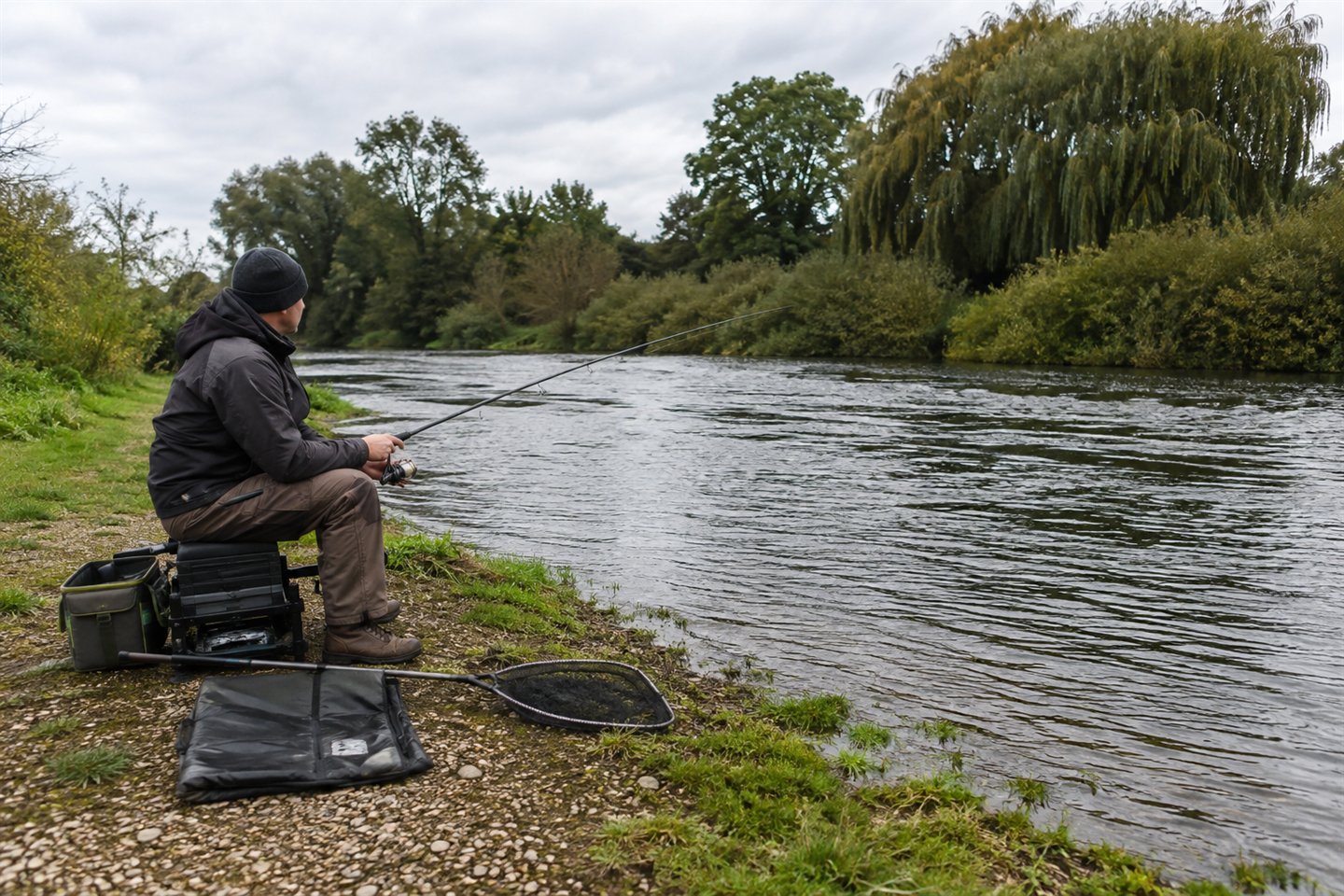
Choose a known club or day-ticket stretch recommended for novices. Check river level, weather, parking, access, licence, permission and the statutory close season. On arrival, avoid steep banks, powerful water, weirs, overhead cables and any peg without a safe landing area. If the river looks materially different from the information used to plan, reassess before unloading.
Begin with a float in a steady glide or a light running feeder on a comfortable line. Plumb or cast carefully to understand depth and bottom, introduce little feed and keep the rod attended. Use tackle capable of controlling the largest likely coarse fish and stop if rising water, debris, heat or poor footing makes fish care uncertain.
Licence, permission and the river close season
In England and Wales, anglers aged 13 or over need the appropriate rod fishing licence for freshwater fishing. That licence is separate from the club membership, day ticket or landowner permission needed to fish a particular bank. A public footpath beside a river doesn't create public fishing rights.
The statutory coarse fishing close season on rivers, streams and drains runs from 15 March to 15 June inclusive in England and Wales, subject to the published national and regional framework. During that period, don't use coarse-fishing methods on a river simply because another species could theoretically take the bait. Local byelaws explain any additional restrictions.
Some tidal reaches and cross-border waters have particular rules, and Scotland and Northern Ireland use different systems. Consult the authority for the country and the exact stretch. The rod licence guide is an introduction, but it cannot replace the current official pages or club book.
A club can close a stretch, restrict access after rain or add a longer conservation period. Respect notices, gates, livestock, crops and parking conditions. Permission can be withdrawn when anglers damage banks or obstruct residents, so access behaviour is part of legal and sustainable fishing.
Plan from conditions, not the calendar
Check recent and forecast rainfall across the catchment, not only at the peg. A dry local morning can follow heavy rain upstream, and river levels may rise later. Use official flood information where available and telephone the fishery when the safe state of the bank is uncertain.
Wind direction and temperature influence comfort and float control, while water colour and pace affect presentation. A slightly coloured, stable river can bring fish closer to cover and the bank. A rapidly rising river carrying branches is a hazard, not an invitation to test heavy feeders.
Set a clear cancellation point before travelling. Flood warnings, lightning, extreme heat, closed access or a level beyond personal experience are sufficient reasons not to fish. The most responsible river session is sometimes the one postponed before tackle leaves the vehicle.
How to read river flow before choosing a swim
Walk only within the permitted length and keep away from fragile or private banks. Look for changes in surface speed, seams between currents, smooth glides below faster water, deeper bends, eddies and cover. These features can provide food, shelter or a route, but their value changes with level.
A crease is the visible or inferred boundary between flows of different speed. Food can travel along it and fish may hold on the easier side while intercepting items from faster water. Cast to a line that can be controlled from the peg, not automatically to the most distant seam.
Inside bends often carry steadier, shallower flow and deposited material; outside bends may be deeper but can be undercut and hazardous. Never stand on an edge merely to gain casting range. Probe the ground with care from well back and reject any platform that shifts, crumbles or becomes slippery.
Bridge shade, tree roots, weed edges and rafts can hold chub and other fish, yet they are also snags. A fish should not be hooked where the tackle and peg provide no realistic route to landing it. Move the presentation away from the obstruction until a safety margin exists.
Flow is three-dimensional
The surface shows only part of the river. Water near the bed is slowed by friction, while bends, depth changes and obstructions create complex paths. A float may travel quickly as a hookbait drags more slowly below, and a feeder may hold while the bow in the line continues to pull.
Use observation and controlled tests. A float that repeatedly dives at one point without a fish may be catching bottom; one that accelerates or swings inward is crossing flows. A feeder that rolls can sometimes reveal the edge of a steadier channel, but repeated uncontrolled movement calls for a different weight, line or swim.
Don't solve every current problem with heavier tackle. Shortening the cast, lowering the rod tip, changing line angle or choosing slower water can restore control with less load. A feeder must be heavy enough to behave predictably, not so heavy that it anchors an unsafe rig or exceeds the rod rating.
Choose float or feeder, then keep it simple
Float fishing provides continuous information about pace, depth and bites. It suits glides where the rig can be followed from the peg. Feeder fishing concentrates bait near the bottom and can work in deeper or steadier lines, but the beginner must recognise quivertip movement caused by current and debris.
A first trip is easier with one assembled method and a modest alternative stored safely. Switching every twenty minutes prevents either swim from developing and fills a confined bank with loose tackle. Choose from what the river does, then give the method a fair test.
The coarse fishing beginner guide explains the wider equipment picture. River tackle should then be adjusted for current, expected species, snags and club rules rather than copied directly from an enclosed stillwater setup.
A controlled float setup
A float rod long enough to manage line and a balanced fixed-spool or centrepin reel can trot a stick float or suitable running-water pattern. Select float capacity for the flow, depth and bait. Enough weight to create a stable, readable rig is more useful than an ultra-fine float that cannot be controlled.
A search for a river stick-float fishing set (paid link) shows different shapes and capacities. Check how each float is attached, whether shot is included and whether the product suits the intended line. A mixed packet doesn't remove the need to plumb and test each pattern.
The stick-float guide for beginners covers shotting, line control and trotting in detail. Begin in an even glide where the float remains visible for the full run and the fish can be netted downstream without climbing or wading.
A basic running feeder setup
Use a feeder rod whose casting rating covers the filled feeder, not just its empty weight. A small fixed-spool reel with sound line and a secure rest completes the basic outfit. The quivertip must show useful bites without being pulled continuously round by current.
A simple running feeder, stopped above a swivel or another rule-compliant connector, allows the line to move without creating a fixed tether. Keep the hooklength suitable for the flow and quarry. Test every knot and confirm what happens if a component becomes damaged.
The detailed feeder fishing for beginners guide explains the running rig and first cast. On a river, use the lightest feeder that holds predictably or settles in a controlled way. If it sweeps into snags, shorten the cast or choose another swim rather than adding weight indefinitely.
Balance line, hooklength and hook
River line encounters gravel, weed, roots and moving debris. Choose main line for abrasion risk and the largest likely fish, then create a coherent hooklength. Very fine tackle can prolong a fight and increase breakage; overly heavy tackle can damage a light rod or make presentation unnecessarily crude.
Hook size is a relationship between pattern, wire, bait and fish. A single maggot needs a different gape from a cube of meat, but club rules may set an upper size or require barbless hooks. Check the point after contact with gravel and replace a hook that is blunt, opened or burred.
Swivels, beads, float rubbers and stops must suit the line diameter and rig design. Pull-test connections before every first cast and after snag contact. A box of extra components cannot compensate for one connection that has never been tested.
Rod rests and an attended setup
A feeder rod needs a stable front rest or feeder arm and a secure butt position. Point the tip to reduce an excessive bow while retaining a safe line angle. Never balance the rod where a bite or floating branch can pull it into the river.
A search for a river feeder rod rest and bankstick (paid link) can help compare heads, threads and adjustment. Check that the bank accepts a stick and that the support will not damage a platform. Some pegs need a freestanding or clamp arrangement instead.
National rules prohibit leaving a baited rod unattended. Stay close enough to respond, with the landing net assembled and path clear. A powerful chub or barbel can move the tip sharply, while weed and debris can build pressure that needs immediate attention even without a fish.
Feed so the bait reaches the fish
Loose feed travels downstream as it sinks. Introduce it above the intended catching point by an amount learned through depth, pace and bait density. A few maggots may travel much farther than a compact ball of groundbait, while a heavy particle can fall through more directly.
Begin with small quantities and watch the response. Regular loose feeding can draw roach, dace and chub into a predictable line, but throwing too far upstream can place fish beyond comfortable control. Feed the swim the rig can cover, not an imagined point hidden by the current.
A feeder delivers bait closer to the hook, but contents still need to release. Groundbait that is too wet can remain trapped; a mix that is too dry may burst at the surface. Test a filled feeder in the margin where safe and adjust the mix rather than guessing underwater.
Simple river baits
Maggots and casters can be loose-fed and cover many silverfish. Worm sections suit bream, perch and chub, bread can be presented as punch, flake or feed, and permitted pellets, meat or sweetcorn can select a larger mouthful. Club rules and species plans should narrow the choice.
Carry two baits that work with the selected hook and feeding method. Large tubs encourage waste and complicate changes. The coarse fishing bait guide offers a broader comparison, but no bait makes an unsafe swim productive.
Protect bait from sun, rain, rodents and dogs. Don't tip leftovers into the river or move live aquatic bait between waters. If using hemp or another prepared particle, follow supplier directions and local restrictions rather than improvising preparation.
Trotting a float
Cast or lower slightly upstream of the catching line, straighten the rig and let it travel at a controlled pace. Keep excess line off conflicting currents without dragging the float across the river. The aim is a repeatable run that makes abnormal movement easy to recognise.
Holding back can slow the float and cause the hookbait to rise or lead, depending on shotting and current. Use it deliberately for short periods and observe where bites occur. Constant heavy restraint can lift the bait unnaturally and pull the rig away from the feed.
Strike with a smooth lift that connects to the float rather than snatching a large bow of slack. Follow a hooked fish downstream from the bank only when the route was checked in advance. Never improvise a climb while holding a loaded rod.
Reading the quivertip
After casting a feeder, allow it to settle, place the rod securely and tighten only enough to create a useful curve. The tip may spring as a feeder moves or tremble when debris touches line. Learn the stable background before treating every movement as a bite.
A positive pull, repeated knock or drop-back can justify lifting the rod, but species and flow change bite shape. Keep the hand near the rod and respond smoothly. A violent strike with braided or low-stretch systems can damage light hookholds; follow the tackle manufacturer's use guidance and club rules.
Recast at a consistent interval while building the swim, then lengthen or shorten it according to bait release and bites. Repeated casting into empty water can overfeed and disturb fish. A clock supports observation; it should not replace it.
Targeting chub without fishing an obstruction
Chub use cover, creases, undercut banks and deeper glides, but the feeding spot can often be moved slightly away with accurate loose feed. Present on the controllable edge rather than directly beneath branches. The chub fishing for beginners guide develops location and bait choices.
Use tackle that can turn a fish before it reaches an obvious snag and stay beside the rod. If the available angle gives the fish an immediate route into roots, don't cast. Catch probability never outweighs the obligation to land safely.
Barbel require extra planning
Barbel are powerful river fish that need balanced tackle, a large knotless net and careful recovery in the flow. They are also particularly vulnerable when warm water contains less oxygen. A first river session should not target them unless the angler has suitable equipment and support.
The barbel beginner guide covers setup, handling and the current hot-weather threshold in more depth. If river water exceeds 21°C, Environment Agency-backed Angling Trust guidance says to consider not fishing for large chub, barbel and pike. A fishery closure or more cautious local limit takes precedence.
Land fish from the bank, not by wading
Position a soft knotless net before casting and choose a handle that reaches the margin from stable ground. Bring the fish over submerged mesh and draw the net to a safe point. Don't step into unfamiliar flow to recover a fish or tackle; depth, silt and drop-offs are difficult to judge.
Wading is a separate skill requiring permission, risk assessment and suitable equipment. It is not a beginner solution to poor bank access. If the swim cannot be fished and landed from a safe position, choose another peg.
A properly fitted buoyancy aid can reduce risk in some river environments but doesn't make unstable access acceptable. The Owntop adjustable adult buoyancy aid (paid link) is one current product to assess. Verify the applicable standard in the listing, then check fit, condition and manufacturer instructions, and never substitute an inflatable leisure toy.
Unhook, recover and release
Wet hands, keep the fish low and use an unhooking mat for larger coarse species. Where safe and practical, unhook in the water. Minimise photographs and don't retain a fish merely while deciding whether to weigh it.
Return a river fish facing upstream so water travels naturally through the front of its gills. Support it upright without pushing it backwards and forwards. Release only when it maintains balance and swims strongly from the support; larger chub and barbel may need more time.
If a fish fails to recover, continue safe support and seek experienced help. Report wider signs of distress, pollution or fish deaths to the Environment Agency incident hotline in England and the appropriate authority elsewhere. Don't assume somebody else has called.
Hot, cold and coloured water
Warm water holds less oxygen, and large hard-fighting fish use substantial oxygen during capture. Carry a water thermometer, ask the controlling fishery for its policy and stop before conditions become marginal. Avoid keepnets in hot weather and shorten handling for every species.
In winter, fish often gather in steadier, deeper areas and feed in shorter windows. Reduce loose feed, search patiently and keep hands warm enough for precise unhooking. Ice on the bank and early darkness may set a shorter safe session than the fish do.
Coloured water can bring fish closer and make bold baits useful, but colour caused by a rising flood is different from stable natural stain. Watch the level, debris and bank. Leave while the exit route is still safe, not after it has begun to disappear.
Check, Clean, Dry
River catchments can spread invasive organisms and disease through wet nets, boots, mats and waders. After fishing, check equipment for mud, plants and animals, clean it according to official guidance and dry it thoroughly before moving to another water.
A simple first-session sequence
At home, confirm legal access, conditions and an exit time. At the river, walk the permitted length, select two safe candidate swims and set up landing equipment at the first. Fish one controlled line with a small feed for long enough to understand its background movement.
If the swim remains quiet, vary depth, distance or hookbait one at a time. Move only when the second peg remains safe and vacant, and carry tackle in a way that contains every hook. Mobile fishing means reducing possessions, not leaving them unattended.
Frequently asked questions
Can river coarse fishing take place all year?
Not on rivers in England and Wales. The statutory coarse close season runs from 15 March through 15 June inclusive, with regional rules and club closures also relevant. Check the exact water and country.
Float or feeder fishing for a first river session?
Both can be beginner-friendly in the right swim. A float teaches pace and depth in an even glide; a feeder offers a stable bottom presentation where it holds predictably. Choose the one that can be controlled safely from the peg.
How heavy should a river feeder be?
Use the lightest filled feeder that behaves predictably in the chosen line and remains within the rod's casting rating. If extra weight is continually needed, shorten the cast or move to steadier water rather than forcing the tackle.
Is it safe to fish a rising river?
A rapidly rising river adds debris, unstable banks and changing exits. Beginners should postpone or leave early. Follow official flood information and fishery instructions; no technique makes a dangerous bank acceptable.
Final thoughts
Check the season and permission, then choose a firm bank and a flow you can manage. Start with one simple method and feed where the rig will actually travel. Use tackle that can handle the largest likely fish. There's plenty to enjoy in a straightforward river swim without making the first trip difficult.
Sources and further reading
GOV.UK: when and where freshwater fishing is allowed sets out the river coarse close season.
Environment Agency national rod-fishing byelaws cover licences, rods, nets, tackle and the need for local checks.
GOV.UK: check for flooding in England provides current warnings, river and sea levels and forecasts where available.
Angling Trust: Best Practice Guide to Freshwater Angling covers fish care, water temperature, safety and biosecurity.