Boilies, pellets or particles—which should go in the bucket? Think about breakdown, nuisance fish and the way you want to feed the spot. We'll compare the useful jobs each bait can do, rather than pick one winner for every lake.
Boilies give you distinct food items that can be left whole, chopped or crumbed. Pellets offer a range of sizes and breakdown behaviours. Prepared particles give many small items, but need particular care over preparation, storage and venue rules.
Not sure how much to take? Use our guide to how much bait to use. Here, we'll help you choose what goes in the bucket. Start with one main feed you understand, and add another ingredient when it has a useful job.
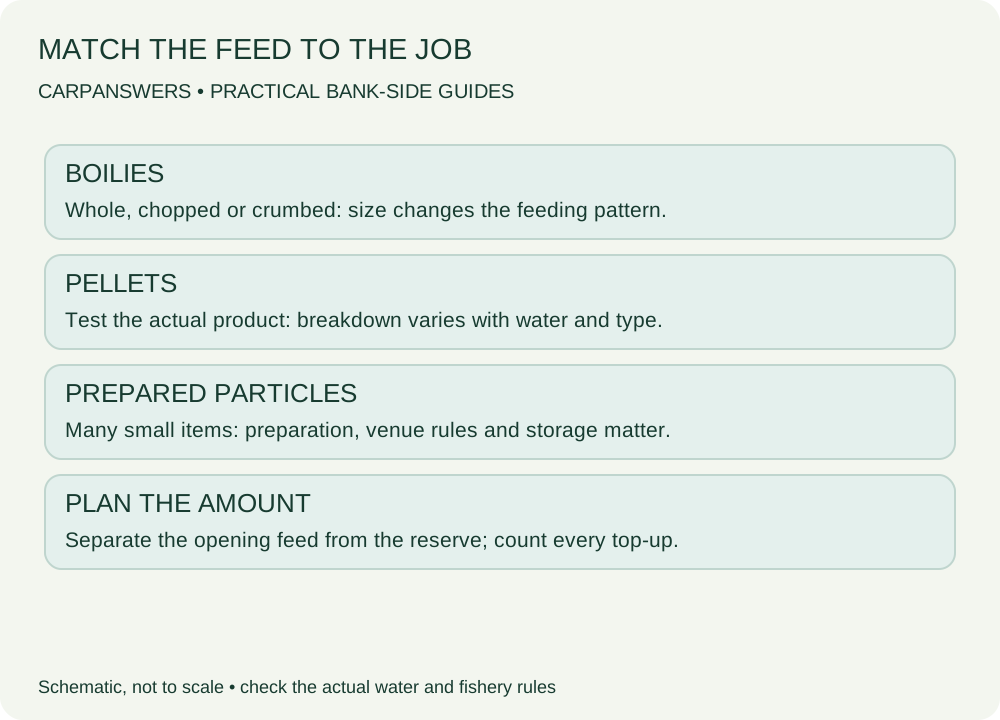
Boilies vs pellets vs particles: what does your mix need to do?
| Feed | A useful role | What to check |
|---|---|---|
| Boilies | Recognisable larger food items; whole or broken to change the pattern | Size, storage type, firmness and nuisance-fish response |
| Pellets | Small feed items with product-dependent breakdown | Actual water test, oil content, size and PVA suitability |
| Prepared particles | Many small seeds or grains for a controlled feeding area | Preparation, venue permission, storage and birds or small fish |
When are boilies a sensible starting point?
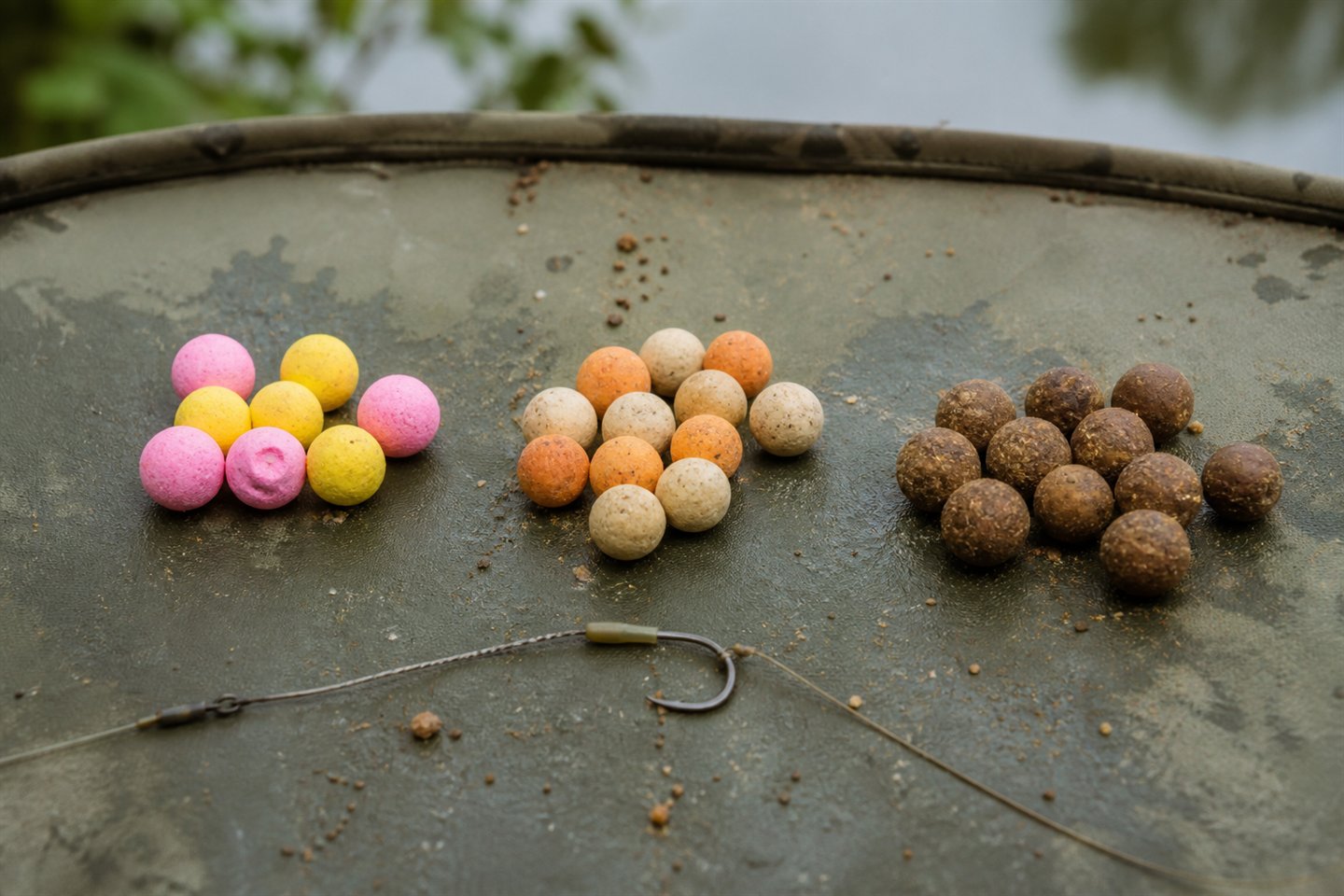
Boilies are convenient when you want a straightforward link between loose feed and a hookbait. Whole baits can be spread or grouped, while chopping and crumbing changes the number and size of food items without requiring a completely different product.
Check whether the bait is a shelf-life or freezer product and follow its storage instructions. A freezer bait left warm through repeated trips is not made suitable by still smelling attractive to you.
Size affects more than visibility. A large whole bait behaves differently from a handful of small pieces and may be less convenient for a short, close-range attempt. Do not assume bigger boilies exclude every nuisance fish or that small boilies guarantee more bites.
For a first trial, buy a pack you can finish or store properly. A bulk deal is only a saving if the bait gets used, and a new flavour does not justify putting in a whole bag. Keep some familiar bait with you so that trying something different does not take over the session.
How does pellet breakdown affect carp baiting?
Pellets can add smaller food items to a mix or a compact PVA parcel. Different formulations, diameters and water conditions produce different softening and breakdown, so avoid treating all pellets as one bait with one timing rule.
Put a sample of the actual pellet in lake water before building the session around a claimed dissolve time. Look at when it softens, how it breaks up and whether the result suits your intended presentation. A warm indoor test is only a starting check.
Sonubaits Fin Perfect 2mm feed pellets (paid link) are a small-feed option, not a large durable hookbait. Check the label and intended use; if you need a hookbait to withstand nuisance fish, solve that separately.
Be cautious about adding a high proportion of oily feed just because oil sounds attractive. Product composition and conditions matter, and more liquid or oil is not automatically more effective. Keep the mix simple enough that you can understand what changes when you alter it.
Hemp, corn, maize and mixed particles
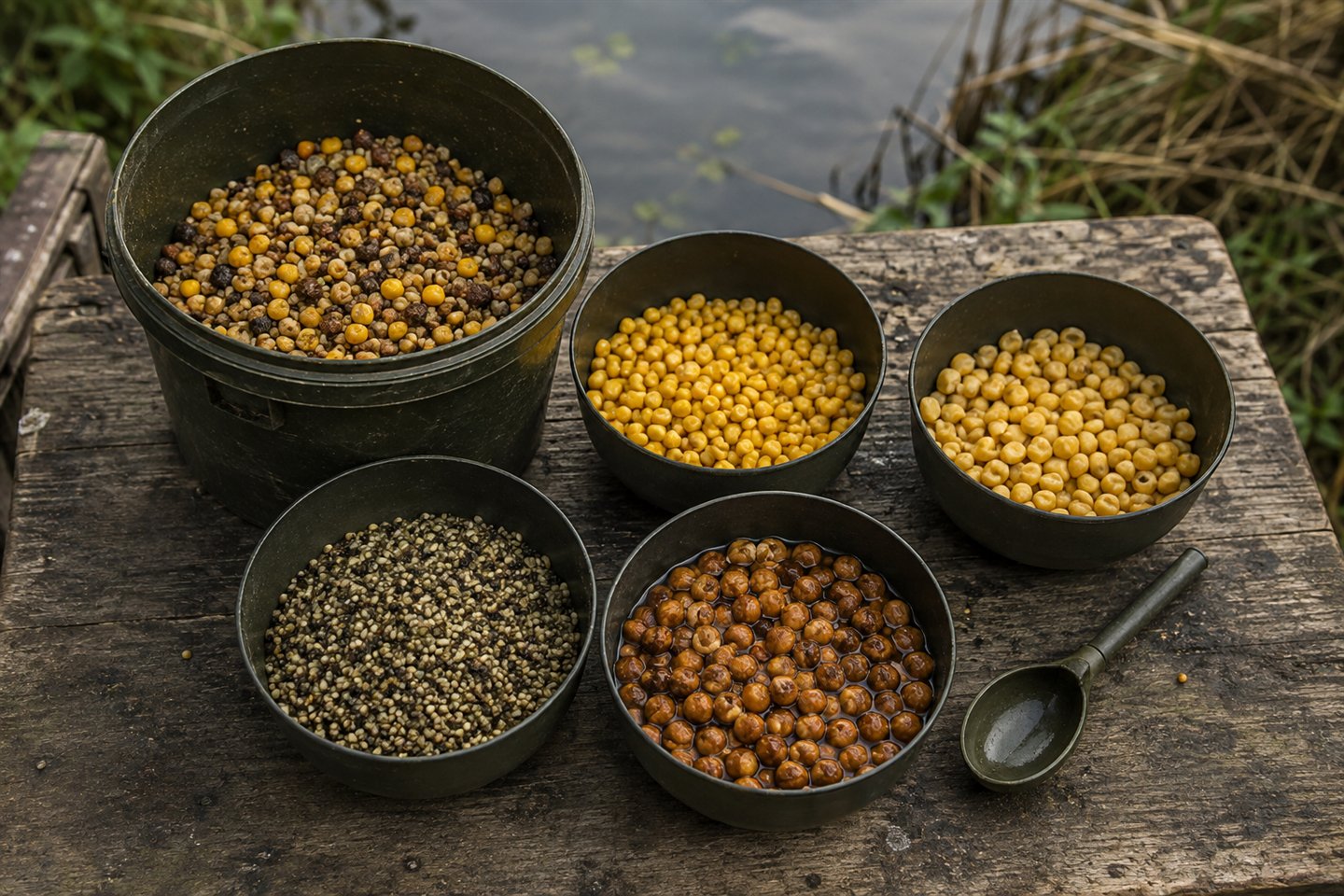
Particles can create a feeding area with many small items. Hemp is small and dark, sweetcorn is soft and visible, and correctly prepared maize provides a firmer grain. Mixed products combine ingredients, but more variety does not automatically improve the result.
Check permission first. Some waters restrict particles or particular nuts, and a ready-prepared label does not override those rules. Our safe particle-preparation guide explains the difference between dry ingredients and bait ready for use.
ready-prepared hemp and particle mix (paid link) is a convenient category option when the exact ingredients are permitted. Read the label, confirm that the product is ready to use and follow its opened-pack storage directions. Do not assume every bag described as “hemp mix” has already been cooked.
Never apply dry-particle preparation instructions to a different seed, grade or mixture by guesswork. If reliable directions are unavailable, buy a suitable prepared angling product instead.
What about food value and attraction?
Do not compare nutritional quality from a flavour name or a glossy photograph. Ingredients and formulations vary, and a manufacturer describing a bait as attractive is not independent proof that it outperforms everything else.
For a practical session, ask simpler questions. Can carp encounter and eat the bait on your spot? Does it remain suitable for the intended time? Can you store it properly? Does the amount make sense for the stock and feeding evidence?
Loose feed and hookbait also have different jobs. A pellet breaking down into small particles may be doing what you intended, while a hookbait that disappears unnoticed leaves you fishing poorly. Use the pop-up, wafter and bottom-bait comparison to make that separate choice.
Let nuisance species influence the mix
If small fish rapidly remove soft feed, do not automatically replace it with more. Work out whether carp are arriving behind that activity or whether it is simply exhausting your bait supply.
A firmer or larger food item may last differently, but there is no guarantee of excluding bream, tench, crayfish or birds. Check the hookbait on a sensible schedule and inspect any damage rather than assuming it is still intact.
If birds are reaching feed or approaching the hooked presentation, manage that risk first. Do not continue putting bait into a visible margin occupied by wildlife and hope the carp arrive before a bird does.
For a more focused change, compare freezer and shelf-life boilies, boilie sizes or the sweetcorn guide. Avoid rebuilding the entire mix after one unexplained missed take.
Choose a baiting pattern as well as ingredients
A small group of whole boilies, a tight PVA parcel and a broad spread of tiny particles encourage different searching patterns. Think about the area you can fish accurately and where the hookbait will sit within it.
For a short session on a known clear spot, a modest parcel beside the rig may be sufficient. On a longer trip with repeated feeding evidence, measured additions can make sense. Neither plan requires every ingredient in your bucket.
If you use a Spomb, the accurate baiting guide helps keep delivery repeatable. A mixed load can separate while sinking, so do not assume every seed, pellet and whole boilie finishes in an identical patch.
Should the season decide the bait?
Use the season as context, not a shopping ban. In cold conditions, a modest amount of familiar bait can be a practical start; in warm conditions, feeding still needs to reflect fish welfare and actual response.
Do not declare boilies unsuitable in winter or particles compulsory in spring. Adjust the amount, preparation and application to what the fish are doing. A large summer feed is no more justified by the calendar than a winter blanket rule against loose bait.
How to compare the usable cost of carp feed baits
Dry particles may look cheap per kilogram, but preparation time, cooking, storage and expansion complicate the comparison with ready-prepared bait. A large boilie bag is poor value if half is stored badly and discarded.
Plan the session with the Bait Quantity Calculator, then divide the allowance into opening feed and reserve. Include PVA recasts and Spomb top-ups in the amount actually used.
Write the bait type and quantity into the Session Planner before packing. Taking a sensible amount leaves you less tempted to dump leftovers into the water at the end of the day.
Bait comparison questions
Can I mix all three?
Yes, where permitted and correctly prepared, but each ingredient should have a purpose. Begin simply enough that you can judge the response.
Are expensive boilies always better?
No. Price does not establish that a bait suits your water, preparation or feeding plan. Fresh, properly stored bait used sensibly matters more than an impressive label.
Which is easiest for a beginner?
A suitable ready-to-use bait with clear storage instructions reduces preparation work. Choose something allowed by the fishery, understand how it behaves and keep the initial quantity modest.
Choose the feed, test what needs testing and retain some bait for later. The fish's response should decide the next addition, not the amount left in the bag.