Freezer or shelf-life boilies? Both can catch carp. The practical question is which suits your trips and how you'll keep the bait in good condition. Let's compare storage, journeys and short-notice sessions without turning the two labels into rival teams.
The labels don't rank every bait from inferior to superior. Different manufacturers use different recipes and preservation methods, and two products in the same category can vary considerably. A well-kept shelf-life bait should not be dismissed simply because another angler prefers frozen bait, nor should convenience excuse poor storage.
We'll look at storage, opened bags and quantities for different sessions, then explain how to compare baits fairly on the bank. Follow the maker's handling and refreezing advice for the product you choose.
Freezer boilies vs shelf-life boilies: which fits your sessions?
Freezer boilies are supplied with a storage requirement centred on keeping them frozen until they are needed, followed by the manufacturer's handling guidance. Shelf-life boilies are formulated and packaged for a stated period of storage without that same frozen chain under specified conditions. The exact instructions remain product-specific.
Don't assume that every shelf-life recipe contains an identical preservative or that every freezer recipe has the same moisture and ingredients. The category tells you how the product is intended to be managed, not its complete nutritional formulation. Look at the information supplied for the actual range you're considering.
Mainline's boilie-care guidance distinguishes storage, air-drying and rehydration for its baits. That is useful practical context, but a procedure described for one manufacturer's bait should not automatically be applied to a different product with different instructions.
Start with your fishing routine
Think about how you normally fish rather than the most ambitious trip on your calendar. A few spontaneous evening sessions each month create different storage demands from a planned weekly overnight. Choose the format that you can prepare reliably on ordinary days, not only when you have unlimited time before departure.
If you often leave straight from work, a suitable shelf-life option may simplify the routine. If you have reliable freezer space and plan sessions in advance, freezer bait may be equally straightforward. Neither situation makes you a more serious angler; it simply changes which handling steps are easy to maintain.
The short-session planning guide helps identify what actually consumes fishing time. Bait that fits your routine leaves more attention for finding carp and placing rigs. Bait that repeatedly causes rushed preparation is worth reconsidering, even if you like its reputation.
Compare products, not old stereotypes
Statements that all shelf-life bait is poor food or all freezer bait is automatically fresher are too broad to support a sensible purchase. Ask what the manufacturer says about the individual product and its intended use. A category-wide claim often conceals differences in recipe, packaging, age and handling.
Parker Baits' comparison of its shelf-life and freezer options treats practicality as an important deciding factor. That is a manufacturer's view of its products, not independent proof that every bait across the market performs identically. It supports comparing realistic use cases rather than repeating an absolute hierarchy.
Be equally cautious about promises of instant attraction from allowing bait to deteriorate. Normal product characteristics and unsafe or spoiled condition should not be confused. If a bag's condition is doubtful, obtain clear guidance from the maker or stop using it rather than assuming every change is beneficial fermentation.
Freezer space is part of the purchase
Before ordering freezer bait, check the space actually available and whether it can be kept under the required conditions from delivery onwards. A large discounted order is inconvenient if it arrives when the freezer is already full. Plan around the packaged volume, not only the weight printed on the listing.
Consider how you'll organise it so older usable stock is not forgotten behind new bags. Keep product identification and handling instructions available. Smaller clearly labelled portions may simplify preparation where the manufacturer permits repackaging, but don't lose the information needed to distinguish different recipes or storage histories.
If sharing household freezer space, make practical arrangements in advance and keep bait appropriately contained. A dedicated freezer is not an essential carp purchase for everyone. The first-year budget guide helps put supporting costs into perspective before a bait preference creates an unnecessary equipment bill.
How to store shelf life boilies after opening
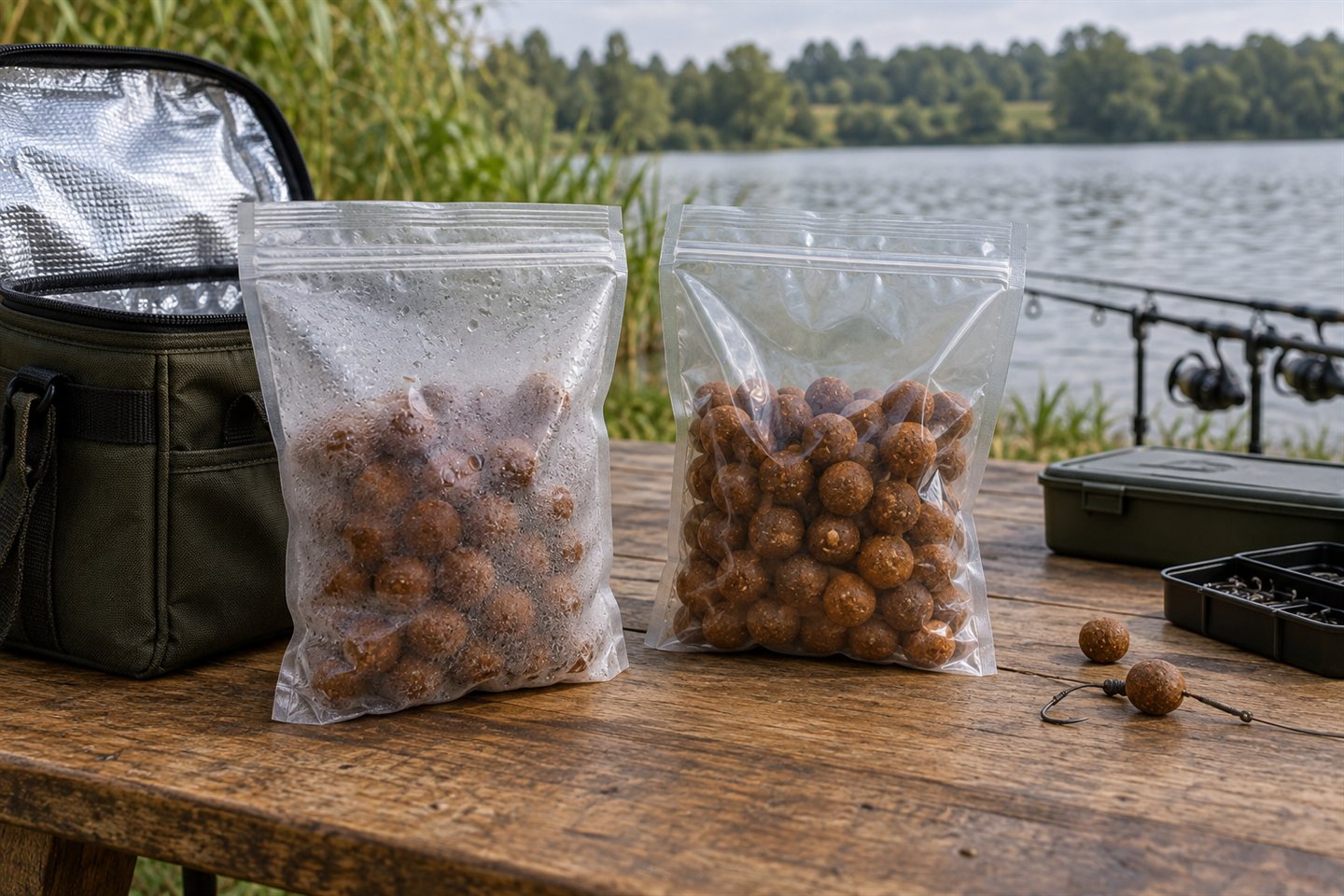
Shelf-life doesn't mean permanently unaffected by heat, moisture or an open bag. Follow the stated temperature, light and sealing guidance, and keep the bait within its recommended life. A package left in a hot car through repeated trips is not being stored carefully simply because it did not begin frozen.
Keep the reserve clean and dry as instructed, using the original resealable packaging where appropriate. Avoid introducing wet scoops, muddy hands or damp bait from another container. Once the storage conditions change, the unopened-bag expectation may no longer describe what is happening inside the product you're using.
Mainline's linked care article specifically highlights protection from direct sunlight for its shelf-life baits. That simple principle illustrates why the format still requires attention. Check the exact instructions on your own bag, especially after opening, adding liquid or dividing the bait into other containers.
How to keep freezer boilies usable on the bank
Think from collection or delivery through to the end of the session, not just the time spent beside the rods. Transport, stops, a warm vehicle and a long barrow journey can all affect bait condition. Choose a suitable cool carrier and quantities that fit the manufacturer's handling requirements throughout that route.
Don't take the entire reserve simply because there is room in the car. A smaller planned portion is easier to manage and leaves unused stock under controlled storage. If the session unexpectedly becomes productive, you can reassess for future visits without making excessive bait transport the default from the outset.
Ask the supplier for guidance if the expected travel time makes handling uncertain. Some products and trip models will be easier to manage than others. Switching format for a particular journey is a practical adjustment, not evidence that the bait you usually use has suddenly become ineffective.
Freezer or shelf life boilies for a week long carp trip?
For a short planned session, either format may be easy to manage in modest quantities. The choice can come down to availability, confidence in the product and how the bait will be used. There is little value in creating a complex drying routine for a handful of boilies if a simpler permitted option fits.
For several days on the bank, storage and reserve management deserve more attention. Ask whether reliable facilities exist and what the maker recommends when frozen storage is unavailable. Don't assume a shaded bucket provides the same conditions as a freezer or that a zip on a cool bag stops time indefinitely.
The first overnight guide helps plan the wider routine. Protecting sleep, food and fish-care arrangements matters alongside bait. Choose a format whose care can be maintained without turning every break from fishing into an anxious inspection of an oversized supply.
Portioning can reduce both cost and uncertainty
Estimate the amount needed for the intended feed pattern, then carry a sensible reserve rather than a bulk quantity chosen by habit. Separate working bait from stored stock so the whole supply is not repeatedly exposed. Follow the manufacturer's advice before repacking or changing the original storage arrangement.
Label portions with enough information to identify the product and relevant date. Don't rely on smell or colour to distinguish several similar brown boilies weeks later. Clear records make stock rotation and troubleshooting easier, especially if you experiment with more than one format or recipe.
Our bait-quantity guide explains how fish activity and session objectives shape the amount used. A measured plan reduces waste whichever format you choose. Unused bait should not be tipped into the lake merely to avoid taking a partially used bag home.
Texture is a presentation question
Some individual baits are firm enough for repeated throwing-stick use or longer casts, while others soften more readily. Test the actual product under the intended conditions. It is unsafe to assume every shelf-life boilie is hard or every freezer boilie is soft simply because those generalisations are common in conversation.
For a hookbait, inspect how securely the needle hole and bait stop hold. For loose feed, consider whether the bait survives the delivery method. A soft bait can be useful in one role and awkward in another, so choose texture for the job instead of treating hardness as a universal quality score.
The boilie-size guide separates size, durability and presentation. Format is only one part of that choice. A change from a small soft bait to a large hard one tests several variables at once, even if the only difference you intended to compare was freezer versus shelf-life.
Air-drying is a method, not a repair for spoiled bait
Some manufacturers describe controlled air-drying as part of managing their freezer baits. Follow a complete product-appropriate procedure, including clean equipment, suitable airflow and protection from contamination. Don't improvise by hanging an overcrowded damp bag somewhere warm and assuming the bait will remain sound regardless of conditions.
Drying changes texture and can alter how the bait mounts, casts and behaves in water. Check those practical effects before fishing. It should not be used to disguise a bag that has already deteriorated, nor does it create a universal storage period that applies to all recipes and climates.
If the maker doesn't provide clear guidance, ask before relying on air-drying for a long trip. A different format or locally sourced bait may be simpler. Keep the bait in good condition and follow its storage instructions. Extra preparation is only worth doing if it helps with that bait and your session.
Rehydration needs the same product-specific care
Where a manufacturer recommends rehydrating dried bait, use suitable liquids and quantities according to that advice. Adding moisture changes storage and handling again. Prepare only what you can manage and use appropriately; a previously dry bait should not be returned casually to an untouched reserve after soaking.
Test how the rehydrated bait behaves on the hair and during the intended cast. It may split differently or soften enough to make a throwing stick unsuitable. Don't judge readiness only by smell or the colour of the liquid remaining at the bottom of the container.
Keep PVA compatibility separate from general bait preparation. A bait or liquid suitable for soaking is not automatically suitable for a PVA bag. Our PVA guide explains why moisture, assembly time and dissolution all need their own checks before the rig is cast.
Refreezing is not a universal yes or no
Follow the exact manufacturer's instructions for the product, its handling history and any return to frozen storage. Advice can differ, and a blanket rule copied from another brand may be inappropriate. If the bait has spent an uncertain period under unsuitable conditions, ask the maker rather than assuming the freezer can restore quality.
Avoid repeated unnecessary cycles by planning smaller portions from the beginning. A clearly managed reserve is easier to assess than a bag that has travelled to several sessions, been partly thawed each time and received fresh bait on top. Don't combine uncertain leftovers with known sound stock.
If the maker's advice is unavailable or the condition is doubtful, choose the cautious option and dispose of unusable bait responsibly. The money already spent is not a reason to feed questionable material. For future trips, adjust quantity or format so the same storage problem is less likely to recur.
Hookbaits may have their own instructions
A tub of pop-ups, wafters or hardened hookbaits is not necessarily stored like the loose-feed boilies in the same named range. Read its own label. Different intended buoyancy, texture and packaging can mean different handling requirements even when the flavour name and branding match the main bait.
Keep hookbait tubs clean and securely closed, and test the finished rig's balance after storage or a change of bait. Don't assume a matching wafter will balance every hook pattern. The hookbait comparison explains the functional differences that matter once the bait is attached.
You can use a durable permitted hookbait with either feed format if the complete presentation suits the situation. There's no requirement that every item share the same preservation method. Match the rig to the bottom and hookbait behaviour rather than treating a coordinated product label as proof of compatibility.
Judge value by the usable amount
Compare the cost of the bait you actually fish, including delivery, storage and waste. A large freezer-bait discount can lose its advantage if much of the order cannot be managed well. A smaller shelf-life bag can also be poor value if it is repeatedly opened, contaminated and eventually discarded unused.
For example, compare two realistic shopping plans using the number of sessions they will serve. Include any special delivery charge and the portion normally left after each trip. Keep the figures based on current quotes; the practical exercise matters more than a universal price-per-kilo threshold that changes with the market.
The beginner budget guide encourages spending on dependable basics first. A bait-storage preference should not crowd out sound line, suitable hooks and fish-care equipment. The best-value format is one you can use responsibly without turning an ordinary session into an expensive logistics exercise.
Make a fairer comparison on the bank
If you want to compare formats, keep the recipe and size as similar as the available products allow and avoid changing the rig at the same time. Record where each presentation is fished and whether carp are actually present there. Two rods in different-quality spots don't produce a fair verdict on bait preservation.
Over several sessions, note practical handling as well as captures: casting resilience, bait condition on retrieval, preparation time and waste. These observations can reveal which format suits you even when catch numbers are too small to say much. A single fish should not settle a broad argument about all boilies.
Be willing to use different formats for different trips. Consistency in good presentation and location is more valuable than loyalty to a storage category. You can prefer one product for planned weekends and another for spontaneous evenings without needing to claim that either is universally superior.
When the bait looks different from expected
Inspect packaging and product information before making assumptions about a colour change, surface coating or smell. Some differences may be normal characteristics described by the maker; others may indicate a problem. Don't guess when the consequence is feeding the bait to fish.
Contact the supplier with the product identity and clear details of storage and condition if necessary. Keep questionable stock separate while awaiting guidance. Avoid adding liquids, mixing it with fresh bait or fishing it first in an attempt to discover whether the carp will accept it anyway.
A reliable retailer and readable product instructions are part of the purchase. If a bait arrives without sufficient identification or handling guidance, resolve that before the next trip. Confidence should come from known condition and a workable routine, not from being told that unusual bait is always more attractive.
Choose a fallback before a longer trip
If the plan depends on freezer access at a venue, confirm that arrangement before departure and ask what happens if it is unavailable. A suitable permitted shelf-life reserve or confirmed local supply may provide a practical alternative. Don't wait until a large quantity is warming in the car before discovering there's no agreed storage space.
Keep any fallback clearly identified and in its own appropriate conditions. It doesn't need to match every feature of the main bait to let you fish responsibly. The useful comparison is between a known usable alternative and uncertain storage, not between the confidence you have in two brand names.
Equipment worth considering
For freezer bait, a suitable insulated carrier and practical portion containers may be useful if they support the manufacturer's recommended handling. For shelf-life bait, clean dry storage and secure resealing may be all that is required. Buy storage equipment for a defined job, with capacity matched to the amount you genuinely use.
A small scale, labels and dedicated scoops can reduce waste by making quantities and stock identity clear. An air-dry bag is only worthwhile when you intend to follow an appropriate drying procedure. None of these items improves bait automatically; they help you maintain the condition and routine you have deliberately chosen.
Once you have selected an appropriate boilie format, the Korda Fine baiting needle (paid link) and Korda Original Funnel Web PVA mesh (paid link) are examples of tools for mounting suitable soft hookbaits and presenting compatible dry feed. They don't determine whether freezer or shelf-life bait is the better choice, and neither is storage equipment. Check the actual bait's hardness before using a fine needle, and test PVA compatibility and dissolution before casting. Buy only accessories that fit the intended method; preserving the bait correctly matters more than adding a different presentation to every session.
Frequently asked questions
Do freezer boilies always catch more carp?
No universal catch-rate advantage can be inferred from the format alone. Recipe, condition, location and presentation all matter. Compare specific products and your ability to manage them properly. A well-kept bait that fits the session is a stronger starting point than a category chosen on reputation alone.
Can shelf-life boilies be left in the car?
Not as a general storage plan. Follow the stated conditions and protect the bait from heat, moisture and contamination. A shelf-life label doesn't mean unlimited tolerance of a hot vehicle or an open bag. Keep the reserve in suitable storage and carry only the session's planned amount.
Should beginners avoid freezer bait?
No, provided they can follow its storage and handling requirements. Beginners with limited freezer space or spontaneous sessions may find shelf-life more convenient, but that is a practical choice rather than a skill ranking. Select the specific product and format that make a dependable routine easiest to maintain.
Choose the format you can look after
Choose the bait that fits your storage, journey and session, and follow its handling instructions. Keep quantities sensible so less goes to waste. You might prefer freezer boilies for planned weekends and shelf-life for short-notice evenings. Both can have a place; there's no need to pick one side and defend it for ever.
Sources and further reading
Manufacturer guidance checked on 15 September 2026 includes Mainline's linked boilie life-cycle article and Parker Baits' format comparison. Their advice relates to their products and experience, not a universal storage period or independent catch-rate trial. Current instructions for the exact bait take precedence, particularly after opening, thawing, drying or adding liquid.