What size boilie should you use for carp fishing? You don't need a tub for every possibility. Start with a familiar bait, then go smaller or larger for a reason: presentation, nuisance fish or the feeding plan. Big carp don't automatically need big hookbaits.
For a beginner, the easiest starting point is often one familiar bait in a manageable middle size, then a clear reason before moving smaller or larger. That keeps the first comparison understandable. Buying every diameter immediately can turn a simple bait choice into a collection of tubs whose different roles are never established.
We'll consider the hookbait and loose feed separately, because they don't have to be the same size. Check the rig's balance, how well the bait lasts and how you're going to deliver it. Those details tell you more than trying to match a boilie diameter to a carp's weight.
What size boilie for carp fishing suits the job?
First decide whether you're choosing the bait attached to the rig, the boilies used as feed or both. They can be the same, but they don't have to be. A single hookbait has a presentation job, while loose feed also has to suit the amount, spread and delivery method you intend.
For a straightforward bottom-bait trial, a common middle-size boilie can be easier to mount and inspect than an unusually tiny or oversized offering. Think of a size such as 15 mm as a possible starting example, not a rule. The actual hook pattern, bait texture and water remain more important than the number alone.
Use the hookbait-type guide before comparing diameter across different products. A 15 mm bottom bait and a 15 mm pop-up have different functions. Swapping between them changes buoyancy and presentation, not merely the size of the food item.
Fish size doesn't produce a simple bait-size chart
A carp's ability to take a bait is not a rule that its weight determines the ideal boilie diameter. Large fish can feed on very small items, and smaller carp can take surprisingly substantial baits. Choosing a bigger boilie because you want a personal best doesn't make the next bite selective by weight.
Mainline's hookbait tips include a reminder that carp can take baits much larger than many anglers expect. That supports avoiding a rigid small-fish, small-bait assumption; it doesn't establish that the largest practical bait is best on every water.
Instead, ask which fish are present, how they are feeding and what must remain intact until a carp finds it. Those questions may justify a larger or smaller presentation. The useful size is the one that answers a real problem while leaving the hook and rig working correctly.
How to match carp hook size to boilie diameter
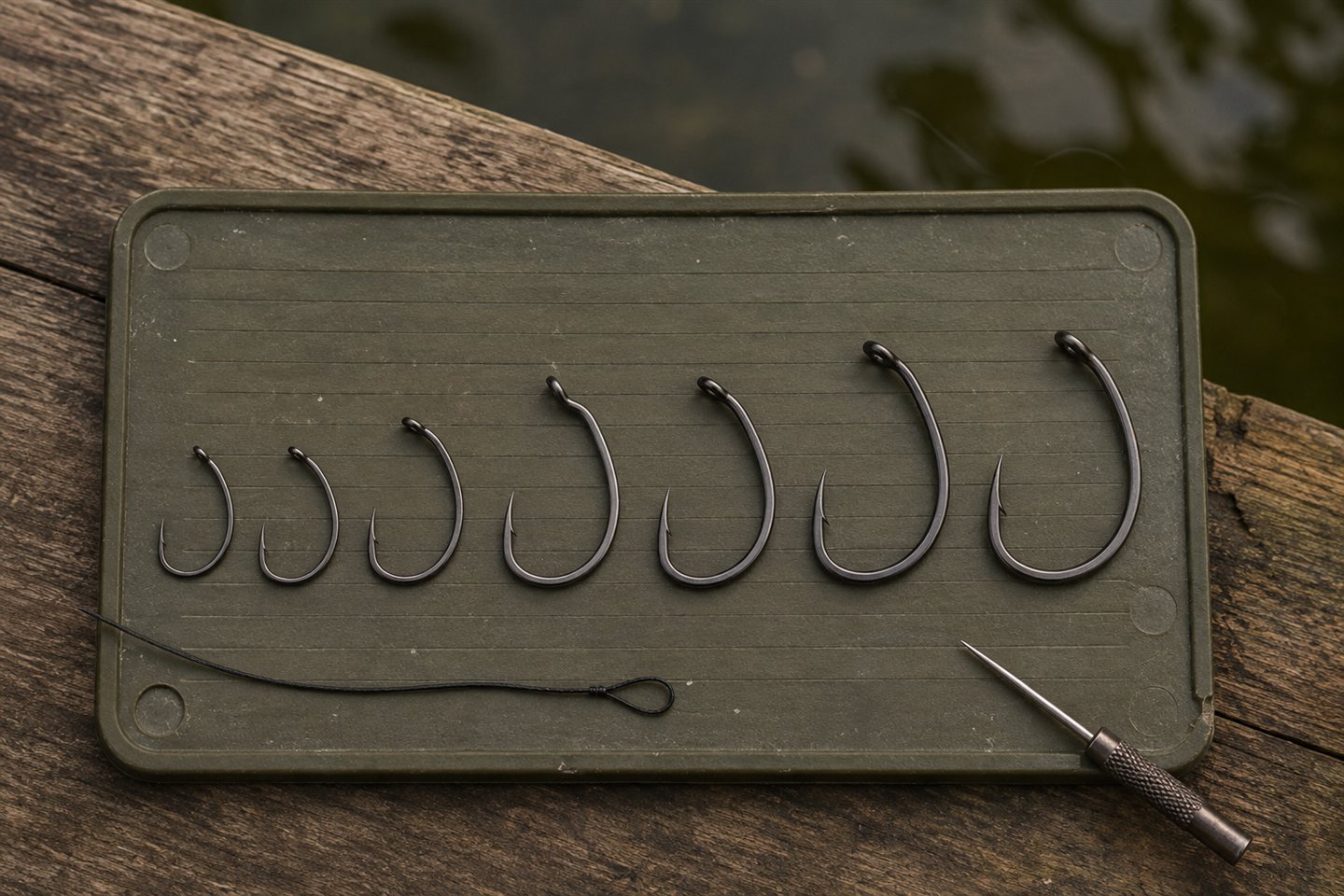
Look at the actual gape, point and strength of the hook with the intended bait attached. A boilie sitting too close can obstruct movement even if the hook size is often recommended online. Different patterns carrying the same number can have different dimensions, so inspect the finished arrangement rather than relying on a chart alone.
The hook-pattern guide explains those differences. Match strength to the line, rod, expected carp and venue requirements. A tiny bait doesn't require an underpowered hook if the fishing situation demands something stronger; the presentation needs to accommodate both requirements.
Test the rig's movement safely in water and keep the point clear. If the bait has been increased substantially, revisit the hook and hair before casting. A visually larger mouthful is not useful if it compromises the part of the tackle responsible for taking a clean, secure hold.
Hair length changes with the arrangement
A single round bait, two smaller boilies and a snowman-style combination occupy different shapes behind the hook. The hair should hold the chosen arrangement without jamming the bait against the bend or leaving excessive freedom to loop around the point. Measure the finished presentation, not only the bare hair tied at home.
Use the hair-rig guide for a simple construction you understand. Bait stops and extenders can help with some compatible arrangements, but they are not a reason to keep an unsuitable hair permanently in service. Remaking a rig properly may be simpler than repeatedly adding small corrections.
Check after several casts and after any small-fish activity. A softened boilie or displaced stop can change the position of the bait even when the original dimensions were sensible. Size selection remains part of a working inspection routine rather than a decision completed once at the tackle-shop shelf.
Smaller boilies create more individual offerings
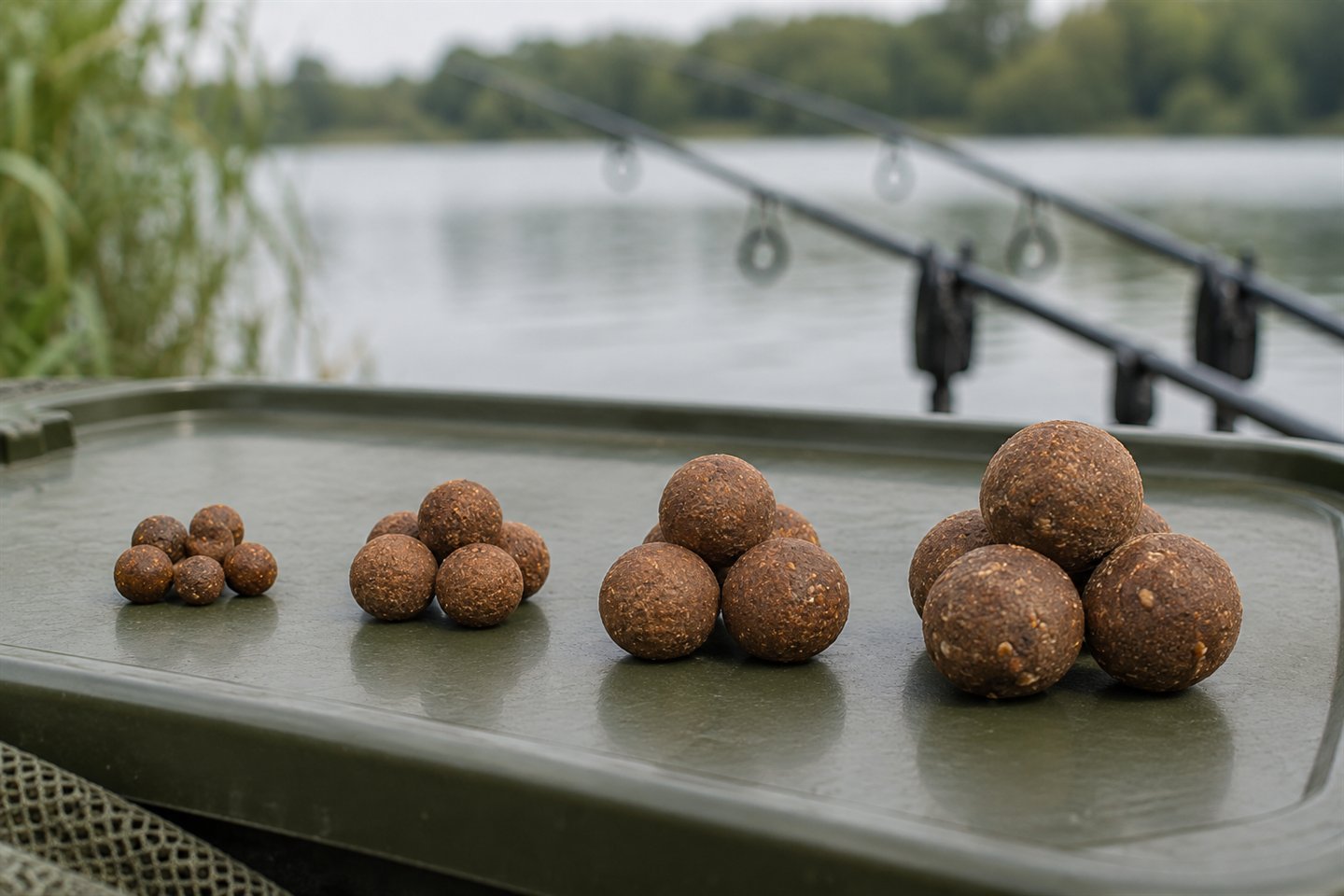
For the same recipe and similar density, smaller boilies produce more pieces from a given weight of bait. That can create a different feeding pattern from a handful of large individual baits. It doesn't automatically mean more attraction or more carp; it changes the number and distribution of food items available.
Imagine cutting the diameter of a round bait in half. Its volume becomes roughly one eighth if the shape and density stay comparable. You would therefore need about eight of those smaller baits to match one larger bait's volume. Real products vary, but the geometry explains why counting pieces can be misleading.
Use weight and the intended spread together when planning feed. The bait-quantity guide shows why a measured total is more useful than a universal handful count. A scoop of small boilies may produce far more individual opportunities than the same apparent count of larger ones.
Larger boilies change the presentation, not just selectivity
A larger bait adds bulk and may require changes to mounting, hook balance and delivery. It can sometimes resist the attention of smaller fish for longer, particularly when texture also supports durability. However, the size alone cannot stop all small carp, bream or other substantial coarse fish taking it.
Use a larger bait when you can explain the intended benefit, such as fewer individual feed items or a more durable hookbait in a particular situation. Then check that it still reaches the spot and sits correctly. Don't accept poor mechanics in exchange for the comforting idea that a bigger bait must mean a bigger carp.
If non-target fish continue to be caught, handle them carefully and reassess the method rather than escalating bait size indefinitely. A different location, feeding pattern or time may matter more. Selectivity is a practical trade-off, not a promise that a chosen diameter excludes an entire species or size class.
Durability is partly about texture
Two boilies of equal diameter can behave very differently after soaking or being investigated by small fish. Recipe, preparation and storage affect how firmly the bait stays on the hair. Inspect the product you actually use rather than treating diameter as a complete measure of how long it will remain intact.
A smaller purpose-made durable hookbait may outlast a larger soft feed boilie in some conditions. Conversely, a very hard bait can require a suitable drill or careful mounting to avoid splitting. Follow the maker's instructions and choose the tool for the actual texture, not the expectation created by the word boilie.
The freezer versus shelf-life guide explains why format labels are not universal hardness ratings. Keep condition and texture separate from diameter when comparing results. Otherwise, a useful change in durability may be misreported as proof that fish preferred a particular size.
A smaller hookbait can suit a modest presentation
When fishing a compact amount of feed or a carefully prepared bag, a smaller hookbait may fit the scale of the presentation. It can also be useful for an actively checked method where durability is less demanding than during a long soak. Choose it because the rig and situation support that role.
Mainline's mini-boilie explanation describes small hair-mounted hookbaits for match-style rod-and-line fishing. That is a distinct application. Don't copy its hook and line choices directly onto a specimen water with larger demands, snags or minimum tackle requirements.
For a carp rig, retest the hookbait's position and buoyancy after downsizing. A smaller wafter may no longer balance the hook as expected, while a bottom bait may move differently on an oversized hair. Small should mean deliberately proportioned, not simply the smallest bait that can be threaded onto the existing rig.
Bigger baits are not compulsory for long waits
Leaving a bait out for longer makes durability important, but the solution may be a hardened hookbait rather than an extreme increase in size. Consider small-fish activity, lakebed debris and the reliability of the presentation. A long wait is only worthwhile if the rig is still fishing effectively.
Retrieve when there is a reason to doubt the bait, such as repeated unexplained indications or a known problem with nuisance species. Don't leave it untouched solely because a large boilie was intended to last overnight. The bite-indication guide helps interpret the information available at the rod.
If the bait returns badly damaged, note the elapsed time and inspect the mounting. Shorten the next interval while testing a more appropriate product or spot. This is a clearer response than assuming the answer must be another five millimetres of diameter without checking what caused the damage.
Buoyancy needs testing every time size changes
Pop-ups and wafters are balanced presentations rather than ordinary sinking food balls. A change of diameter can alter how much lift is available, and products of the same size can differ. Test the complete rig in water with the actual hook, swivel, putty and bait rather than relying on the tub label alone.
The hookbait guide explains the intended differences. A wafter should be assessed against the rig you're using, and a pop-up must be supported by an appropriate arrangement. Don't make a bait larger or smaller and assume the original counterweight still produces the same behaviour.
Trimming a buoyant bait changes both shape and lift. Make small deliberate adjustments where the product and rig allow, then test again. Keep the result repeatable enough to remake it confidently rather than creating a finely balanced one-off whose behaviour is forgotten after the first cast.
Two small boilies are not the same as one large one
A pair of smaller baits creates a longer overall shape, a different contact area and more joints that can move around the hair. It may be a useful alternative presentation, but it is not just a convenient substitute for a single sphere of equal total weight. The rig needs to accommodate the complete shape.
Check the distance from hook to bait and how the pair rotates when wet. A stop positioned poorly can let the outer bait loosen or create an awkward stack. If the presentation repeatedly tangles or masks the hook, simplify it before deciding whether its unusual appearance offers any benefit.
A snowman-style combination adds buoyancy as well as size. Its balance depends on the actual bottom bait, topper and hardware. Keep those variables separate in your thinking so that a change in behaviour is not attributed only to a bigger visual target.
Chops and halves change shape as well as size
Cut boilies can reduce the size of individual pieces and stop some baits rolling as readily on a suitable slope. They also expose a different surface and can soften or break down differently from the intact bait. Test the handling and don't assume every chopped recipe behaves identically in water.
Use safe cutting tools and make only the quantity that fits the session. Chopping the entire reserve can reduce your options for throwing-stick use or durable hookbaits later. Keep some intact bait if those roles remain part of the plan, and follow the product's storage instructions after preparation.
Chopped feed doesn't require a chopped hookbait, although matching the presentation can be a deliberate experiment. Start with a secure mount and watch for splitting around the needle hole. If the cut piece cannot stay attached consistently, a suitable whole or purpose-made hookbait may be the more dependable choice.
Mixed sizes can broaden a feeding pattern
A mix of diameters can create a range of food items rather than a uniform patch. That may fit your plan, but it also makes quantity and interpretation more complicated. Decide what each size contributes before combining several bags merely because mixed bait looks more interesting in a bucket.
Keep track of the total weight and the spread. A handful of large baits among many small ones is different from feeding equal numbers of each. The carp's route through the area and the way you place the rig are likely to matter more than producing an aesthetically balanced mixture.
If you're testing hookbait size, consider holding loose feed steady initially. Otherwise, changing the entire feeding pattern at the same time makes the result difficult to interpret. A simple baseline gives you clearer information than a mixture that changes composition every time the scoop reaches a different part of the bucket.
Delivery can set the practical size range
Your baiting method may work well with some diameters and poorly with others. A throwing stick, catapult or baiting device has its own intended use and capacity. Follow those specifications rather than forcing an unsuitable size through a tool or assuming the bait will survive because it fits inside.
Test accurate delivery in a safe fishing area, clear of people and wildlife. If baits split or scatter widely, change the product, size or method. Our accurate baiting guide explains why placing food where intended is more valuable than reaching maximum distance with a poor spread.
For any cast payload, include the whole rig or loaded baiting device within the rod's capability. Hookbait size is a small part of that total but not the only one. Adding larger PVA bags to carry bigger boilies can change the casting task substantially even when the lead itself is unchanged.
The lakebed may favour a different form of bait
On a clean firm spot, a straightforward sinking boilie is easier to assess. In soft debris or weed, merely increasing diameter doesn't guarantee that the bait remains visible or the hook stays clear. Choose an appropriate presentation for the bottom rather than asking a bigger sphere to solve an unsuitable rig.
The silt-fishing guide explains the role of depth, debris and rig arrangement. A buoyant or balanced bait may be worth considering in some situations, but it still needs testing and a safe system. No diameter removes the need to establish what the rig is landing on.
On slopes, think about where round free offerings may finish relative to the hookbait. Chops or a different feeding position can be more useful than changing size alone. Observe the feature and choose a controlled target instead of assuming every boilie remains exactly beneath its point of entry.
Seasons don't demand fixed diameters
Smaller baits and modest feed may be worth testing when carp are taking little food, but winter doesn't require every angler to use the smallest available boilie. Likewise, warm weather doesn't justify large quantities of big bait regardless of activity. The actual fish response should lead the decision.
Use the winter-bait guide alongside observation of your own water. A durable medium-sized hookbait on a known patrol route may be more useful than a tiny bait in empty water. Seasonal habits should remain starting ideas that can be revised, not rigid rules.
If you change size with conditions, record what else changed: feeding quantity, location, session timing and rig type. This prevents the common mistake of crediting diameter for an improvement that came from finding active fish. Good notes allow practical learning without pretending a small number of sessions proves a universal preference.
Three useful starting situations
For a first session on a manageable lake, choose one familiar middle-size bottom bait and a simple compatible hair rig. Confirm that it survives the cast and leaves the hook clear. A small accurately placed feed gives you a practical baseline before adding alternative diameters.
For a compact feeder or bag presentation, a smaller suitable hookbait may fit the scale of the offering, provided tackle strength and buoyancy remain correct. Test the complete setup and inspect it regularly. The benefit is a well-proportioned presentation, not a guarantee that wary carp demand tiny food.
For repeated bait damage during longer waits, assess a firmer or larger permitted hookbait while keeping the rig functional. Reduce other changes so you can judge durability. If the problem persists, reconsider the spot, check interval or method instead of increasing size indefinitely.
Equipment worth considering
A suitable baiting needle, stops and a protected storage box for completed rigs cover most size changes. A small ruler or clearly labelled bait tubs can make comparisons repeatable. Use a drill only where the bait requires it and follow the product's instructions with the hook secured away from your hands.
A modest scale helps track loose-feed quantities when mixing sizes, while an appropriate cutter is useful if chops form part of the plan. Start with one or two purposeful bait options rather than filling luggage with every diameter. Equipment should help you control the presentation, not multiply decisions without improving the fishing.
A Korda Fine baiting needle (paid link) is useful to compare for mounting suitably soft boilies, while Korda RazorBlades scissors (paid link) can help remake a hair or hooklink cleanly when the complete presentation needs adjusting. Very hard hookbaits may need a different preparation tool; forcing a fine needle is not a sensible shortcut. Test the bait, hook and hair together in water instead of judging the choice from diameter alone. Retain working tools you already own and change only what the rig actually requires, keeping loose hooks and cut line safely contained.
Frequently asked questions
Is 20 mm too big for ordinary UK carp?
Not automatically. Many carp can take a bait of that size, but the right choice still depends on the rig, fish behaviour and intended role. A 20 mm boilie is not a guarantee of a larger capture, and it should not be used if it compromises the hook or mounting arrangement.
Do small boilies attract only small fish?
No. Large carp can eat small food items, while small-fish attention depends on the water and the bait's durability as well as diameter. Choose small baits for a clear presentation or feeding reason, then assess the response rather than treating them as a size filter.
Must my hookbait match the free offerings?
No. Matching can provide a straightforward baseline, while a different size or buoyancy can be a deliberate alternative. Keep the complete rig functional and avoid changing several variables without a reason. A contrasting hookbait is an option to test, not an automatic improvement over the food around it.
Use size to solve a specific problem
Start with a hookbait that stays on, leaves the hook clear and settles as the rig needs it to. Then try a different size for a clear reason, such as durability or nuisance fish. Keep track of how much loose feed you're adding too. Getting to know a few sizes is more useful than collecting every tub.
Sources and further reading
Primary manufacturer references checked on 15 September 2026 include Mainline's linked hookbait tips and mini-boilie guide. They illustrate different practical bait sizes and applications, not a universal hook-to-boilie chart or independent catch-rate comparison. Examples of volume changes are geometric comparisons assuming similar shape and density, not claims about the nutritional value of different recipes.