Sweetcorn is an easy carp bait to get started with. Hook a sound grain directly, put a few on a hair or feed small amounts around a float. We'll cover mounting it neatly and the checks to make before using corn with PVA.
That doesn't make corn a guaranteed carp catcher. It also appeals to other coarse fish, can be removed from the hook and needs thoughtful handling around PVA. A bright hookbait in the wrong place remains a hookbait in the wrong place, however enthusiastic the label or recommendation sounds.
This guide concentrates on ready-to-use sweetcorn, particularly the soft cooked grains sold in tins and suitable prepared fishing products. It is not a soaking recipe for hard dry maize. The aim is to help you choose a sound grain, mount it securely and build a feeding plan that fits the water and your session.
Sweetcorn for carp fishing: direct hook or hair rig?
Ordinary canned sweetcorn intended to be eaten ready to use is already cooked, so it is a convenient starting point. Read the packaging and choose a plain product whose condition you can assess. There's no need to treat it like an unprepared hard particle simply because both products come from maize.
Prepared fishing sweetcorn may offer selected grain size, colouring or flavouring. Those features can be useful for a particular presentation, but they don't prove it will catch more fish than a suitable plain grain. Compare usability, quantity and storage requirements before paying more for a specialist version.
If buying frozen sweetcorn, follow its preparation instructions rather than assuming all frozen products are ready to use identically. Our particle-bait guide explains why product state matters. Never substitute hard dry maize and assume a quick rinse makes it equivalent to cooked sweetcorn.
Check permission before opening the tin
Read the fishery's bait rules, including any limits on particles, quantities or artificial hookbaits. A venue may allow ordinary corn but restrict other prepared products, or apply different rules to separate lakes. Ask a direct question if the wording is unclear instead of relying on what another angler used elsewhere.
Make sure the intended method is allowed too. Corn on a float, corn on a hair and corn mixed into a feeder are different presentations even though the food is the same. The UK fishery-rules guide helps separate bait permission from restrictions on rigs, feeding and equipment.
Bring a sensible alternative only if it has also been checked. An unopened tin is easy to leave for another trip; an unverified substitute can complicate the session unnecessarily. Good preparation means arriving with one clear permitted plan rather than a bag of products you hope will be accepted.
Choose grains for their job
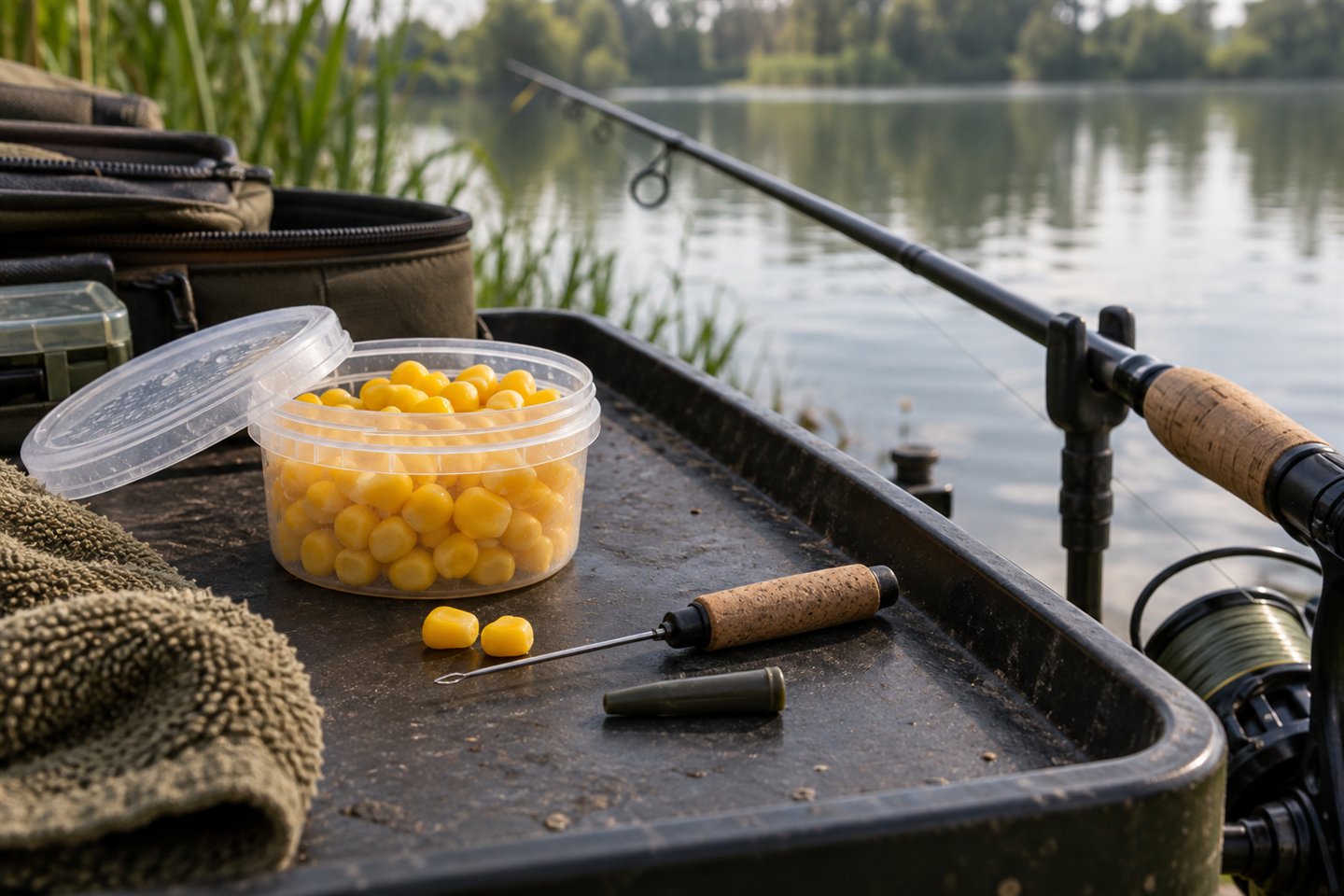
Tip a small amount into a clean working tub and inspect the grains. Firmer intact pieces are useful for hookbaits, while split or softer pieces may suit loose feed if still fresh and usable. Separate a few suitable hook grains so you're not searching through the whole tub with the rod waiting.
Size should follow the hook and presentation. One well-mounted grain can be enough; a larger stack is an option when it has a purpose. Don't add more grains simply because the target carp is large. The hook must remain able to work with the complete bait attached.
Keep the reserve protected and avoid contaminating it with muddy hands or wet tackle. A small working portion helps you notice texture changes during the session. If the best grains become soft and tear repeatedly, change the portion or presentation rather than assuming the latest missed bite was a fish rejecting the flavour.
How to hook sweetcorn for carp fishing
For an actively watched float presentation, a single grain mounted on an appropriate hook is an uncomplicated starting point. Pass the point through a firmer part of the skin and position the grain so the point remains exposed and effective. Test gently that it will not slide across the gape when the line moves.
The exact path through the grain depends on its shape, firmness and the hook pattern. Avoid forcing a large thick hook through a very small soft grain, which can split it immediately. Equally, a tiny fine hook should not be chosen solely because it hides neatly inside corn when the intended fish require stronger tackle.
Drennan's Sweetcorn Barbless specification shows a hook designed for direct corn presentation. It is an example of shape and purpose, not proof that one pattern or size fits every carp water. Follow the venue's hook rules and match the whole outfit.
How to attach sweetcorn to a hair rig for carp
A hair holds the bait separately from the hook, leaving the hook point and bend free. Thread suitable grains carefully with an appropriate needle, draw the hair through and secure the end with a compatible stop. Avoid tearing a wide channel through soft corn that lets the stop pull back through immediately.
Check the finished gap between bait and hook. The grains should not mask the point, slide over the bend or swing around the hook during gentle movement. The hair-rig guide explains the basic construction; adjust the presentation to the actual corn rather than tying an excessively long hair by habit.
A hair is not automatically better than direct hooking for every short float cast. It adds another detail to inspect, particularly with soft bait. Choose it because it makes the intended presentation secure and functional, not because every carp photograph seems to show a bait positioned away from the hook.
Pushstops and needles need the right touch
Purpose-made soft-bait stops can speed up mounting on compatible hairs. Drennan's Pushstop information lists sweetcorn among the intended soft baits. Use the correct tool and fitting method, then check that the stop holds behind the grain without splitting or crushing it.
Secure the hook while working and keep the needle pointed away from fingers. A thick or damaged needle can destroy a soft grain, while a hurried push can create an avoidable injury. Work on a stable tray rather than balancing the rig over your lap beside the water.
If the bait continually tears, change the grain or mounting method before adding more hardware. A tiny improvised stopper may pull through, while a large one can make the presentation awkward. The useful combination is one you can bait consistently and inspect easily during the actual session.
Match hook strength without burying the point
Choose a hook that suits the expected carp, line and rod, then select a corn presentation that leaves it effective. Hook numbers are not standard dimensions across every range. Compare the actual gape, wire and point rather than assuming one recommended number will produce the same rig with any brand.
The hook-pattern guide explains those differences. At close range, a balanced float outfit can present a small bait without becoming deliberately weak. On a specimen lake, the fishery's minimum equipment requirements remain relevant even if the hookbait is only one grain.
After a cast, check whether the point has collected weed, been blunted or become masked by folded skin. Soft bait can change shape in flight or when investigated by small fish. A grain still attached on retrieval doesn't prove it left the hook point clear for the whole period.
Start with a measured bottom-fishing presentation
On a suitable open swim, corn works well as a simple bait to learn depth and indication with a float. Plumb the intended spot, use a compatible shotting pattern and begin with the grain on or just at the bottom. Avoid treating a float that stands up correctly as proof that the hookbait is clear of debris.
The close-range float guide covers the complete setup. Keep casting range within the area you can feed accurately and see clearly. A small bait doesn't require a long cast, and the easiest learning opportunity may be only a few metres beyond the near-bank shelf.
Observe how the float settles with the bait attached. Changing from one grain to several can alter the balance and fall. If you modify the hookbait, check the float again instead of assuming that the original depth and shotting will produce identical behaviour.
Corn on a ledger or feeder needs a complete safe rig
When fishing a bottom rig with a lead or feeder, choose the system for the lakebed, casting distance and fishery rules. Corn is only the hookbait; it doesn't determine whether an inline, running or other recognised arrangement is appropriate. Follow the whole setup's instructions, including what happens after a line break.
The safe lead-systems guide and method-feeder introduction explain those different approaches. Don't attach a heavy lead to a light float outfit simply because you have leftover corn and want to fish farther out.
Soft grains need a controlled cast and a realistic inspection routine. If small fish repeatedly remove the bait, a long unattended soak becomes difficult to justify. Either improve durability within the rules, check more often or choose another hookbait while retaining corn as a modest loose-feed component.
Feed a small area you can actually fish
Begin with a restrained amount near the hookbait and watch the response. Corn is visible and easy to count, which makes it useful for learning how small additions change the swim. Avoid tipping in half a tub simply because the product was inexpensive compared with a bag of boilies.
At close range, use a safe, accurate delivery method and repeat the same comfortable action. If most grains land short, move the fishing spot closer or improve placement before adding more. An accurate small feed offers a clearer test than a wide scatter with the hookbait somewhere beyond it.
The bait-quantity guide provides the wider decision process. Fish presence, session length and observed feeding matter more than a fixed number of tins per day. Keep reserve bait available, but require a reason before introducing it.
A few grains in a mix can be enough
Corn can be one component of a permitted mix rather than the entire feeding strategy. A limited number of grains among suitable pellets or prepared particles gives you visible individual offerings without necessarily creating a large volume of food. Make sure every ingredient is allowed and prepared correctly.
Don't assume a more complicated mix is automatically more attractive. With several baits, liquids and textures, it becomes harder to know which part changed the presentation or drew unwanted small-fish attention. For a beginner trial, keep the recipe simple enough that its handling and total quantity remain obvious.
Consider how ingredients travel and settle. Grains, crumbs and pellets may separate in flight or descend differently through deep or moving water. A mixed splash is not an exact picture of the finished feeding area, so use observation and sensible placement rather than imagining a perfectly uniform carpet.
Can I use sweetcorn with PVA for carp fishing?
Ordinary wet sweetcorn and its water-based liquid can damage PVA before the cast. Korda's PVA-mesh explanation identifies this compatibility issue. Don't assume a quick drain, a dusting of powder or an arbitrary splash of oil makes every batch safe to use in a bag.
If you want corn with a PVA presentation, use a product explicitly intended for that job and test the exact combination, including the time it will remain prepared. Check both pre-cast survival and dissolution in water. A bag that survives assembly but fails while you wait to cast is still unsuitable.
An easier beginner option is to keep a tested dry PVA mix separate and introduce ordinary corn by another permitted method. Our PVA guide explains the choices. There's no need to complicate a reliable presentation simply to fit every ingredient inside one package.
Artificial corn is a different product
Imitation corn can offer durability, and some versions are buoyant. Those properties depend on the exact product, so test it with the actual hook and rig. A floating imitation grain may lift part of the presentation or change a previously balanced hookbait in a way that needs deliberate adjustment.
Check whether artificial bait is permitted and ensure it is securely mounted. It should not be shed around the lake through repeated poor attachment. Don't describe plastic corn as equivalent food to real corn; it is a hookbait presentation option, while the edible free offerings perform a different role.
The buoyancy guide explains why a small change can alter how a rig sits. Combining real and artificial grains may be useful, but the finished arrangement must be tested rather than judged only by its appearance above the water.
Small fish may change the best presentation
If roach or other species remove soft grains rapidly, inspect the hookbait more often and reduce unnecessary feed. A firmer grain or secure hair may help it last, but no sweetcorn arrangement guarantees carp-only fishing. Larger coarse fish can also take corn, and their capture should be handled responsibly.
A change of safe spot or feeding pattern may be more useful than a larger stack. If the bait is constantly damaged before carp arrive, consider a tougher permitted hookbait over a few grains of feed. Our boilie-size guide discusses durability without promising complete selectivity.
Treat the small-fish response as information about the water. It may make corn an excellent mixed-fish bait but an awkward choice for a long carp wait. You can still enjoy the session or switch methods without deciding the bait itself has failed in every context.
Colour and flavour are secondary experiments
Plain corn gives you a clear baseline. If trying a coloured or flavoured prepared product, keep the other parts of the approach steady long enough to judge whether it changes anything useful. A capture after simultaneously moving swims, changing rigs and adding flavour cannot tell you which change mattered.
Use only products intended for fishing and follow their directions. More liquid is not automatically better, and it can soften bait, complicate storage or interfere with PVA. Avoid homemade chemical mixtures whose effects on fish, water or bait stability you don't understand.
Don't assume yellow is always the most visible or attractive option in every light and bottom colour. What you can see from the bank is not a complete account of what a feeding carp detects. Reliable placement and an effective hook are better first priorities than a collection of different dyes.
Keep opened bait in usable condition
Follow the package instructions for refrigeration, storage time and any freezing advice after opening. Transfer the session's working portion into a clean suitable container and protect it from sun and contamination. Don't use one universal number of days for all canned, flavoured and prepared fishing products.
Plan the quantity so you don't repeatedly warm and chill a large reserve. Label stored bait clearly and keep it separate from food where appropriate. If the condition becomes doubtful, dispose of it responsibly rather than relying on a stronger scent to conceal deterioration.
Remove tins, ring pulls and packaging from the bank. Sharp lids deserve particular care in a bag used for nets or wet hands. A reusable bait tub can simplify the session and reduce the chance of leaving a small hazardous piece of packaging beside the water.
A first-session example to adapt
On a manageable stillwater, select one clear bottom spot and begin with a single securely mounted grain over a very small feed. Watch how the float or indicator behaves and retrieve after suspicious activity. Establish whether the bait remains intact before deciding that the absence of carp means more corn is needed.
If fish arrive and clean bites develop, add modest amounts in response while keeping accurate placement. If indications multiply but the bait returns damaged, address mounting or species activity first. If nothing changes, review location and timing rather than repeatedly filling the same spot with another tub.
Record the usable grain size, mounting method, amount fed and condition of retrieved bait. Those observations are transferable to the next visit. A note that one firm grain survived the cast is more useful than attributing a capture to a particular supermarket label without any meaningful comparison.
Equipment worth considering
A clean bait box, a suitable fine needle or compatible soft-bait stop system and a few appropriate hooks cover most corn presentations. Protect sharp tools and carry spare stops. Choose the mounting system that works with your intended rig rather than buying several overlapping accessories before learning one method.
A small cool carrier may be useful when the product requires chilled handling, while a secure container prevents leaks in luggage. Keep bait storage separate from dry PVA and electrical equipment. The best supporting purchase is often a practical way to preserve usable bait, not another flavour to add to it.
For preparing corn hookbaits, the Korda Fine baiting needle (paid link) is an example of a fine tool to use gently with suitable soft kernels. The Roddarch four-piece bait-box set (paid link) can keep your working bait separate from other feeds. Don't force a needle through a hard or awkward piece towards your hand, and cover the point when it is not being used. Ventilated tubs are not spillproof containers for corn liquid. Keep the main supply suitably stored, take out only what the session needs and retain any reliable equipment that already performs these jobs.
Frequently asked questions
Can I use sweetcorn straight from a tin?
Plain canned sweetcorn sold ready to eat is a convenient ready-cooked option where the fishery permits it. Check the packaging and condition, then mount a sound grain appropriately. This doesn't apply automatically to hard dry maize or every frozen product, which require their own preparation instructions.
How many grains should go on the hook?
Use enough to create the intended presentation without obstructing the hook. One well-mounted grain is a sensible trial; a larger stack needs a compatible hair and hook. Fish size alone doesn't determine the number, and a large carp can take a small bait.
Does adding corn juice make a PVA bag better?
Ordinary water-based corn liquid can dissolve PVA prematurely, so don't add it to a bag unless the complete combination is specifically suitable and tested. Keep wet corn separate from a reliable dry PVA mix if uncertain. A bag that fails before reaching the spot cannot improve presentation.
Make a familiar bait work deliberately
Choose a sound grain, mount it securely and start with a little feed. Check the bait when you reel in, then change one detail if you need to. Corn's simplicity is part of its appeal. Get the presentation and location right before worrying about adding another flavour to the tin.
Sources and further reading
Manufacturer information checked on 15 September 2026 includes Drennan's linked sweetcorn-hook and Pushstop specifications and Korda's PVA-mesh guidance. For the distinction from larger prepared maize, see Dynamite's Frenzied Maize product information. Product-specific preparation and storage instructions take precedence over general bait habits.