You don't need a spool of every carp hooklink material. Start by understanding supple braid, coated braid, fluorocarbon and stiff mono. We'll compare how they move and settle, then help you choose for your rig and lakebed.
The label on a spool is only the beginning. Diameter, stiffness, coating, knot compatibility, abrasion, buoyancy and the way the material leaves the hook all change the finished presentation. Fishery rules and the rest of the tackle come first, particularly near weed or snags. Tie a recognised rig, pull-test it with safe tools and watch it settle in water before trusting it on a cast.
Which carp hooklink material suits your rig and lakebed?
The hooklink is the section between the hook and the lead-system connection. It controls how freely the bait moves, how far the hook is pushed from the lead, how the rig lies over the bottom and how it reacts when a carp disturbs it. It is not the same as a shock leader or abrasion leader, even though some materials are marketed for more than one job.
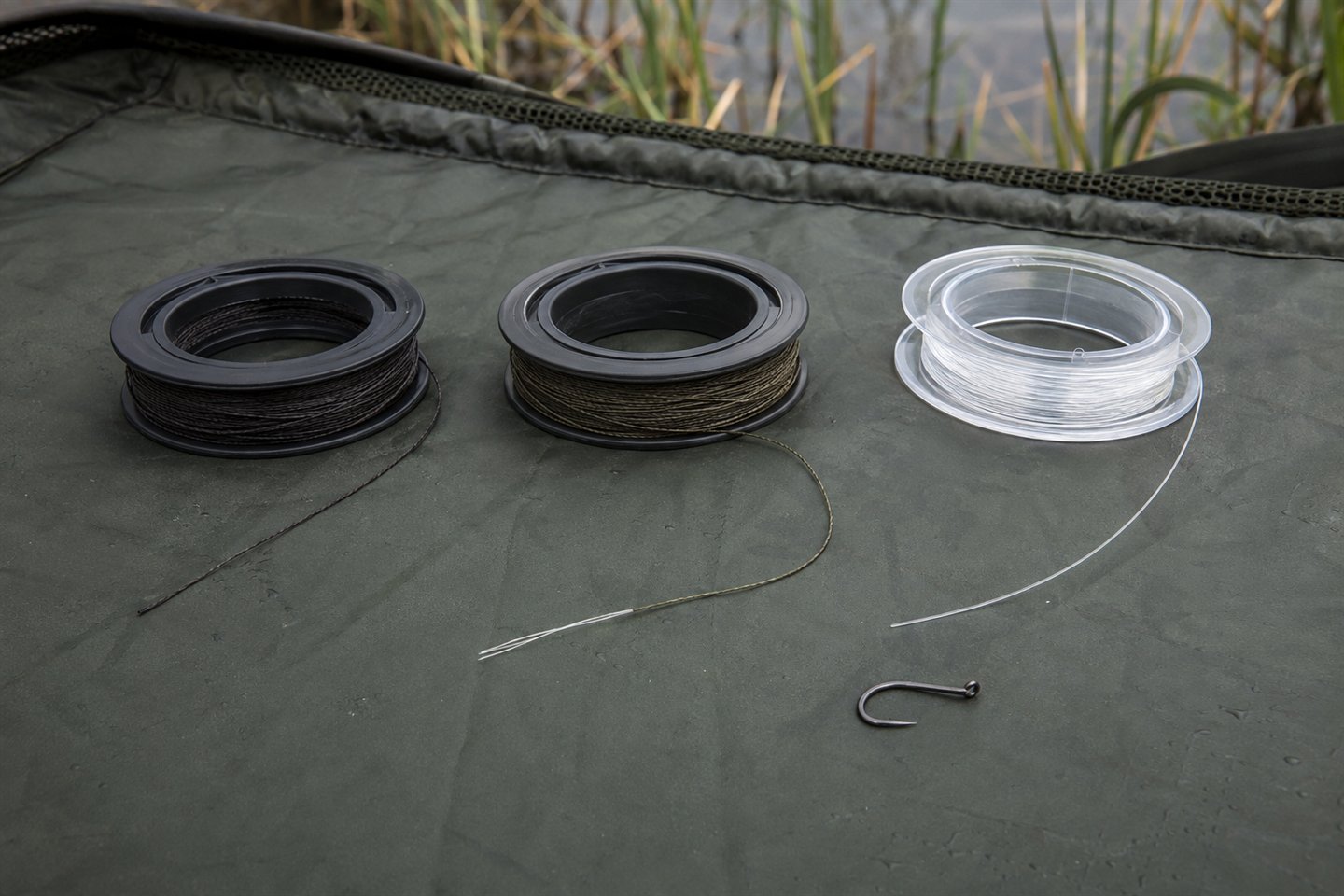
Supple uncoated braid bends easily in every direction. Coated braid has a braided core inside a removable or permanent outer coating, with products ranging from soft to very stiff. Fluorocarbon is a dense single-strand material whose stiffness varies by formulation and diameter. Nylon monofilament can also form hooklinks, including stiff sections, but it stretches and behaves differently from fluorocarbon.
Those families overlap. A soft coated braid can behave closer to an uncoated braid than to an extra-stiff coated product. A fine fluorocarbon may be more compliant than a heavy boom material. Compare the actual spools and maker specifications rather than assuming the material name fixes its behaviour.
What matters when choosing a hooklink?
Start with the rig. A solid-bag-style presentation usually needs compact suppleness, while a long boom for a spinner rig is intended to remain extended. A conventional hair rig can work with several materials, provided the hair, hook and hooklink leave the bait free and the complete setup doesn't tangle.
Then consider the lakebed. A very stiff link can bridge hollows or sit awkwardly across debris. A very supple braid can fold naturally over silt but may also collapse close to the lead or tangle on an unprotected cast. Weed density, casting distance, lead arrangement and whether the spot is clean all affect the choice.
Strength must be balanced with main line, leader, knots, hook and rod. The printed breaking strain is useful within a range, but test methods and real knot strength differ. Diameter can be as informative as pounds. Our guide to carp line breaking strain explains why a headline number cannot replace condition and diameter.
Supple uncoated braid
Uncoated braid is formed from woven fibres without a removable outer skin. It folds readily and lets the hookbait move with little resistance. That can help a rig settle over uneven silt, low weed or inside a compact bait parcel, and it makes simple knots relatively easy to form.
The same suppleness creates its main limitation: it can wrap around the lead, hook or leader during flight. An anti-tangle sleeve, shorter link, controlled cast or PVA parcel may help, but each addition needs to be compatible with the lead system. After retrieval, check for small loops or damage where fine fibres have caught a burr.
Fox currently lists Edges Reflex Camo as a soft sinking braid in 20, 25 and 35 lb versions on 20 m spools. The maker recommends it where suppleness matters. Check its visibility and condition on your water, and pull-test the knots you tie.
Fox Edges Reflex Camo hooklink (paid link)
Coated braid
Coated braid puts a firmer skin around a woven core. Left intact, the coating can help the hooklink extend and resist tangles. Strip a measured section near the hook and the exposed braid creates a hinge with more movement. That makes one spool adaptable to simple hair rigs, blowback arrangements, multi rigs and many combi-style presentations.
Soft, semi-stiff and stiff labels are relative to a particular range. A soft coating may follow contours while retaining enough body to separate from the lead. A semi-stiff coating is a common middle ground. A stiff version holds a straighter boom but is less forgiving over sharp changes in depth. Compare samples rather than treating the category names as standardised measurements.
Korda's N-Trap Soft is a current coated braid with a Dyneema core, a removable matt coating and maker-listed choices of 15, 20 and 30 lb. Its coating is deliberately on the supple side. It provides a useful example for an all-purpose coated material, but the right strain and colour still depend on the water and venue rules.
Korda N-Trap Soft hooklink (paid link)
How much coating should I strip from a carp hooklink?
Strip only enough to create the hinge or supple hook section required by the rig. If the entire link is stripped, most of the coating's anti-tangle value is lost. If no coating is removed from a rig that needs free movement near the hook, the presentation may remain too rigid. There's no universal distance because hook size, hair length and rig design differ.
Use a tool intended for coated hooklink and apply light, controlled pressure. A blade can nick the braided core before the damage is visible. Inspect the transition between coating and braid, because a sharp split can create a stress point. Tie and test a new section if fibres look flattened, fuzzy or cut.
Some rigs use a cracked hinge rather than removing the coating. Only do this where the manufacturer describes the material as suitable, because coatings fracture differently. Repeated bending can weaken or peel the skin farther than intended.
ESP Tungsten Loaded as another coated example
ESP lists Tungsten Loaded in soft, semi-stiff and extra-stiff versions, all with a coated braided core and a published 20 lb-plus rating. The range illustrates how different behaviours can sit under one product family. Select the named stiffness, not simply the colour or brand.
The maker describes the coating as dense and able to sink without putty. That doesn't guarantee every finished rig lies flush on every bottom. Trapped weed, a short hollow or a light hookbait can still change the angle. Observe the exact rig in water and avoid repeating claims such as best or ultimate as independent findings.
Fluorocarbon hooklinks
Fluorocarbon is a single-strand material that is generally denser and stiffer than supple braid. It can sink without a braided core, push the hookbait away from the lead and retain a defined shape. Those characteristics suit booms, D rigs and presentations intended to reset after being moved.
Manufacturers often claim reduced visibility for fluorocarbon because its refractive index is closer to water than ordinary nylon. That is a comparative optical property, not a promise that carp cannot see it. Diameter, scratches, suspended material, light and the background all affect visibility. Low visibility should never be presented as a measured catch advantage without evidence.
Stiff fluorocarbon can kink when folded tightly or pulled across a hard edge. Run it between damp fingers after retrieval and look along it against the light. Replace any section with flattening, whitening, nicks or a permanent bend that is not part of the design.
Korda Boom and purpose-made stiff sections
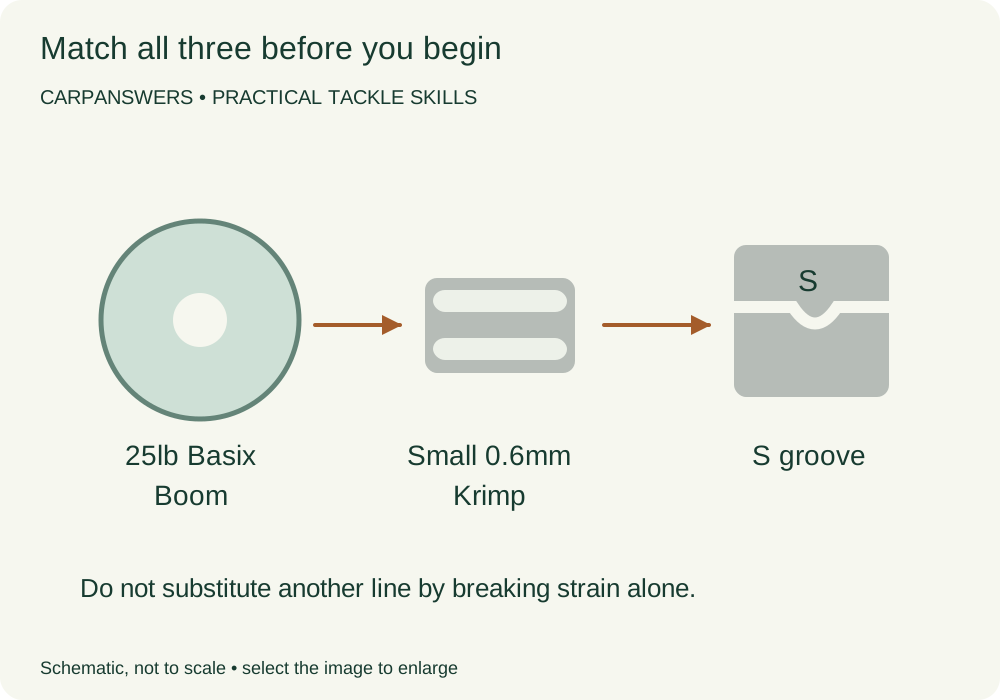
Korda Boom is a stiff fluorocarbon developed for boom sections in rigs such as the spinner or hinged presentation. The manufacturer lists several breaking strains and describes it as suitable for knots or correctly matched crimps. Its job is to provide a firm section and keep the hookbait separated from the lead.
A boom can be too stiff for a deeply contoured or debris-covered spot. It may span a depression or hold part of the rig above soft material. Use feature-finding information and watch a sample settle over something similar at the margin. The guide to carp fishing in silt explains why depth and lead entry change presentation.
Fluorocarbon versus nylon mono
Nylon monofilament is normally more elastic and less dense than a purpose-made fluorocarbon of comparable diameter. It can be useful for some stiff rigs, D sections, zig rigs or low-cost experimentation when the product is specified for that job. Standard main line should not automatically be treated as a hooklink merely because it is monofilament.
Stretch matters when making connections. A crimp that appears secure on a rigid material can slip or cut into a stretching mono under load. Korda's current crimping guidance specifically limits which materials are suitable. If a manufacturer doesn't approve a material for crimping, tie an appropriate knot or choose another product.
For zigs and surface hooklinks, buoyancy, diameter and controlled stretch become more relevant than pinning a rig to the lakebed. Our zig rig fishing guide covers those specialised choices. Don't transfer bottom-bait boom advice to a hooklink intended to suspend a bait in open water.
Coated braid or fluorocarbon hooklink for carp?
Coated braid offers an adjustable hinge and a flexible core. It can cope with uneven bottoms while retaining some anti-tangle structure. Fluorocarbon provides a continuous single strand with more defined stiffness and is often easier to form into a repeatable boom. The trade-off is adaptation versus rigidity, not old material versus new material.
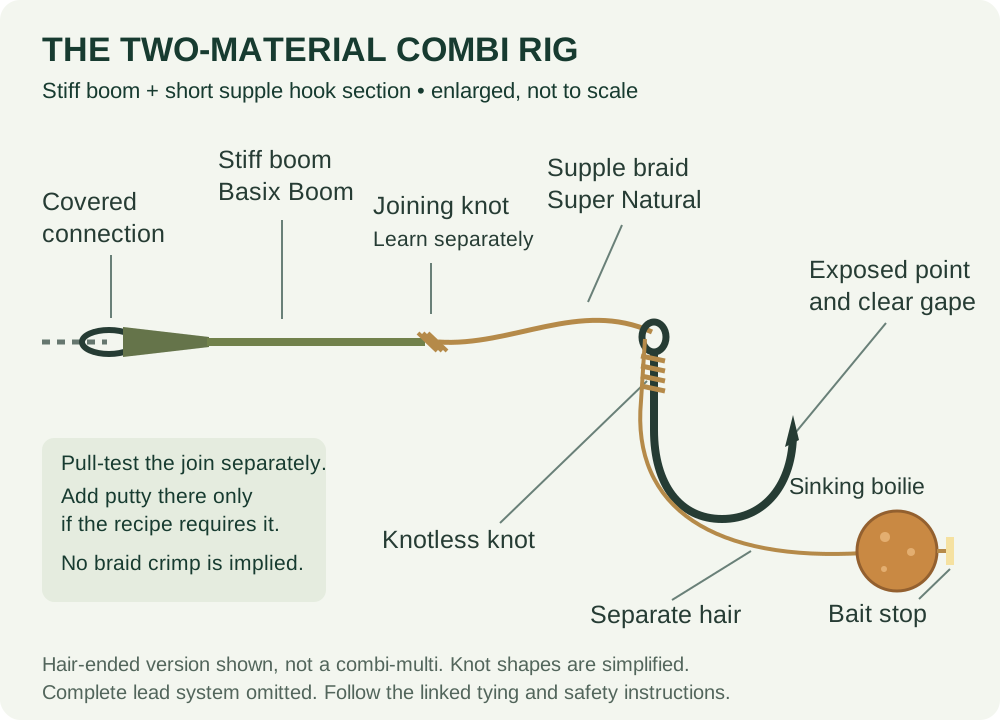
Choose coated braid when one-piece construction, a stripped section or some contour-following movement serves the rig. Choose fluorocarbon when a firm boom, D shape or strong reset characteristic is central. Choose supple braid when maximum flexibility and compactness matter. If two properties are needed, a combi rig can join different materials, provided the connection is secure and tested.
Colour should be a secondary decision. Green, brown and silt shades may look different in air but appear much closer at depth. A correctly presented, undamaged hooklink on the right spot is more important than a colour name. Don't assume a dark material always vanishes over weed or a clear one always vanishes in water.
Match the material to the rig
A simple knotless-knot hair rig can use supple braid or coated braid, depending on the cast and lakebed. Coating left intact for most of the length can help it extend, with a short stripped portion supplying movement at the hook. Our hair rig guide shows the underlying hook and hair arrangement.
A blowback rig often benefits from coated braid because the shank component and supple section can move while the coated length provides shape. The material must suit the ring or tubing and the hook size. A spinner or Ronnie rig commonly uses a semi-stiff coated boom or purpose-made fluorocarbon boom to push its hook section away from the lead.
A chod or hinged-stiff hook section requires a high-memory material able to retain a controlled curve. That is a different job from the boom below it. Don't use the word stiff as if every stiff product is interchangeable; check whether the maker specifies it for knots, curves, booms or crimps.
Choose a length for the bottom
Hooklink length changes how far the hookbait can move and how it settles after the lead. A short link may keep a compact parcel together and give prompt contact, but it can be pulled into soft silt by a heavy lead. A longer link can settle above debris but may tangle or give a fish more movement before the lead is felt.
Use the shortest or longest link only when the spot and rig justify it. On a firm clean area, a conventional length that casts reliably is a good baseline. In silt or low weed, a longer, more supple link may settle more naturally, while a helicopter-style lead arrangement can let it rest higher. Every lead setup must still be fish-safe; see the guide to safe carp lead systems.
Record length from consistent points, such as the hook eye to the loop, so successful rigs can be reproduced. Measure after tightening knots because they consume material. When changing from braid to stiff fluorocarbon, retest rather than copying the same measurement automatically.
Knots for braid, coated braid and fluorocarbon
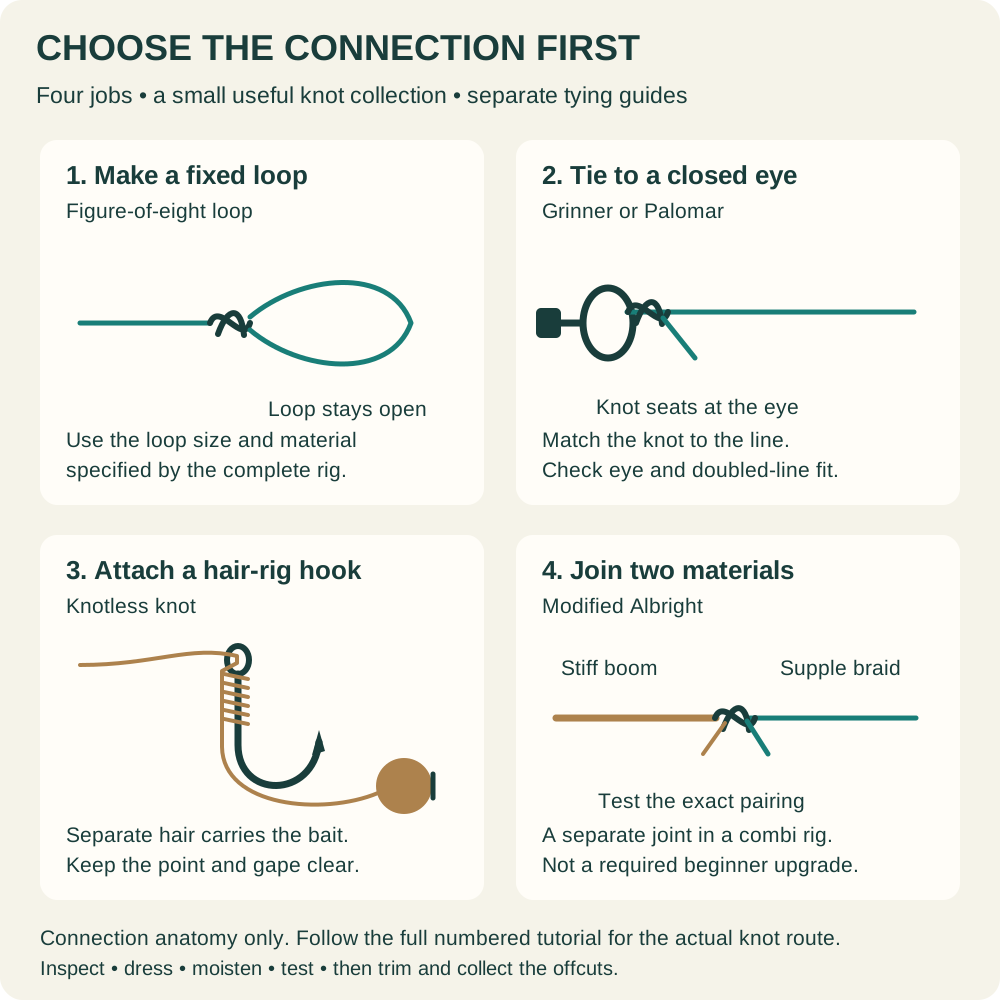
Use a knot recommended for the exact material and connection. Braid can slip if a knot is poorly chosen or insufficiently tightened. Coated braid can split where a knot bites into the skin. Stiff fluorocarbon can form a bulky knot or crack if forced around a very small component.
Moisten appropriate knots, tighten them gradually with rig tools and inspect every turn. Trim tags to the maker's guidance without cutting into the knot. Pull-test steadily from both ends in a clear area, wearing eye protection if a failure could send a component back. Never wrap hooklink around fingers or teeth.
If joining materials, practise the chosen knot with fresh samples and test several examples. A connection that looks neat is not necessarily secure. Check diameter compatibility and protect the join from debris where the rig design requires it.
Crimps: only with approved materials
Crimps make repeatable loops and lengths in stiff material, but the crimp, tool and hooklink diameter must match. Use the manufacturer's chart for the exact product. The wrong bore can slip; excessive force can cut or flatten the line; too little compression may not hold.
Don't crimp supple braid, ordinary mono or coated braid unless its maker explicitly approves that use. Korda states that its Boom fluorocarbons and selected high-memory or stiff coated materials are suitable when used with the appropriate Krimp system, while ordinary stretching nylon generally is not.
Inspect the crimp after compression. It should be even, without a sharp edge or cracked material. Pull-test every finished boom and discard any connection that moves. A crimp is a construction method, not a shortcut around testing.
Abrasion, weed and snag safety
No hooklink is snag-proof. Coatings and thicker diameters may improve resistance to some surfaces, while fine braid can cut into weed, but actual damage depends on the obstruction and angle. Unknown timber, wire or masonry may make a spot unsafe regardless of material.
Inspect the complete line path and fish only where carp can be landed. If a fish reaches an obstruction, the line returns rough or a break cannot be explained, move the rig and investigate. The snag-fishing safety guide gives practical buffer and stop rules.
Don't deliberately fit a weak hooklink as a sacrificial component beside snags. A break can leave a hook and line attached to a fish. Balance all components, configure the lead system so it can behave safely after a failure and stay close enough to respond.
Storage and checks before casting
Keep spools dry, shaded and away from heat or solvents. Retain the label so breaking strain, product and colour are not guessed later. Don't wind used hooklinks back onto a spool of fresh material, and keep pre-tied rigs straight or in a box that protects their intended shape.
Before every cast, inspect the hooklink, knots, loop or crimp, hook eye and lead-system connection. Straighten only by a method approved for the material. Steam and hot water can burn, weaken unsuitable products or deform coatings, so don't assume heat is necessary.
Lower the rig into water with the actual hookbait and any PVA product. Watch until it settles. A dry rig held in the hand cannot reveal trapped air, slow-sinking braid, a critically balanced bait or a boom bridging debris.
Frequently asked questions
Is fluorocarbon always better than braid?
No. Fluorocarbon is useful when density and stiffness serve the rig. Supple braid can settle better over uneven material and offers freer movement, while coated braid sits between those behaviours. The correct choice follows the rig and lakebed.
Does a higher breaking strain prevent tangles?
Not on its own. Stiffness, diameter, link length, coating, sleeve, casting and lead arrangement influence tangles. Higher strain may be thicker or stiffer within one range, but products are not directly comparable by pounds alone.
Should coated braid be stripped near the hook?
Only when the rig needs a supple hinge. Some presentations use the coating intact; others strip a short measured section. Follow a recognised rig design and inspect the core after using a stripping tool.
Can every fluorocarbon be crimped?
No. Use only material, crimp size and a tool combination approved by the manufacturer. Test each connection. A fluorocarbon label doesn't guarantee the diameter and formulation will hold a particular crimp.
What hooklink material should I use over silt?
A supple braid or soft coated braid can follow gentle contours, while a longer link and suitable lead arrangement can help avoid burial. Depth and consistency of the silt matter. Test the spot and rig rather than choosing by colour alone.
Final thoughts
Hooklink selection is a mechanical choice. Supple braid gives movement, coated braid provides adjustable structure and fluorocarbon or stiff mono can create separation and reset. Compare the actual stiffness and diameter, because category names and breaking strains don't form a universal standard.
Pick the material your chosen rig needs and match it to the lakebed and the rest of the tackle. Use the approved knot or crimp, pull-test it and check for damage after an abrasive retrieve. Learn one combination properly first; you can try other materials when you've got a clear reason to change.