A cube of luncheon meat is simple carp bait, provided you can keep it attached through the cast. We'll compare direct hooking and hair rigs, keep the hook clear and look at feeding sensible amounts where the venue allows meat.
The name covers products with different textures and storage requirements. One tin may produce firm cubes while another crumbles around the needle or softens quickly in the sun. Treat the bait you've bought as the starting point rather than assuming every luncheon meat behaves like the bait used in a favourite video.
Let's prepare a few cubes, compare direct hooking with a hair and deal with the common problems. Start at a comfortable range where you can check that the bait arrives intact. Once you've got that right, you can judge whether meat deserves a regular place in your bait bag.
Luncheon meat for carp: how should you cut and mount it?
Meat is particularly easy to test where a gentle close-range cast will reach fish on a known clear spot. You can inspect the bait regularly and introduce a few matching pieces accurately. That makes an open margin or modest float-fishing range a sensible place to learn its handling characteristics.
At longer range, soft meat has more demands placed on its mounting and casting resilience. It may still have a role in an appropriate setup, but the first task is proving that the bait arrives intact. Don't build an entire distance session around an untested cube that might leave the hair during the cast.
The close-range float guide offers a manageable starting method. Choose an open playing area with stable access, not a tight snag merely because meat can be lowered quietly beside it. The bait's softness doesn't change the strength and control needed to land the carp.
Check bait rules before buying in bulk
Ask whether luncheon meat is permitted and whether the fishery specifies a particular product, quantity or presentation. Some waters restrict meat or require fishery-supplied bait. Don't assume a rule allowing sweetcorn or pellets implies that any supermarket food can also be used.
Read the current lake-specific information rather than relying on an old forum post. The fishery-rules guide explains why a venue can apply different restrictions to neighbouring waters. If you plan to use a flavoured fishing meat, confirm that the product also falls within the permission given.
Once permission is clear, buy enough for a realistic trial. Meat is easy to over-purchase because the unopened package looks convenient. Several spare tins can encourage unnecessary feeding, while a modest supply leaves you free to change bait if the water responds differently from expected.
Ordinary meat and prepared fishing meat
Plain luncheon meat can be a practical starting point if it is firm enough to mount and the venue allows it. Read the ingredients and storage instructions, and avoid assuming that colour or smell alone predicts performance. What matters first is a usable texture and a product you can manage safely during the session.
Prepared angling products may be formulated for more resilient hooking or a different sinking behaviour. Dynamite's Frenzied MeatCorn specification describes a fishing meat suitable for direct hooking and hair mounting. That is a product-specific characteristic, not a claim that all luncheon meat shares its formulation or handling.
Compare the amount you'll actually use, not just the price per package. A slightly dearer product that remains usable for the intended presentation may waste less, but it doesn't automatically catch more carp. Buy for a clear handling advantage rather than assuming a specialist label replaces good placement.
Prepare a clean, stable workspace
Cut meat on a stable board with a suitable clean knife, away from loose hooks and line. Protect your hands and work slowly enough to produce consistent pieces. Preparing bait beside the water while balancing the tin on a knee makes both neat cutting and tool safety unnecessarily difficult.
Remove the meat according to the packaging and deal carefully with sharp tin edges or lids. Transfer the working portion into a reusable bait tub so the open tin doesn't remain among nets, towels and tackle. Pack all metal and plastic waste securely for removal from the venue.
Keep bait tools separate from food preparation during the session and wash hands before eating. Plan the prepared quantity in advance so you can return unused reserve to the correct storage promptly. A tidy preparation routine makes it easier to notice the bait's condition and avoid contaminating the whole supply.
Cut consistent cubes before experimenting
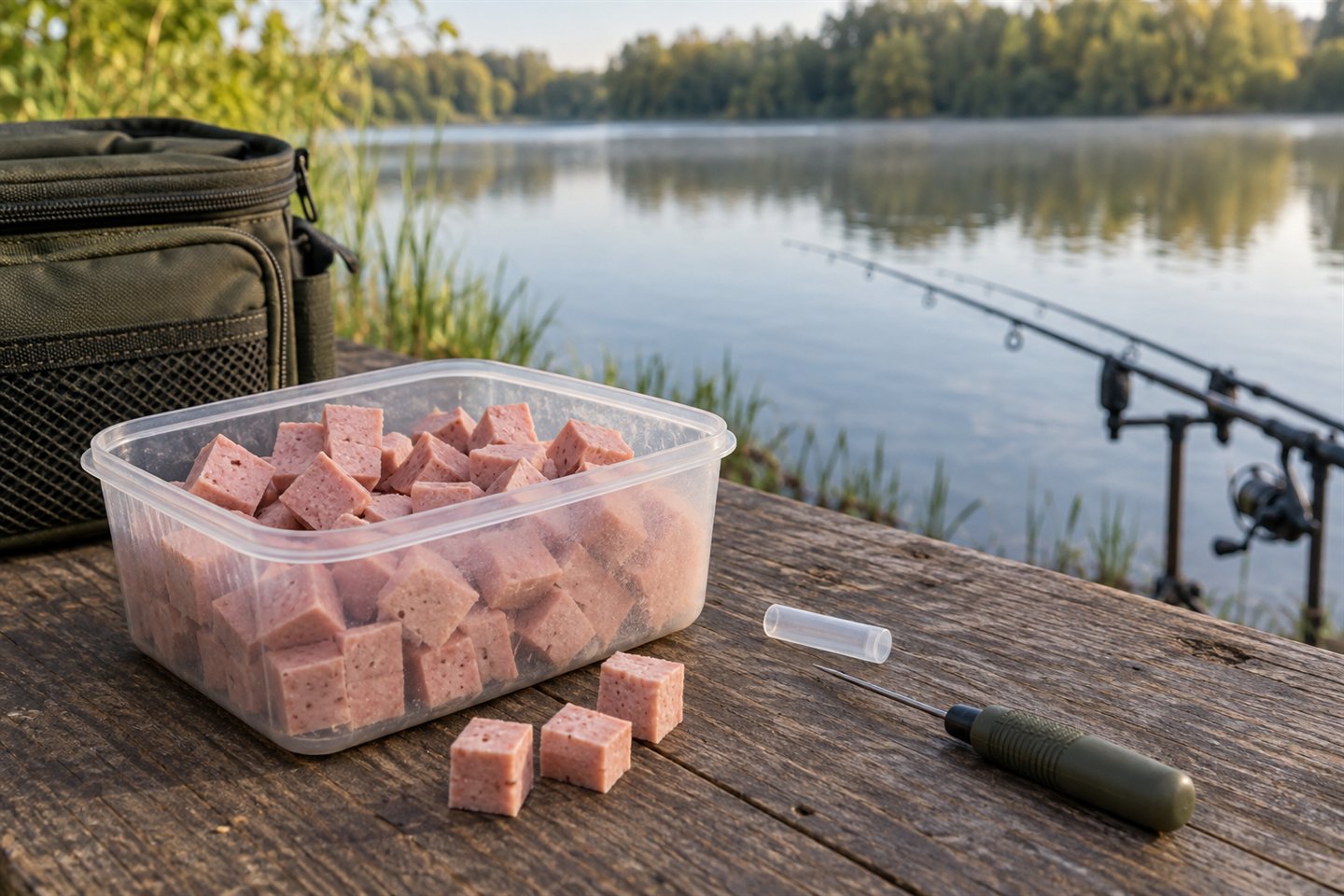
For modest carp on open commercial water, an 8 mm hookbait cube with a few 6 mm feed cubes is a useful close-range example from Dean Barlow's Drennan guidance. Check that the actual hook remains effective and the cube survives the cast. Consistent pieces make comparisons easier than torn chunks; these dimensions are a starting trial, not a specimen-water rule.
Use the dimensions as a starting aid, not a rule tied to carp weight. The cube should be large enough to mount securely while leaving the hook free to work. A bigger bait may survive some small-fish attention better, but it also changes the load on the hair and the way the rig settles.
Keep a few firmer pieces aside for the hook and use suitable softer offcuts sparingly as feed. Don't automatically mince the whole tin because small pieces look more plentiful. The preparation should follow the fishing plan, with the intended hookbait and amount of loose feed decided separately.
Cube size changes the food quantity quickly
When cubes have similar texture, increasing their side length changes volume much faster than it changes their appearance. A cube with twice the side length contains eight times the volume. That simple geometry explains why replacing small cubes with visibly larger ones can increase the amount fed dramatically even when you count the same number.
Weigh a typical working portion at home if you want a useful baseline. Then use a small dedicated scoop or tub on the bank to track the total. You don't need laboratory precision, but you should know whether a few repeated feeds amount to a modest handful or most of a large package.
The bait-quantity guide puts that total into the session context. Feed according to fish presence and response rather than a fixed cube count. A larger hookbait doesn't require surrounding it with equally large amounts of food.
Direct hooking for gentle, actively watched fishing
Direct hooking can be simple at close range when the meat is firm enough and the hook is appropriate. Pass the hook through carefully, then position the bait so the point can work without being buried in a thick block. Inspect the gape from more than one angle before casting.
Avoid squeezing the cube tightly around the bend until it resembles paste. That may make it look secure while masking the point or creating a bait that falls away as one damaged lump. If the product is too soft for a clean mounting, use a different piece, a suitable hair arrangement or another bait.
The hook-pattern guide explains how shape and strength affect the choice. A tiny fine hook hidden in meat is not a sensible shortcut when the fishery's carp and your tackle require a stronger pattern. Match the complete setup, then choose a bait size that fits it.
How to hair rig luncheon meat for carp fishing
A hair allows the meat to sit away from the fishing hook. Thread carefully with a suitable needle, draw the hair through and secure a compatible stop behind the bait. The hole should not be so large that the cube can slide off before it reaches the bottom.
Check that the stop spreads the load appropriately without becoming an awkward oversized attachment. Soft meat can split under a small narrow stop during a cast, while a poorly positioned larger one can interfere with the presentation. Test gently over a safe area before placing the bait near feeding fish.
Use the basic hair-rig guide for construction, then adjust hair length to the actual cube. The bait should not jam against the point or twist around the hook. A neatly tied rig still needs to be assessed with its intended soft hookbait attached.
How to keep luncheon meat on the hook for carp
A purpose-made stop system may simplify hair mounting if used with the correct tool and compatible hooklength. Drennan's Pushstop specification lists cubes of meat among its intended applications. Follow those instructions instead of using a sharp improvised pin that can be left protruding from the bait.
Support the cube while pushing the tool through and keep the fishing hook secured. If the meat splits, inspect the grain of the product and try a firmer piece or gentler mounting. Forcing the same tool through increasingly soft cubes is unlikely to produce a dependable hookbait.
Drennan also offers ready-tied method hooklengths with Pushstops. Their length and line specification belong to that method. Don't assume a convenient bait stop makes every ready-tied rig suitable for a different lead system, lakebed or casting approach.
Keep hookbait and loose feed separate decisions
You can fish one cube over very little feed, or use a limited number of smaller matching pieces where carp are clearly feeding. The bait on the hook doesn't dictate a large bed of meat. Choose a small starting quantity and retain enough reserve to respond if the fish justify it.
At close range, feed accurately enough that the hookbait remains within the area you're trying to develop. If cubes roll down a slope or settle into debris, changing the presentation or selecting a flatter patch may be more useful than feeding harder. Know the spot before committing substantial bait.
The single-hookbait guide provides another way to keep the trial controlled. A visible carp investigating a clear patch may offer a chance with one well-placed cube. Extra food is an option to assess, not a requirement to make meat believable.
Float presentation lets you learn the bait's behaviour
A properly plumbed bottom float setup makes it easier to watch indications and refresh meat frequently. Measure depth at the actual target, shot the float with the bait attached and begin with a simple presentation. A heavy cube can change the way the float settles compared with the smaller bait used during setup.
If the float drifts or dips continually, inspect depth, shotting and bait position before assuming fish are feeding. A cube held just above the bottom may behave differently from one resting on it. Our plumbing guide explains the checks that make those adjustments meaningful.
Keep the cast gentle and controlled. Meat lost on impact creates a bare hook even when the float looks perfectly balanced afterwards. Retrieve after suspicious movement or a noticeably poor cast and look at the bait; the returned cube is part of the evidence, not an inconvenience to ignore.
Ledgering and feeder fishing need a reliable arrival
With a lead or feeder, choose a recognised fish-safe system appropriate to the water and follow its complete instructions. The lead-system guide explains the difference between presentation and release function. Meat doesn't make an unsuitable fixed arrangement safe or exempt it from venue rules.
Test the bait's resilience at the intended range before accepting a long wait. An empty hair after retrieval may indicate casting damage, small-fish attention or gradual softening; a single cause should not be assumed. Shorten the inspection interval while you work out what is happening.
If using a feeder, include the loaded feeder and bait in the casting payload and stay within the rod's rating. Don't add a large cube, a heavy feeder and a full load of feed while considering only the feeder's empty label. A controlled, repeatable cast is more useful than stretching unsuitable equipment.
Freelining is a close-range option with clear limits
A piece of meat can provide its own weight for a gentle unweighted cast. That can suit a visible fish on a clear reachable spot, but you must retain prompt bite indication. It is not an excuse to leave a sinking bait unattended with loose line while waiting for a long run.
The freelining guide explains observation, line control and why the method becomes unsuitable when you can't read a take. Choose another presentation if the cube disappears into unclear water and you can't monitor it confidently. A float may make the same bait much easier to fish responsibly.
Don't enlarge the meat indefinitely to gain casting distance. A huge cube changes the hookbait mechanics and may create a poor fit with the hook and tackle. If the safe opportunity is beyond reliable reach, use a properly assembled method designed to reach it or choose another spot.
PVA compatibility is not guaranteed by a fatty texture
Meat can contain moisture, and wet surfaces or added liquids can compromise PVA. Don't assume an oily feel means a cube is automatically PVA-friendly. Test the exact product and preparation with the intended PVA, including any time spent waiting between assembly and casting.
Keep the test separate from the fishing rig first so failure doesn't scatter bait or expose a hook unexpectedly. Check that the bag survives preparation and dissolves properly in water. If either result is uncertain, deliver the meat separately by a permitted method or use a tested dry PVA mix.
The PVA-mesh guide explains moisture and attachment issues. There's no need to add powders or liquids blindly in an attempt to make a soft bait fit a bag. A straightforward separate feed can preserve the advantages of both components without an unverified mixture.
Deal with small-fish attention honestly
Smaller fish can peck soft meat, while larger non-target coarse fish may take a whole cube. Inspect regularly and compare the damage with how the bait looked after a test cast. A cube arriving intact but returning ragged suggests a different problem from one that flies off before touching the water.
A firmer product or adjusted size may help durability, but neither creates a guarantee that only carp will bite. Reduce unnecessary loose feed if it is drawing constant unwanted attention. Changing the time, safe spot or hookbait can be more effective than repeatedly putting another large cube on the same damaged presentation.
If the session develops into mixed-species fishing, adapt expectations and handle every fish properly. You can enjoy that response or choose a tougher carp presentation. The useful lesson is understanding what the water is doing, not finding a harsher way to exclude fish that also recognise the bait as food.
Additives are optional and can change handling
Plain meat provides a useful baseline. If trying a prepared flavoured version or a fishing additive, follow its instructions and change only one part of the approach. A capture after moving swims and changing the entire rig is not clear evidence that a particular spice or colour made the difference.
Liquids and powders can alter surface texture, firmness and storage requirements. Check the finished cube rather than assuming it still behaves like the original product. Avoid improvised chemical treatments and don't use a stronger smell to mask deteriorating bait; questionable condition is a reason to stop using it.
Store the actual product as instructed
Follow the package guidance after opening, including refrigeration, time limits and any advice about freezing. Don't apply one brand's storage rule to every supermarket and fishing product. Prepare a small working portion and keep the reserve under the specified conditions rather than repeatedly warming a large tub.
Use clean labelled containers and protect the bait from sunlight, rain and contamination on the bank. An insulated carrier can help with a product that needs chilled handling, but it is not an unlimited guarantee of safe storage. Plan the session length and take only what can remain usable.
Dispose of leftovers responsibly when their condition is doubtful. Don't tip unwanted meat into the lake as a final feed or leave it for wildlife. Remove the bait, clean the containers and note whether a smaller package would have suited the session better.
Build a useful first-session record
Begin with one product, one manageable cube size and a clear spot. Note whether direct hooking or a hair gives more consistent arrival at your chosen range. This is a practical handling comparison, not a scientific verdict on what carp prefer, but it can immediately improve confidence in the baited rig.
Record the approximate amount fed and the condition of each retrieved hookbait. If bites occur, note the depth, timing and hook placement as well as the capture. If they do not, separate uncertainty about location from confirmed bait damage so the next change addresses a real problem.
Equipment worth considering
A stable cutting board, suitable knife and secure bait tubs are the most useful preparation tools. A meat cutter can speed up consistent cubes if you use enough bait to justify it, but it is not essential for a small trial. Keep sharp items protected and separate from loose rigs.
For mounting, choose a fine needle and compatible stops or one proven soft-bait stop system. An insulated carrier may be worthwhile for the product's storage needs. Prioritise secure, clean handling and sound fish-care equipment over extra flavours, specialist cutters or a second rod purchased solely for one bait.
The Korda Fine baiting needle (paid link) can help thread suitable soft meat carefully onto a hair, and the Roddarch four-piece bait-box set (paid link) offer separate containers for prepared cubes and other bait. Compare the tool with the firmness and size of the actual bait rather than forcing it through. These ventilated boxes are not insulated food-storage equipment, and they don't make exposed meat safe indefinitely. Follow the product's storage instructions, maintain sensible hygiene, keep preparation tools away from children and use a secure bait stop appropriate to the presentation.
Frequently asked questions
What size meat cubes should I use for carp?
Choose a size that mounts securely, leaves the hook effective and suits the presentation. Larger cubes contain much more food and are not required simply because the target fish is large. Start with a manageable piece, test its arrival and adjust only when the water gives you a reason.
Is hair-rigged meat better than direct hooking?
It depends on the bait and method. A hair can keep the hook separate, while direct hooking can be simple for gentle actively watched fishing. Both fail if the meat tears or masks the point. Compare the finished presentation rather than assuming one mounting label guarantees a better hookhold.
Can I freeze unused luncheon meat?
Follow the exact product's instructions and any advice from its manufacturer. Don't assume every opened fishing or food product can be handled identically. Plan small portions so you avoid repeated warming and uncertain storage, and discard bait whose condition is doubtful rather than returning it to the lake.
Let preparation support the fishing
Cut a few consistent cubes, choose a secure mounting and make sure the bait reaches the spot intact. Start with modest feed and watch the response before adding more. That's enough to begin with. Simple preparation leaves you more time to watch the water and enjoy the session.
Sources and further reading
Product references checked on 15 September 2026 include Dynamite's linked Frenzied MeatCorn information and Drennan's Pushstop and method-hooklength specifications. They support particular mounting and handling options, not universal formulations or storage periods. Always use the current instructions on the meat product and the complete rig components you actually choose.