What lead weight suits your carp fishing? Think about the whole casting load, including the bait and any PVA bag, then consider your rod, range, wind and lakebed. Here's how to choose without asking too much of the tackle.
Start with the actual rod's guidance and include everything being cast, not just the number moulded into the lead. A baited rig with a PVA bag can weigh noticeably more than its bare lead. Ignoring that difference is an easy way to overload an outfit that seemed suitable on paper.
We'll use the rod's casting guidance, range and conditions to narrow the choice. Rods with the same test curve can behave differently, so avoid choosing a lead from an ounces-per-pound formula alone. The right weight should feel manageable and work with a fish-safe lead system.
What lead weight for carp fishing suits your complete setup?
Identify the exact rod model, length and any stated casting-weight range or manufacturer recommendation. If only a test curve is supplied, seek guidance for that model before making assumptions about a heavy payload. Information about another rod carrying the same pound figure is not a substitute for its actual specification.
Korda's carp-rod explanation distinguishes test curve from suggested casting weight and notes variation between rods. That is the essential principle: the rating describes one aspect of the blank, while action, design and intended use affect what it can cast comfortably.
Use the test-curve guide for the terminology. A rod's static bend measurement should not be treated as a direct arithmetic instruction to cast a certain number of ounces. If the intended range requires uncertain or excessive loading, choose a closer spot or more suitable equipment.
How to include a PVA bag in the casting payload
Weigh the assembled payload safely with the hook protected if there is any doubt. Include the lead, hookbait, rig components and any filled PVA bag or stick. A packet's empty bag size tells you little about the weight after you have packed it tightly with pellets and other feed.
For example, a 70 g lead combined with 25 g of feed and 5 g of other cast components gives a 100 g payload. Those are illustrative measured amounts, not a recommended setup. The exercise shows why choosing the lead alone can understate the actual load placed on the rod during acceleration.
Repeat the check when changing bag size or baiting style. The solid-PVA-bag guide explains how a complete bag presentation differs from a bare lead and hooklink. A familiar lead doesn't make an increasingly heavy bag automatically compatible with the same rod.
Understand ounces and grams without overcomplicating them
Carp leads are commonly labelled in ounces or grams. One ounce is approximately 28.35 g, so a 2 oz lead is about 57 g, a 3 oz lead about 85 g and a 4 oz lead about 113 g. These are conversions, not recommendations for particular rods or fishing distances.
Labels and real weights can vary slightly, especially once coatings, swivels and additional components are included. Use the complete measured payload when working close to a stated limit. Don't round down generously simply because the next smaller-looking label seems to fit the recommendation you hoped to use.
Keep the unit consistent in your notes. If the rod's guidance is in grams, compare it with grams rather than mentally switching between approximate ounce labels. A clear record of the complete setup is more useful than remembering only that a certain lead felt about right during one cast.
Check the material rules for lighter weights
In England and Wales, GOV.UK tackle guidance permits lead weights only at 0.06 g or less, or above 28.35 g. Intermediate weights must therefore be legal non-lead alternatives. This applies to the individual lead weight, not the total payload after adding PVA and bait. Check local and fishery requirements as well, and don't assume the same national rules apply throughout the UK.
Distance is a system result
Casting range depends on the rod, reel, line, lead shape, payload and your technique. A heavier lead may load a suitable rod more effectively up to a point, but adding weight indefinitely will not keep increasing safe distance. An overloaded or poorly coordinated cast can become less accurate and more dangerous.
Korda's long-range fishing guide discusses matching lead weight to rod and casting style. Treat its specialist examples as context, not a beginner prescription. A weight used by an experienced distance caster on a powerful rod may be unsuitable for your outfit.
Our accuracy guide explains the value of controlled technique. First reach a comfortable target repeatedly with the rig intact. More distance is useful only when the bait can still be placed accurately, the line managed and a hooked fish landed responsibly.
Short-range fishing still needs deliberate selection
At close range, choose enough weight to place the rig accurately and maintain the intended presentation without unnecessary impact. A manageable lead often allows a gentler cast. However, simply choosing the smallest available weight can make line adjustment drag the rig or leave the chosen lead system behaving differently from intended.
Consider whether a lead is needed at all for the opportunity. A suitable float or carefully supervised unweighted bait may be a better approach to visible fish within reach. The freelining guide explains that separate method, including its requirement for clear bite indication.
Don't confuse a soft landing with permission to fish dangerously close to snags. The lead's weight doesn't determine whether there is enough space to control a carp. Choose a safe open route first, then select a weight and system that support the presentation within it.
Shape affects flight and the way the lead sits
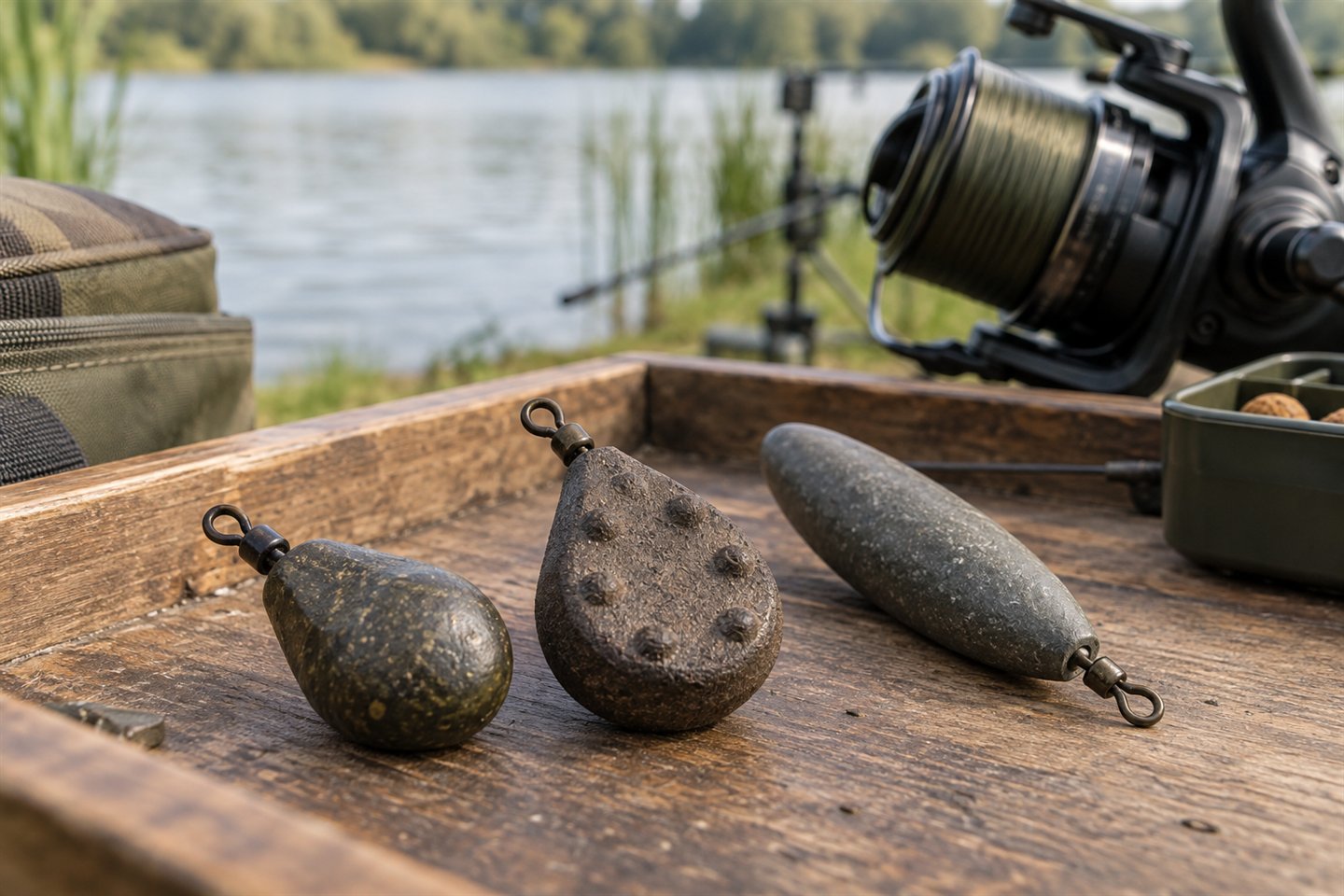
An aerodynamic distance shape is designed for a different priority from a flat or grippy bottom-holding shape. Two leads with the same mass can therefore behave differently in the air and on the lakebed. Weight is only one choice; the profile and attachment belong in the decision too.
Korda's Tournament Casting Heli specification describes a nose-weighted casting design with a ring intended for compatible helicopter arrangements. That is not interchangeable with every swivel lead. Select the correct version for the whole setup rather than judging suitability by the weight and colour alone.
If a compact flat lead holds adequately where a rounder shape moves, a shape change may avoid unnecessary extra weight. Test safely and consider how the lead can release as intended. A product designed to grip more firmly still needs a fish-safe assembly and an understood retrieval route.
Wind may change the useful weight, range or timing
A headwind or crosswind can make a previously comfortable cast harder to repeat. First reassess whether the target remains sensible and safe. Moving closer or choosing a sheltered authorised position may preserve accuracy more effectively than immediately increasing lead weight and casting with greater force.
If a modest change of weight is appropriate, keep it within the exact rod's guidance and the complete payload limit. Test the result without assuming heavier always means straighter. Lead shape, line diameter and how the cast is controlled also affect what happens before the rig reaches the water.
Don't cast into gusts while people or wildlife are close to the possible flight path. A missed target can carry a heavy projectile beyond the intended area. The useful fishing range is the distance you can control in current conditions, not the maximum achieved on a calm day months earlier.
Line and knots must match the casting task
Inspect main line, knots, guides and reel before using a heavier payload. Damage that tolerated a gentle short cast may fail during a more powerful one. A lead that remains within the rod's capability can still be unsafe if the line system is unsuitable or poorly maintained.
Follow manufacturer guidance and venue rules for any casting leader or tapered line. Don't use an arbitrary breaking-strain formula as permission to assemble unfamiliar components. The carp-line guide explains why diameter, condition, abrasion and the complete arrangement matter alongside the printed strength.
Where a leader is used, the fish-safety function must still work across the relevant knots and joins after a break. A casting improvement is not acceptable if it traps the lead system. Have the complete arrangement checked by a competent person when compatibility or release behaviour is uncertain.
Protect the casting process
Check the area behind, beside and above the rod on every cast. Keep clear of electricity cables and never cast a heavy lead across occupied water or a public route. Good technique begins with a safe location; no fingerstall or specialist line can compensate for an unsafe casting corridor.
Use suitable finger protection where the technique and line require it, and follow the reel and casting guidance so the spool doesn't slip unexpectedly under load. Korda's casting masterclass highlights those practical checks within its distance setup.
After casting, restore the reel and indication arrangement to a safe fishing setting appropriate to the swim. The settings used during acceleration are not automatically the settings for a taking carp. Make that transition part of the routine rather than something you remember only after the first alarm sounds.
Lakebed softness changes the presentation problem
A lead settling into soft silt may finish differently from the same weight on firm gravel. Increasing weight can make some soft-bottom presentation problems worse rather than improve stability. Examine the bottom and choose a suitable complete rig instead of assuming a heavier lead always gives a more positive result.
The silt-fishing guide explains how hooklink arrangement, depth and debris affect the decision. A lighter lead may be worth considering in an appropriate setup, but it doesn't automatically keep the hookbait above every soft layer. The whole presentation still needs to be understood.
On firm open ground, a straightforward lead can be easier to assess because the landing is more consistent. Use that kind of spot while learning how different permitted weights feel through your own rod. Avoid drawing confident conclusions from an unknown bottom that changes between every cast.
Slopes and undertow need diagnosis before extra weight
If the rig will not remain where intended, ask what is moving it. A round lead can roll on a slope, while line tension or water movement can pull a setup away from its landing point. Those causes may call for different shape, position or line management rather than another ounce.
Avoid winding hard against the lead immediately after it settles. You may be moving the rig yourself while trying to create a neat tight line. The line-lay guide explains controlled tension and the route between rod and rig. A heavier lead should not be a remedy for an unnecessarily forceful setup routine.
If conditions require more holding ability than your tackle can safely provide, choose another spot or method. There's no obligation to fish the original target. A lead that only holds after the rod is overloaded for the cast is not a workable solution.
River carp fishing is a different holding task
Flow, debris and changing water levels add demands beyond an ordinary stillwater cast. Lead shape, line angle and the chosen feature can matter as much as mass. Start with a safe, understood area and suitable tackle, rather than transferring a stillwater weight chart directly onto moving water.
The UK river-carp guide covers permissions, conditions and the wider approach. Don't keep increasing weight as floating debris builds on the line. Retrieve, inspect and reassess whether the swim remains suitable; additional mass cannot make unsafe flow or access manageable.
Avoid fishing in conditions that require taking risks with footing, wading or landing fish. The lead is only a component of the plan. If holding bottom is difficult because the river is unsuitable for your experience and equipment, the correct adjustment may be postponing the session.
Lead weight doesn't replace rig mechanics
Some carp systems use the lead's resistance as part of their initial hooking behaviour, but the result also depends on the hook, hooklink, attachment and direction of movement. The same mass can act differently in different arrangements. Don't assume heavier automatically creates a better hookhold or solves repeated losses.
If fish are lost, inspect the point, hookbait position, tackle balance and playing technique. Our lost-fish troubleshooting guide provides a useful order. Adding weight without identifying the problem may increase the load during the fight without improving the actual cause of poor connection.
Likewise, a very light lead doesn't automatically create a harmless presentation. The complete rig still needs prompt indication, appropriate tackle and a clear release path after failure. Safety is a property of the assembled system and how it is used, not a simple label attached to a number of grams.
Check the lead system whenever the weight changes
Use the correct lead attachment for the chosen system, whether that requires a swivel, ring or particular inline insert. Components that look similar may not fit or release identically. Read the maker's instructions and inspect wear rather than forcing a mismatched lead into a clip because its weight happens to be convenient.
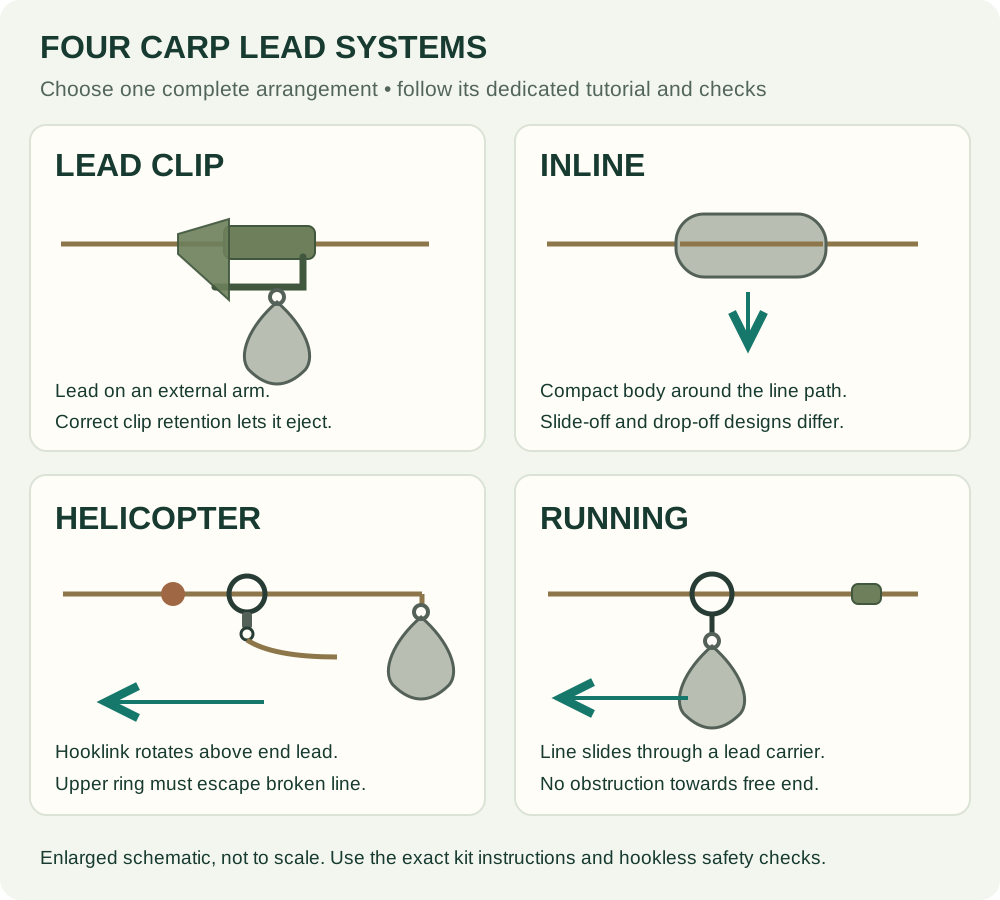
The safe lead-systems guide explains the separate checks for lead clips, inline and helicopter arrangements. A system must retain or release components as designed during normal use and after relevant failures. Don't immobilise a safety component to prevent a lead falling off during a poor cast.
Where lead release is necessary for fish safety, follow the recognised system and venue requirements. Don't deliberately discard leads on every cast without a reason, and consider approved alternatives where appropriate. Environmental care and fish safety should both inform the choice rather than being treated as competing slogans.
Lighter is not always quieter in practice
A small lead cast badly can make more disturbance than a slightly heavier appropriate lead placed smoothly. Splash also depends on trajectory, landing control, depth and any attached PVA. Before changing weight to reduce noise, examine whether the cast itself is producing a steep uncontrolled impact.
At short range, a gentle accurate placement may reduce disturbance without changing the rig's intended function. At distance, reducing weight too far can make the cast less controllable and encourage excessive force. Keep the whole sequence in view instead of judging discretion from the lead lying in your palm.
The anti-tangle troubleshooting guide explains the importance of controlled flight and descent. A quiet splash is useful only if the hookbait lands intact and the rig remains properly presented. Don't sacrifice reliability for an appearance of finesse that cannot be verified beneath the water.
Compare weights with a controlled test
Choose a safe open target within comfortable range and begin with a manufacturer-supported complete payload. Make several smooth casts using the same rig and bait. Note accuracy, effort, landing control and whether the rig returns intact. Those practical outcomes matter more than a single longest cast.
If testing another permitted weight, keep shape and other variables similar where possible. Otherwise, you may be comparing shape, bag size and technique at the same time. Record the full combination so the result can be repeated rather than remembered only as a preference for the heavier lead.
Stop if the cast feels uncontrolled, the rod behaves unexpectedly or the line shows damage. Don't treat discomfort as something to push through for one more attempt. Seek model-specific guidance or practical tuition, and return to a comfortable safe setup until the uncertainty is resolved.
Keep a small, purposeful selection
Most ordinary sessions don't require carrying every available weight and shape. Choose a few compatible options that cover your known venues and remain within your outfit's capability. Label them clearly and protect swivels, coatings and inserts from damage in transit.
A simple record might pair one suitable weight and shape with a close-range clear-bottom presentation, and another verified setup with the longer cast you regularly make. Those are personal working combinations, not universal rigs. Recheck them when rods, line, PVA size or conditions change.
Keep feature-finding leads separate where their design serves a different job. A pronged or specialised marker lead is not automatically the best fishing lead because it gives strong feedback on the retrieve. Select the final lead for casting, presentation and system compatibility after the spot has been assessed.
Equipment worth considering
A small scale capable of weighing the complete protected payload is useful when using filled PVA bags or comparing equipment limits. A compact lead pouch with separated compartments helps protect fittings and keep approved weights identifiable. Carry the exact spare inserts, clips or sleeves required by your existing system.
Suitable finger protection and sound main line support the casting routine, while practical tuition can improve accuracy without increasing payload. Buy heavier leads only when the rod guidance and actual fishing task justify them. More weight in the tackle bag doesn't create more capability in the outfit.
If the casting setup needs maintenance, Korda SUBline monofilament (paid link) offers a monofilament example to compare by diameter and strength, and Korda RazorBlades scissors (paid link) provide a clean way to remove damaged sections when retying. These are not permission to increase the casting load. Check the rod's stated guidance, line arrangement, knots and the complete payload before choosing a lead. Existing sound equipment may need no replacement at all. A manageable cast with the correct components is more useful than buying stronger-looking accessories while leaving the underlying load mismatch unresolved.
Frequently asked questions
What lead should I use on a 3 lb test-curve rod?
Check the exact model's casting guidance and include the full rig and any PVA in the payload. There's no dependable universal conversion from 3 lb test curve to one lead weight. Rod action and design differ, so ask the maker or a competent retailer when the specification is unclear.
Will a heavier lead always cast farther?
No. A suitable weight may help load a particular rod, but excessive weight can reduce control or overload the equipment. Shape, line, wind and technique also matter. Compare safe complete setups at a manageable range rather than assuming distance increases indefinitely with every extra ounce.
Should I increase lead weight to stop hook pulls?
Not without diagnosing the losses. Hook condition, rig mechanics, tackle balance and playing technique may be the more relevant issues. A heavier lead is not a universal hooking cure and can introduce other demands. Inspect the full system and use the lost-fish guide to identify a specific cause.
Choose control before extra weight
Check your rod's guidance and the weight of everything you're casting, including bait and PVA. Then choose for the range, wind, lakebed and lead system. Start with something you can cast comfortably and accurately. If the outfit needs forcing to reach the spot, change the plan rather than see what it can survive.
Sources and further reading
Manufacturer references checked on 15 September 2026 include Korda's linked rod-selection explanation, long-range guide, Tournament Casting Heli specification and Terry Edmonds casting masterclass. Their specialist examples are not universal beginner prescriptions. Exact rod and rig instructions take precedence over general advice, and ounce-to-gram figures here are unit conversions rather than recommended loads.